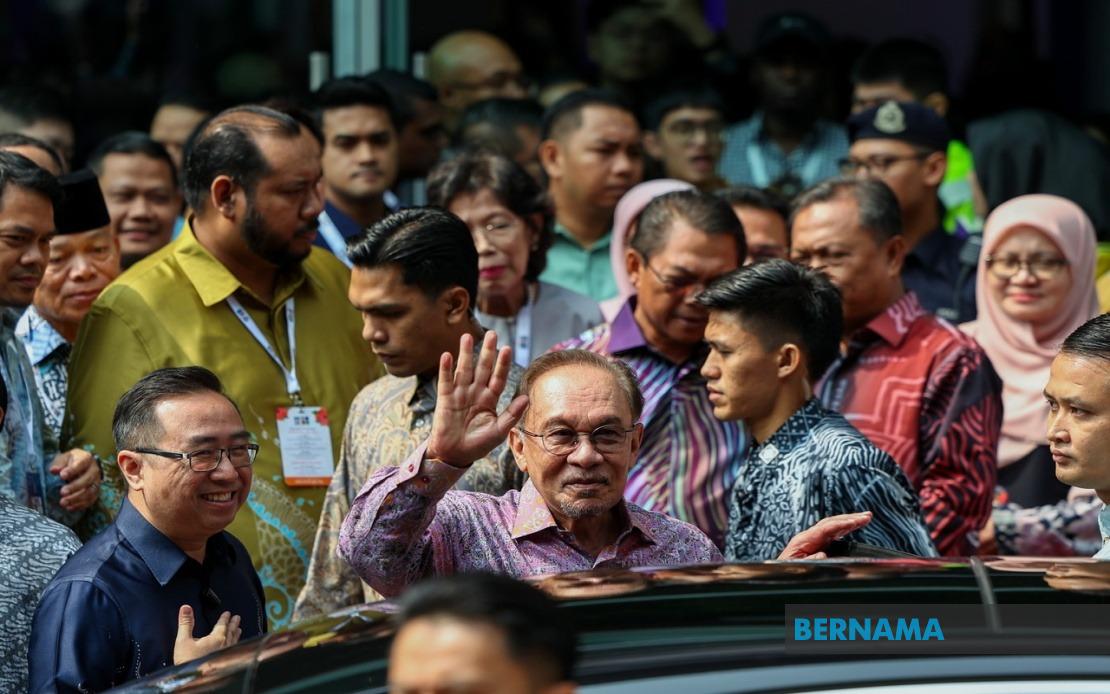
Prime Minister Anwar Ibrahim has distanced himself from reports that his party, PKR, has been extending invitations to former members to rejoin, including ex-deputy president Datuk Seri Mohamed Azmin Ali. Speaking at the National Innovation and Commercialisation Expo (NICE) 2026 at the Kuala Lumpur Convention Centre (KLCC) in Kuala Lumpur on Tuesday, Anwar responded with evident surprise when questioned about the reported recruitment drive, stating plainly that he had received no briefing on the matter.
The Prime Minister's curt denial—"Has anyone invited him? Was there an invitation? I was not informed"—suggests either a breakdown in internal party communication or a deliberate effort to avoid endorsing any such initiative at the highest level. His response carried an undertone of frustration, implying that if such invitations were being issued, they were happening without his knowledge or approval. This stands in contrast to the apparent momentum within PKR circles to bring back high-profile figures who departed during the party's turbulent political realignments of recent years.
Azmin, now entrenched as secretary-general of Parti Pribumi Bersatu Malaysia (Bersatu), has firmly closed the door on any possibility of returning to PKR. Just days before Anwar's statement, Azmin made clear his allegiance to his current party, explicitly ruling out any homecoming despite invitations reportedly being circulated among former members. His position reflects the entrenched factional divisions that continue to define Malaysian politics, where party switches often harden into permanent allegiances rather than fluid movements.
The reported overtures to rejoin PKR extend beyond Azmin to other prominent former figures. Datuk Kamarudin Jaffar, who previously represented Bandar Tun Razak as an MP, and Datuk Mansor Othman, the former member for Nibong Tebal, are said to be targets of recruitment efforts. These moves suggest that PKR leadership is attempting to rebuild its roster after years of defections and internal strife that weakened its parliamentary strength and influence within the federal government coalition.
One notable success in PKR's apparent reconciliation efforts involves Datuk Dr Xavier Jayakumar, the former vice-president, who has confirmed his return to the party. His decision to rejoin indicates that not all bridges between departed members and PKR have been irreparably burned. Jayakumar's acceptance signals a willingness among some former figures to rebuild relationships with the party, though his return may carry conditions or require healing of prior grievances.
The timing of these recruitment efforts deserves scrutiny. PKR has faced considerable pressure regarding its parliamentary representation and internal cohesion as the government navigates a challenging political landscape. By reaching out to former members, the party appears to be compensating for losses and seeking to strengthen its hand in legislative and leadership calculations. However, Anwar's apparent non-involvement in the process raises questions about whether the drive reflects coordinated party strategy or ad-hoc initiatives by mid-level operatives.
Anwar's distancing himself from the invitation process carries political significance. As PKR president and Prime Minister, his explicit lack of knowledge about—or apparent non-endorsement of—such activities suggests either organisational dysfunction or a calculated political stance. If he is truly uninformed, it implies that his party machinery is operating independently of his oversight. Alternatively, his denial may be strategic, allowing him to avoid responsibility if the recruitment efforts prove counterproductive or controversial.
The broader context involves the ongoing realignment of Malaysian politics following the 2022 elections and subsequent coalition shifts. PKR emerged as a core component of the unity government, yet has struggled to consolidate its position and expand its support base. Efforts to recover departed members represent an attempt to address these structural weaknesses without undertaking the more difficult work of attracting new voters or broadening the party's ideological appeal.
For Malaysian and Southeast Asian observers, the episode illustrates the fragile nature of political party structures in the region. Personalities, factions, and opportunism frequently override institutional loyalty. The ease with which figures like Azmin move between parties, and the apparent willingness of PKR to welcome back defectors, reflects the transactional character of contemporary Malaysian politics. Trust appears provisional and dependent on shifting calculations of power and advantage.
The situation also underscores tensions within PKR's leadership. If recruitment drives are proceeding without the knowledge of the party president and Prime Minister, this suggests either weak hierarchical control or deliberate compartmentalisation. Such dynamics can create confusion about the party's actual strategic direction and may indicate that influential figures within PKR are pursuing their own agendas.
Looking ahead, the success or failure of PKR's recruitment campaign will likely depend on whether figures like Azmin can be persuaded to reconsider or whether the party can consolidate gains from those willing to return. Anwar's measured response suggests he will not personally champion such efforts, placing responsibility for outcomes on other party machinery. This pragmatic distance allows him flexibility while maintaining his authority as party president and Prime Minister.
The episode also raises questions about party discipline and the enforcement of strategic decisions within PKR. If Anwar's lack of knowledge is genuine, it suggests that clearer communication channels need to be established. If his denial is strategic theatre, it reflects sophisticated political calculation about which battles are worth fighting and which are better left to subordinates. Either way, the incident reveals the complexity of managing large political organisations where multiple power centres compete for influence and resources.

