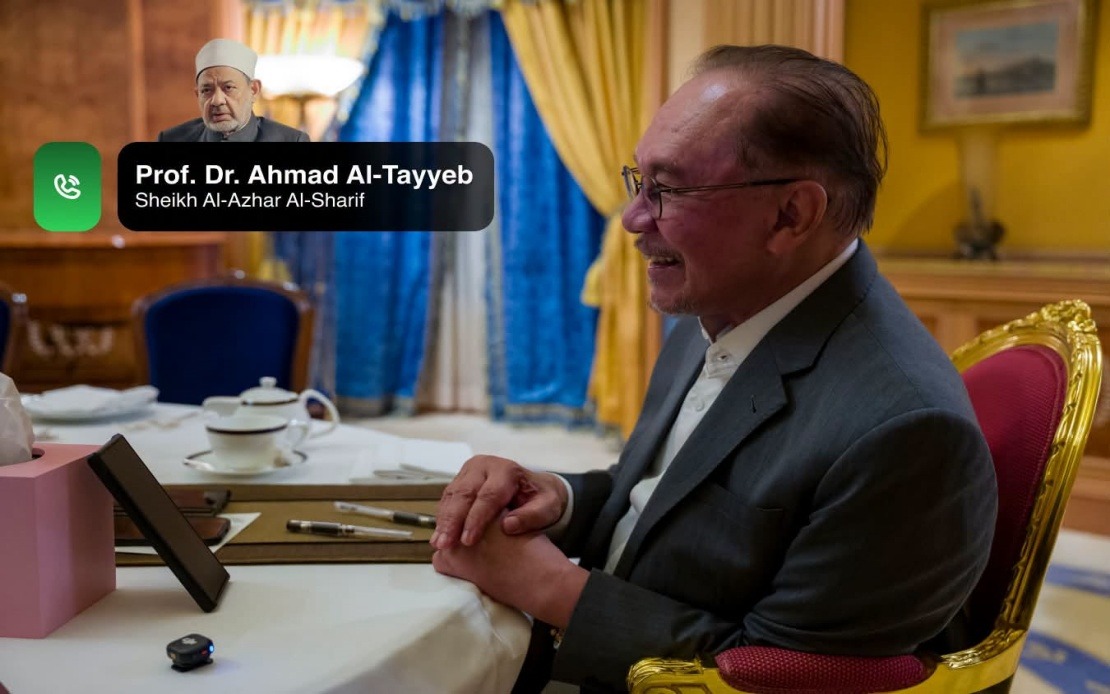
Prime Minister Datuk Seri Anwar Ibrahim has been in direct contact with one of Islam's most prominent spiritual leaders, Sheikh al-Azhar al-Sharif Prof Dr Ahmad al-Tayyeb, to explore shared initiatives aimed at deepening Islamic understanding across communities. The conversation between the two figures took place when the respected Egyptian cleric reached out to inquire about Anwar's health following his recent surgical procedure, demonstrating the personal warmth underlying their official relationship.
According to Anwar's account of the interaction, the discussion ranged beyond mere pleasantries to encompass substantive matters affecting Islamic scholarship and religious outreach throughout the region. The Prime Minister confirmed that his recovery from surgery has progressed satisfactorily, allowing him to engage meaningfully in dialogue about the continuation of dakwah and Islamic studies programmes. This engagement underscores Malaysia's positioning as an active participant in broader Islamic intellectual discourse, rather than a peripheral observer of developments centred on traditional Middle Eastern seats of religious authority.
A central theme that emerged from their exchange involved reinforcing what Anwar characterised as the noble tradition of Islamic knowledge and ensuring that religious guidance continues to benefit entire communities. The Prime Minister emphasised that Sheikh al-Tayyeb's perspectives and counsel would serve as important reference points as Malaysia navigates its approach to Islamic education and community welfare. This framing suggests that Anwar sees value in aligning Malaysian Islamic thought with internationally respected interpretations, potentially countering more insular or divisive theological approaches that have periodically gained traction in the region.
Anwar also referenced the considerable impact made by Sheikh al-Azhar al-Sharif's previous visit to Malaysia, describing it as having resonated deeply with Malaysian Muslims. Such high-profile visits by respected international Islamic figures typically generate significant public interest and media coverage, helping to shape perceptions about the character of Islamic practice and scholarship. By highlighting the positive reception accorded to the Egyptian cleric, Anwar appears to be signalling Malaysia's openness to engagement with moderate, intellectually rigorous expressions of Islamic faith that command respect across diverse Muslim-majority populations.
Looking forward, both parties expressed enthusiasm about potential future meetings, with Anwar suggesting that encounters could take place either in Cairo or Kuala Lumpur as circumstances permit. These prospective engagements would ostensibly focus on advancing joint dakwah initiatives and expanding Islamic knowledge in service of communal welfare. For Malaysia, hosting such visits carries symbolic weight, positioning the country as a credible hub for Islamic dialogue and contemporary Islamic thought within the Southeast Asian context. Al-Azhar University, the institution from which Sheikh al-Tayyeb derives his title and authority, has historically exerted considerable influence on Islamic education and interpretation across the Muslim world.
Beyond his conversation with the Egyptian cleric, Anwar also communicated with Mohamed Abdelsalam, Secretary-General of the Council of Muslim Elders (Majlis Hukama Muslimin), in what appears to be part of a broader pattern of engagement with international Islamic leadership figures. During this separate interaction, the Prime Minister extended personal concern for Abdelsalam's wife, who is currently hospitalised, whilst discussing Malaysia's aspirations regarding its relationship with Al-Azhar and the cultivation of a particular vision of Islamic practice and understanding.
Anwar's articulation of this vision—described as promoting a form of Islam that is simultaneously simple, free, and authoritative—offers insight into the theological orientation his administration appears to favour. The emphasis on simplicity suggests resistance to overly complex or highly formalised religious structures, whilst the stress on freedom indicates openness to rational inquiry and individual conscience within Islamic frameworks. The requirement for authority, however, underscores the importance of grounding religious interpretation in established scholarly traditions rather than idiosyncratic personal readings, a balance that many Muslim-majority democracies struggle to achieve.
The Prime Minister's public acknowledgment of his wife Datuk Seri Dr Wan Azizah Wan Ismail's role and steadfastness throughout his political career adds a personal dimension to the official narrative. By framing her contributions in terms of exemplary womanhood within an Islamic context, Anwar subtly reinforces themes about the compatibility between Islamic values and progressive social roles for women—a topic of ongoing debate across Southeast Asia and the broader Muslim world.
For Malaysia specifically, these engagements represent an effort to consolidate the country's position as a moderating force within global Islam whilst deepening institutional connections with established centres of Islamic learning and authority. The repeated emphasis on strengthening Malaysia's relationship with Al-Azhar suggests that Anwar's administration views such linkages as strategically valuable, potentially enhancing Malaysia's soft power within the Islamic world whilst simultaneously helping to inoculate the country against the influence of more doctrinally rigid or politically radical interpretations of Islamic faith.
The tone of these interactions also reflects a diplomatic strategy that privileges relationship-building and personal connection alongside institutional engagement. By personally reaching out to and maintaining dialogue with international Islamic leaders, Anwar positions himself not merely as a national political figure but as an engaged participant in transnational Islamic discourse. This approach may help to legitimise his government's particular vision of Islamic governance and social organisation both domestically and internationally, whilst creating opportunities for Malaysian influence on how Islamic principles are interpreted and applied across the region.

