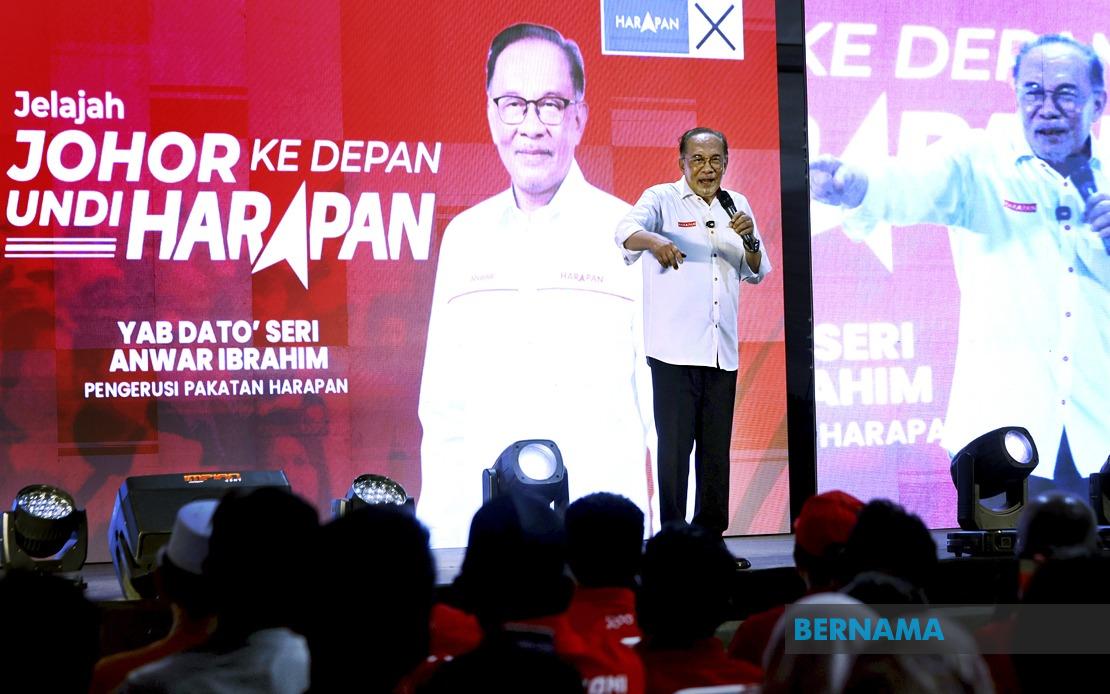
Prime Minister Datuk Seri Anwar Ibrahim has declared an uncompromising stance against systemic corruption, announcing that Malaysia's era of patronage networks and state-sponsored enrichment has definitively ended. Speaking in Muar during campaigning for the Johor State Election, Anwar framed the MADANI Government's mission as one of comprehensive institutional cleansing, fundamentally restructuring how the state manages public resources and dispenses power.
The core message centred on repositioning governmental legitimacy away from narrow factional interests towards serving the broader public good. Anwar emphasised that reclaiming every ringgit of state wealth for ordinary Malaysians represented a threshold commitment, not merely a campaign talking point. This rhetorical shift reflects growing recognition that electoral success increasingly depends on demonstrating tangible commitment to governance reform, particularly as public confidence in institutions erodes following decades of documented malfeasance at the highest levels.
Anwar explicitly rejected the notion that integrity standards should fluctuate based on political affiliation or ethnic background, articulating a vision of meritocratic leadership that transcends communal divisions. His statement that he welcomes honest Malay leaders, Chinese leaders, and leaders of all backgrounds—provided they maintain clean records—attempts to neutralise narratives portraying anti-corruption efforts as ethnically motivated. This framing proves significant in Malaysian politics, where opponents frequently weaponise racial sensitivities to deflect from corruption allegations and undermine reform initiatives.
The Prime Minister targeted what he characterised as the ancien régime's institutionalised corruption, describing arrangements wherein officials leveraged their positions to funnel state contracts towards spouses, children, and business associates. By naming these practices explicitly as remnants of an obsolete system, Anwar positioned his government as fundamentally discontinuous with predecessor administrations. The rhetorical strategy attempts to establish psychological distance between the current political order and the kleptocratic patterns that dominated the previous two decades.
An explicit guarantee that no individual would receive governmental protection if implicated in corrupt conduct carries significant weight given Malaysia's historical patterns. Where previous administrations selectively prosecuted opponents while shielding allies, Anwar's assurance addresses a core source of public cynicism regarding the judiciary and enforcement agencies. Yet the credibility of such promises ultimately depends on demonstrable follow-through, particularly regarding figures with institutional power or political leverage.
The campaign appearance in Sungai Mati occurred against the backdrop of upcoming Johor elections, where 172 candidates compete for 56 state seats, with polling scheduled for July 11. The eight separate engagements Anwar conducted across the state on this single day underscore the intensity with which the federal government is mobilising for the contest. Johor's electoral outcome carries symbolic weight beyond state boundaries, potentially signalling the trajectory of Pakatan Harapan's political fortunes nationally.
Anwar's presence alongside Penang Chief Minister Chow Kon Yeow and Ledang MP Syed Ibrahim Syed Noh reflected deliberate coalition-building, leveraging established regional figures to amplify the anti-corruption message. Such collaborative appearances attempt to project unity across the opposition coalition and contrast with rival camps increasingly fractured by competing ambitions and ideological differences. The optics of senior leaders converging on a single state contest demonstrate how central electoral competition has become to determining governance legitimacy in contemporary Malaysia.
The Prime Minister characterised opposition campaign activities as fundamentally self-interested, motivated primarily by desire to recapture federal power rather than genuine policy disagreement. This framing attempts to delegitimise opposition critiques of government performance by suggesting they stem from factional interest rather than principled concern. However, such dismissals risk appearing defensive if significant voter dissatisfaction regarding inflation, employment, or service delivery remains unaddressed.
Anwar's appeal to Johor voters specifically invoked intergenerational responsibility, urging citizens to reject leaders lacking integrity to preserve opportunities for younger Malaysians. This rhetorical strategy connects anti-corruption commitments to tangible life outcomes—economic mobility, educational access, equitable resource distribution—that resonate across socioeconomic strata. The linkage between governance integrity and individual prosperity represents a central challenge for Malaysian political discourse, as corruption's drag on growth remains largely invisible in daily experience yet compounds across decades.
The broader context involves Malaysia's struggle to rebuild international credibility following systematic corruption scandals that eroded the nation's reputation during the previous decade. Anwar's emphasis on earning global respect through institutional cleansing addresses not merely domestic audiences but international investors and observers who factor governance quality into their assessments. Malaysia's positioning as a regional financial centre depends partly on demonstrating that legal and regulatory systems function fairly and transparently.
Yet significant implementation challenges persist. Transforming institutional cultures developed over decades requires sustained commitment across multiple governmental sectors, from procurement systems to judicial independence to law enforcement impartiality. Anwar's moral clarity regarding corruption's unacceptability provides necessary political cover for reform efforts, yet without corresponding structural changes to incentive systems, oversight mechanisms, and accountability frameworks, rhetorical commitments risk remaining performative rather than transformative.
The Johor campaign sequence represents a critical moment for testing whether anti-corruption messaging translates into electoral support and whether the government can sustain reform momentum beyond immediate political necessity. Success in these elections would provide enhanced legitimacy for pursuing more ambitious institutional restructuring, whilst setbacks could embolden those questioning the government's commitment to genuine transformation rather than mere selective prosecution of predecessors.

