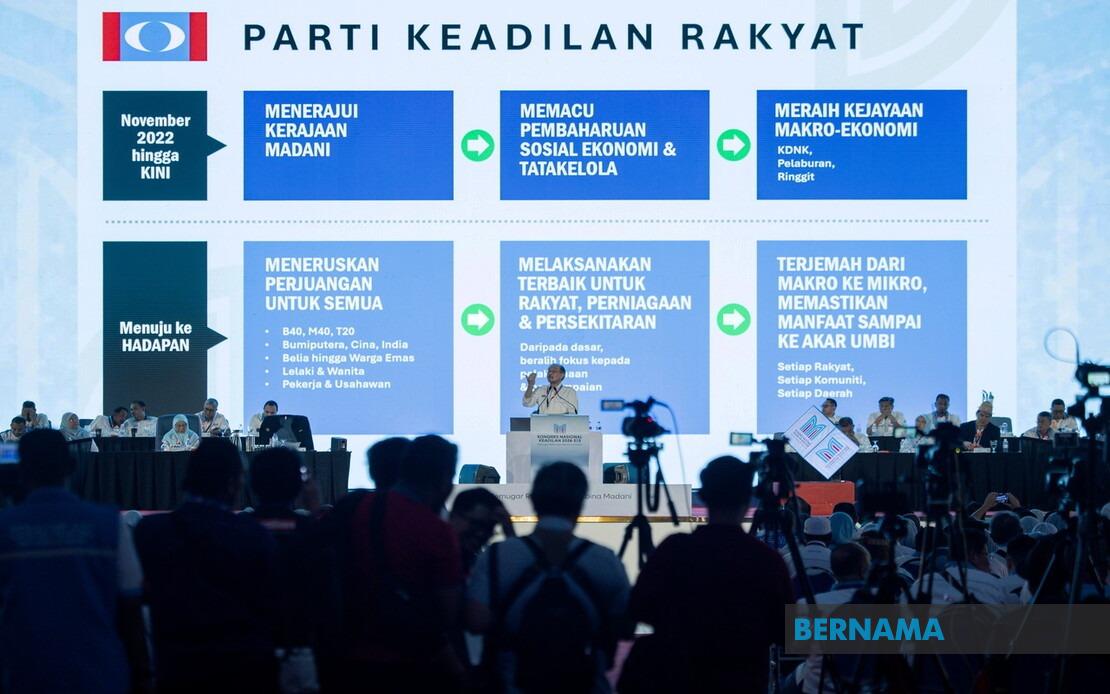
Prime Minister Datuk Seri Anwar Ibrahim has formally vested full authority in Home Minister Datuk Seri Saifuddin Nasution Ismail to discharge the duties of PKR deputy president, a decision announced during the party's national congress in Melaka. The move comes as Nurul Izzah Anwar, the incumbent holder of that position, steps back temporarily from her responsibilities. Speaking at the PKR National Congress 2026 held at the Melaka International Trade Centre in Ayer Keroh on August 16, Anwar characterised the assignment as a natural progression for a trusted lieutenant, describing Saifuddin Nasution as a long-time associate whose loyalty and understanding of his working methods made him the ideal choice to bridge the leadership gap.
Anwar's confidence in Saifuddin Nasution reflects the Home Minister's standing within the party apparatus and the broader government machinery. By publicly framing the interim appointment at a party congress, Anwar signalled to the rank-and-file membership that this transition carries the full weight of his presidential authority and demands unqualified support from party structures. The Prime Minister explicitly appealed to the Keadilan machinery to rally behind Saifuddin Nasution with complete cooperation and allegiance, underscoring that fragmentation or resistance would undermine party cohesion during a period of leadership flux.
The structural necessity for this interim arrangement had been laid out by PKR Information Chief Datuk Seri Fahmi Fadzil on August 6, when he announced that the party's Central Leadership Council had endorsed granting Nurul Izzah temporary leave while simultaneously installing Saifuddin Nasution in her functional capacity. This procedural choreography suggests the party leadership anticipated potential questions about legitimacy or continuity, opting for transparent communication through official channels rather than allowing speculation to fester among members and observers.
Simultaneously with this appointment, Anwar unveiled a broader recalibration of senior party roles. Datuk Seri Amirudin Shari, another vice-president, has been elevated to the position of party election director, a strategically significant portfolio responsible for orchestrating campaign operations and candidate selection processes. Meanwhile, Tengku Datuk Seri Zafrul Tengku Abdul Aziz assumed the newly created or redefined role of coordinator in the Prime Minister's Office, positioning him at the intersection of party politics and governmental administration. These moves suggest Anwar is consolidating authority while deploying capable subordinates across critical leverage points.
Anwar devoted particular attention to the situation in Negeri Sembilan, where PKR suffered a setback in state elections held on August 1. Six division chiefs from the state had petitioned for a review of Datuk Seri Aminuddin Harun's position as chairman of the Negeri Sembilan PKR State Leadership Council, signalling discontentment with his stewardship during the electoral reversal. Rather than immediately capitulating to these demands, Anwar publicly committed to personally addressing their concerns, a move that preserves his prerogative to make final determinations while acknowledging legitimate grievances from the grassroots.
However, Anwar explicitly rejected the notion of scapegoating Aminuddin for the state election loss, insisting instead that electoral defeats represent collective failures requiring collective responsibility. This framing is crucial for party morale and cohesion: it prevents toxic blame-shifting while avoiding the impression that senior leaders escape accountability. By redirecting Aminuddin's energies toward his duties as vice-president and his portfolio overseeing cadre training and member empowerment, Anwar retained the former Negeri Sembilan Menteri Besar in the leadership hierarchy whilst reassigning his focus toward longer-term party building rather than frontline state politics.
The emphasis on Aminuddin's responsibility to develop PKR's younger membership reveals Anwar's strategic thinking about party renewal and succession planning. Electoral losses, while painful, present opportunities to diagnose institutional weaknesses and recalibrate organisational capacity. By tasking Aminuddin with elevating the quality and preparedness of incoming party cadres, Anwar articulated a vision where current setbacks generate learning that strengthens future campaigns. This approach transforms failure into a catalyst for institutional improvement rather than a mere electoral embarrassment.
For Malaysian observers, these moves illustrate how dominant ruling coalition parties manage internal tensions and redistribute power without triggering open factional conflict. PKR, as the largest component of the Pakatan Harapan alliance and home to the Prime Minister himself, operates under intense scrutiny from both competing political forces and its own membership. Public announcements of leadership reshuffles at major party congresses serve multiple functions: they demonstrate dynamism and responsiveness to challenges, they reinforce the PM's control over party machinery, they signal to members that grievances receive attention, and they preempt rival factions from exploiting vacuums of uncertainty.
The Negeri Sembilan situation carries broader significance for Malaysian federalism and intra-coalition dynamics. PKR's loss of that state represents a meaningful territorial contraction for Pakatan Harapan in a region where the coalition had held ground. Understanding why the defeat occurred—whether due to local leadership failures, broader anti-government sentiment, or specific policy disconnects—will shape how Anwar's government calibrates its approach in upcoming elections and governance priorities. The public airing of Aminuddin's performance and the willingness of division chiefs to petition for leadership changes demonstrates that even ruling coalition parties face genuine internal democracy pressures.
Looking forward, the interim nature of Saifuddin Nasution's appointment as deputy president raises questions about duration and permanence. Will Nurul Izzah return to the role following her leave, or might this interim arrangement transition into a permanent restructuring? How the party handles this transition—whether through formal elections, reappointment by Anwar's prerogative, or other mechanisms—will signal the degree to which PKR operates as a consultative meritocracy or a top-down hierarchy guided by the Prime Minister's preferences. These governance patterns within PKR frequently serve as templates for how the broader government functions.
Anwar's deliberate cultivation of Saifuddin Nasution as a potential successor or co-leader also warrants attention. The Home Minister's assumption of deputy president duties, combined with his integration into party machinery, positions him as a tangible alternative leadership option should circumstances require transitions at the apex. This may reflect genuine succession planning or simply prudent institutional design ensuring that no single leader becomes irreplaceable. For Malaysian politics more broadly, whether PKR can nurture credible second-tier leadership determines whether the party survives and flourishes beyond Anwar's tenure or faces internal instability upon his eventual departure.

