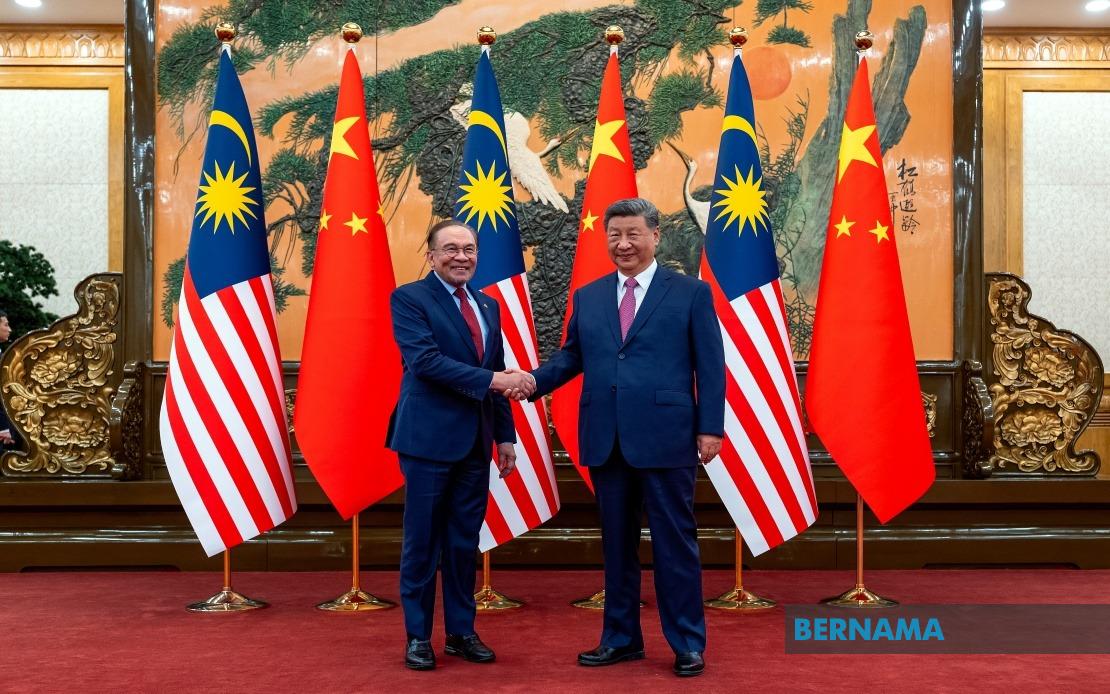
Prime Minister Datuk Seri Anwar Ibrahim has formally conveyed Malaysia's felicitations to the Chinese government on the occasion of the 105th anniversary of the Chinese Communist Party, demonstrating the continuing warmth of diplomatic relations between Kuala Lumpur and Beijing. Through a Facebook statement, Anwar disclosed that he had personally dispatched a letter to Chinese President Xi Jinping, encapsulating congratulations from both the Malaysian government and its people on this significant milestone in China's political history.
In his correspondence, the Prime Minister took the opportunity to acknowledge the transformative role played by the ruling party in steering China's development trajectory over more than a century. Anwar's message highlighted how the party's long institutional journey has been instrumental in driving the country's modernisation, drawing strength from the depth of Chinese civilisation, accumulated historical experience, and the enduring values that have been transmitted across generations of Chinese society.
The gesture carries particular resonance given Malaysia's own pivotal role in China's post-revolutionary diplomatic recognition. Anwar deliberately invoked Malaysia's historic decision on May 31, 1974, when the nation became the first non-communist country in Southeast Asia to formally extend diplomatic recognition to the People's Republic of China. This landmark moment, taken during the era of Prime Minister Tun Abdul Razak Hussein, reflected a strategic calculation rooted in pragmatism and forward-thinking statecraft that transcended Cold War ideological divisions.
The 1974 recognition decision remains foundational to contemporary Malaysia-China relations, according to Anwar's statement. Over the subsequent five decades and more, this initial diplomatic breakthrough has evolved into a multifaceted partnership characterised by deepening economic integration, cultural exchange, and strategic coordination. The relationship has weathered shifting regional geopolitics and weathered periods of both convergence and tension, emerging as one of Southeast Asia's most substantial bilateral connections.
Anwar's reaffirmation of Malaysia's commitment to expanding strategic cooperation with China is framed explicitly within the parameters of mutual respect, reciprocal trust, and equitable benefit-sharing. These three pillars—respect, trust, and shared advantage—represent the operational framework through which Malaysian policymakers conceptualise their engagement with Beijing, seeking to balance the obvious benefits of cooperation against the imperative of protecting national sovereignty and regional stability.
For Malaysian observers, Anwar's diplomatic outreach underscores the government's intention to maintain stable, predictable relations with China despite the complex regional environment. Malaysia navigates competing interests from multiple major powers operating across the Indo-Pacific, including the United States, China, and other regional actors. The anniversary message signals continuity in Malaysia's approach of cultivating pragmatic partnerships while avoiding alignment that would compromise strategic autonomy.
The timing of such diplomatic courtesies also reflects broader patterns in Malaysian foreign policy under the current administration. Since returning to office in November 2022, Anwar has worked systematically to repair and revitalise Malaysia's international relationships, which had experienced periods of strain under the previous government. China, as a neighbouring great power and Malaysia's most significant trading partner within Asia, naturally commands considerable attention in this diplomatic restoration effort.
The invocation of the 1974 recognition decision carries particular weight in this context. Malaysian policymakers frequently reference this moment as evidence of Malaysia's capacity for independent strategic thinking and its willingness to recognise geopolitical realities ahead of conventional consensus. By connecting the anniversary message to this historical precedent, Anwar positions contemporary Malaysia-China cooperation as an extension of longstanding wisdom rather than a recent strategic pivot.
Looking forward, the reaffirmation of commitment to deepening cooperation carries implications for several substantive areas of bilateral engagement. Economic ties, including Chinese investment in Malaysian infrastructure, manufacturing sectors, and technology transfer initiatives, remain areas of significant mutual interest. Additionally, connectivity projects, particularly those involving Belt and Road Initiative frameworks, continue to shape transportation and logistics across the region in ways that affect Malaysian commerce and strategic positioning.
Regional stability considerations also feature implicitly in Anwar's emphasis on peace and prosperity. Malaysia, with its location astride vital sea lanes and its exposure to regional maritime disputes, has a vested interest in maintaining the rules-based international order and preventing escalation of tensions in contested waters. The message to Xi implicitly endorses Malaysia's preference for dialogue, negotiation, and peaceful resolution of differences, positioning China as a partner in these endeavours.
The diplomatic courtesy extended through the anniversary letter also serves domestic audiences within Malaysia. It reassures business communities invested in China-related trade and investment of governmental commitment to stable relations, while simultaneously demonstrating to international observers that Malaysia maintains professional, cordial ties with all major powers without succumbing to pressure for exclusive alignment with any single partner.

