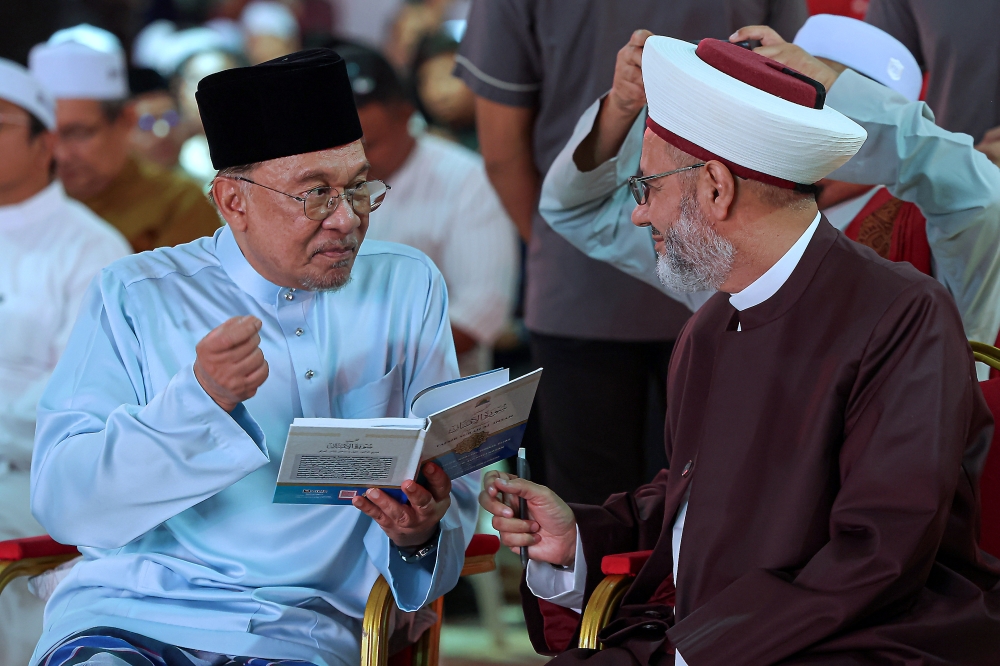
Prime Minister Datuk Seri Anwar Ibrahim has publicly lauded Ahmed Al-Tayyeb, the Grand Imam of Al-Azhar, as a towering figure in advancing moderate Islamic thought and promoting peaceful coexistence across religious and cultural boundaries. The Malaysian premier's commendation underscores the growing diplomatic emphasis on positioning Islam as a religion fundamentally compatible with pluralism and democratic values—a messaging strategy increasingly central to Malaysia's regional and international positioning under Anwar's leadership.
Al-Azhar, one of the world's oldest and most influential Islamic institutions based in Cairo, carries substantial weight within Sunni Islamic scholarship and global Muslim discourse. The institution's Grand Imam serves as a key authority in Islamic jurisprudence and theological matters for hundreds of millions of Muslims worldwide. By endorsing Al-Tayyeb's approach, Anwar effectively aligns Malaysia's brand of Islam with a prominent international voice that consistently emphasises the compatibility of Islamic teaching with human rights, democratic governance, and interfaith respect.
Anwar's remarks reflect a deliberate political strategy to reinforce Malaysia's identity as a moderate Muslim-majority nation. Since his return to the premiership in late 2022, the PM has repeatedly stressed the need for Islam to engage constructively with modernity and to serve as a unifying rather than divisive force in diverse societies. The affirmation of Al-Tayyeb's work suggests that Malaysia views such international religious figures as valuable partners in countering narratives that portray Islam as inherently at odds with secularism or minority rights.
The Grand Imam of Al-Azhar has become increasingly visible in diplomatic circles over recent years. Al-Tayyeb has engaged in high-profile meetings with Christian leaders, Jewish scholars, and secular dignitaries, consistently articulating positions that distinguish between core Islamic principles and the extremist interpretations that have damaged Islam's global reputation. His willingness to condemn terrorism, sectarian violence, and religious intolerance while simultaneously defending Islamic orthodoxy has made him a bridge-builder in an era of religious polarization.
For Malaysia specifically, such endorsements carry practical implications. The country has positioned itself as a hub for Islamic finance, education, and diplomacy, seeking to attract Muslim-majority nations and organisations seeking alternative models to theocracy or religious authoritarianism. By aligning with mainstream Islamic intellectuals like Al-Tayyeb, Anwar strengthens Malaysia's credibility as a steward of a progressive interpretation of Islam that does not require political Islamism or the rejection of secular governance frameworks.
Anwar's appreciation also signals Malaysia's stance within broader regional dynamics. Southeast Asia has witnessed growing concerns about Islamic radicalism, with some extremist groups exploiting grievances to recruit fighters or promote violence. Prominent voices advocating for moderate Islam become essential tools for governments seeking to delegitimise extremism while respecting the genuine religious convictions of their Muslim populations. By publicising his respect for Al-Tayyeb, Anwar sends a message that reasoned, tolerant Islamic scholarship represents the true mainstream of Muslim thought.
The timing and context of Anwar's statement merit consideration. Malaysia continues to navigate complex religious and ethnic dynamics domestically, with ongoing debates about the role of Islam in governance, minority rights, and secular law. International validation from revered Islamic figures can provide political cover for policies that some domestic constituencies might resist, while assuring international partners and minority communities that Malaysia's Islamic framework operates within universally recognised standards of tolerance and human dignity.
Al-Tayyeb's influence extends beyond theological matters into practical interfaith initiatives. He has hosted dialogues at Al-Azhar bringing together Muslims, Christians, Jews, and other believers to discuss shared values and common challenges. These initiatives, though sometimes critiqued by hardliners as diluting Islamic distinctiveness, have garnered considerable international support and recognition. Anwar's public endorsement suggests Malaysia sees value in such model-building, possibly aspiring to position the country as a similar centre for interfaith engagement within the Islamic world.
The broader geopolitical context cannot be overlooked. As Western-Muslim relations face strain and as regional powers compete for influence over Islamic narrative-setting, countries like Malaysia benefit from alignment with respected international Islamic voices. Al-Tayyeb's prominence ensures that Anwar's association with him reaches audiences across the Muslim world, reinforcing Malaysia's image as a nation where Islam thrives alongside democratic institutions and religious pluralism.
Anwar's comments also reflect his personal intellectual trajectory. Before entering his current political role, he spent years advocating for Islamic reform and the compatibility of Islamic governance with democratic accountability. His admiration for Al-Tayyeb appears consistent with this longstanding philosophical commitment, suggesting that the PM's appreciation is rooted not merely in tactical political calculation but also in genuine ideological affinity.
Looking forward, such diplomatic engagements may deepen. Malaysia could potentially formalise collaborative frameworks with Al-Azhar in education, research, or interfaith programming, leveraging the institution's global standing to amplify Malaysia's soft power. For Anwar, the cultivation of relationships with influential international Islamic figures appears integral to his vision of Malaysia as a model Islamic democracy capable of influencing discourse far beyond its borders.

