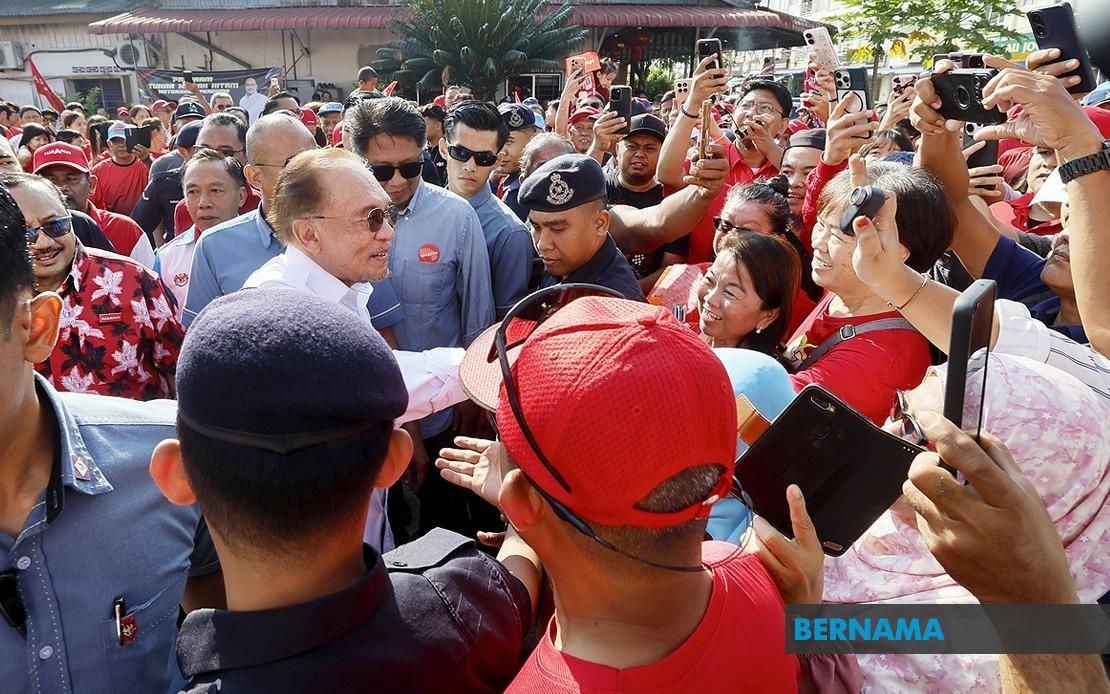
Prime Minister Datuk Seri Anwar Ibrahim has moved to counter perceptions of political favouritism, declaring that the Federal Government under his administration extends equal consideration to all states and communities regardless of their electoral allegiances when channelling resources for public benefit. Speaking in Batu Pahat on July 9, Anwar sought to underscore what he characterised as a consistent pattern of development spending and strategic investment spanning multiple states, including those governed by opposition parties.
The Prime Minister's remarks carried particular weight given that they were delivered during campaign activities for the 16th Johor state election, an event that carries significant symbolic importance for the ruling coalition. Anwar, who additionally chairs the Pakatan Harapan alliance, emphasised that the government's track record stood as tangible evidence of impartiality in disbursing public funds for infrastructure and welfare initiatives. This messaging directly addresses longstanding concerns among opposition-controlled states that they receive disproportionately lower allocations compared to coalition-governed territories.
Among the specific initiatives Anwar highlighted was the Johor-Singapore Special Economic Zone, a substantial cross-border development project intended to enhance regional competitiveness and attract foreign investment. This project represents the kind of transformative infrastructure investment that typically forms the centrepiece of federal development strategy. Beyond commercial zones, Anwar pointed to the allocation of billions of ringgit earmarked for flood mitigation infrastructure in Segamat and Muar, two areas in Johor that have historically suffered from seasonal inundation and associated economic disruption.
The deliberate invocation of flood management initiatives carries particular resonance for Malaysian audiences accustomed to witnessing devastating annual floods that inflict considerable economic losses and human suffering. By placing emphasis on such essential protective infrastructure, Anwar positioned his government as responsive to immediate, tangible needs that directly affect quality of life. This contrasts with promises of development that remain abstract or distant, addressing instead the daily existential challenge of environmental vulnerability that communities across multiple Malaysian states face.
Anwar's insistence that the Federal Government "helps everyone" and that officials "do not only come and promise assistance during election season" appears directed at dismantling a persistent narrative in Malaysian politics. Opposition parties and their supporters have frequently alleged that federal resources flow predominantly during campaign periods to constituencies and states represented by coalition allies. By asserting consistent, year-round commitment to development across diverse political jurisdictions, Anwar attempted to establish a contrasting image of governance based on permanent institutional mechanisms rather than cyclical electoral calculations.
The campaign event in Senggarang featured senior coalition figures including Datuk Fahmi Fadzil, who holds the portfolio of Communications Minister and serves as PH communications director, signalling the significance the ruling coalition attached to messaging around equitable resource distribution. The presence of multiple PH candidates contesting different constituencies within Johor reflected the coalition's strategic focus on securing and consolidating support in a state that has historically exhibited volatile electoral patterns and significant political competition between rival alliances.
Johor carries outsized political importance for Malaysian national politics given its substantial parliamentary representation and its role as a bellwether for broader electoral sentiment. Success or failure in state elections there frequently presages subsequent national-level contests, making the state a crucial testing ground for political narratives and governance claims. The emphasis on development projects spanning Johor thus served dual purposes: simultaneously affirming the administration's performance record while inoculating the coalition against anticipated opposition counterarguments regarding selective resource allocation.
The specific mention of multiple states including Kelantan and Kedah alongside Johor appeared strategically calculated to broaden the narrative beyond a single constituency. Kelantan, long a stronghold of the Islamist PAS party, and Kedah, which has experienced shifting political control, together present a more comprehensive picture of federal engagement across diverse political contexts. This geographical and political diversity was presented as evidence that development transcends factional interests, thereby challenging any perception that the Federal Government privileges certain states based on electoral alignment.
For Malaysian readers, particularly those in opposition-governed states, such assurances merit scrutiny against empirical evidence of federal resource distribution over recent years. Questions around budget allocation, infrastructure spending ratios, and the timing of project announcements relative to electoral cycles have persisted as contentious issues throughout Malaysian politics. Anwar's categorical assertions, while intended to reassure, necessarily invite comparison with independently verifiable data on actual spending patterns.
The broader context of Malaysian federalism shapes how such statements resonate across the country. The constitutional division of powers between federal and state authorities, combined with the dependence of many state governments on federal grants and loans, creates inherent tensions around resource allocation that transcends any single administration. The perception or reality of partisan treatment in federal development spending carries consequences for national cohesion and intergovernmental relations, extending well beyond electoral calculations.
Anwar's emphasis on development projects as proof of non-partisan governance reflects a particular framing wherein physical infrastructure and capital allocation become proxies for political neutrality. This approach presumes that citizens evaluate government impartiality primarily through visible development outcomes rather than procedural fairness or institutional mechanisms. Such framing may resonate with constituencies experiencing tangible improvements in local infrastructure, though it potentially overlooks concerns about the quality, sustainability, or appropriateness of such projects for actual community needs.
Looking forward, whether these assertions of equitable resource distribution will satisfy opposition-controlled states and their constituents remains uncertain. The track record of any government becomes the ultimate arbiter of such claims, and sustained patterns of development spending across genuinely diverse political contexts would be necessary to substantiate Anwar's position comprehensively. For now, the Prime Minister has staked a significant position on this issue, framing responsible federalism as fundamentally divorced from electoral calculation and party advantage.

