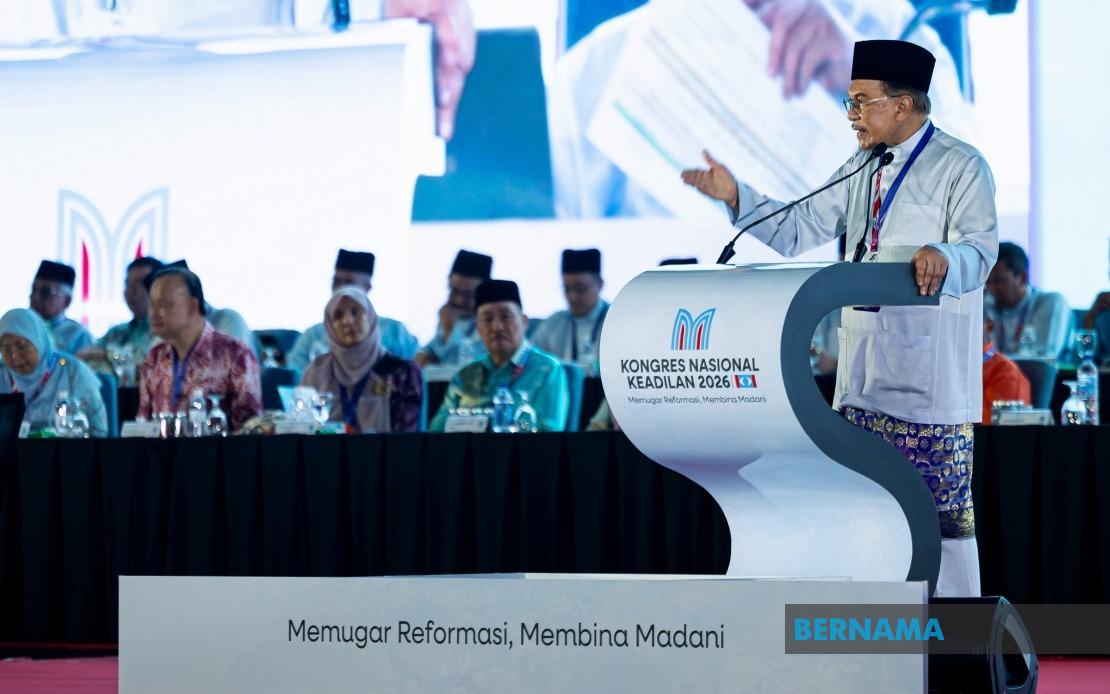
Prime Minister Datuk Seri Anwar Ibrahim moved swiftly on Thursday to counter suggestions that his political partnership with Deputy Prime Minister Datuk Seri Dr Ahmad Zahid Hamidi has soured, asserting during the PKR National Congress in Melaka that their relationship remains constructive and purposeful. Speaking after delivering his presidential address at the party gathering held at the Melaka International Trade Centre, Anwar dismissed characterisations of deteriorating ties as merely reflecting the personal interpretative lens of one observer rather than objective reality on the ground.
The Prime Minister's comments came in direct response to claims made a day earlier by former UMNO Youth chief Khairy Jamaluddin, who had suggested that trust between the two leaders had reached its nadir since the Unity Government was established following the 15th General Election in 2022. Anwar framed this divergence of views as symptomatic of differing worldviews, suggesting that while some individuals habitually view political developments through a prism of conflict and antagonism, he himself approaches governance with a commitment to dialogue and reconciliation. This philosophical distinction, he argued, explains why claims of fundamental ruptures do not accord with his lived experience of working with Zahid across the coalition government.
In his formal address to PKR delegates, Anwar took the opportunity to publicly acknowledge Ahmad Zahid's instrumental role in the original establishment of the Unity Government architecture. The Prime Minister specifically credited the Deputy Premier, acting in his capacity as both Barisan Nasional chairman and UMNO president, with facilitating the complex negotiations that ultimately resulted in the formation of the cross-party coalition that now anchors Malaysia's political system. By highlighting this historical contribution during a major party gathering, Anwar sought to reinforce the narrative of constructive partnership rather than deterioration, sending a signal to his own party members about the centrality of maintaining interparty consensus.
The controversy surrounding alleged tensions between Malaysia's top two leaders reflects deeper anxieties about the stability of the Unity Government itself, a coalition structure that has faced periodic stress since its inception. The arrangement bringing together ideologically distinct entities—the traditionally Islamist-leaning UMNO and Barisan Nasional with the progressive Pakatan Harapan alliance—has always required careful management and goodwill to function effectively. Questions about the personal chemistry between its two most powerful figures inevitably carry implications for the entire governmental framework, making Anwar's public reassurances about his relationship with Zahid matters of genuine strategic importance rather than merely personal diplomatic courtesy.
Khairy's allegations had specifically linked deteriorating Anwar-Zahid relations to escalating frictions between Barisan Nasional and Pakatan Harapan more broadly, particularly highlighting Negeri Sembilan's state election as a flashpoint. In that recent contest, Barisan Nasional chose to align tactically with Perikatan Nasional rather than with their Unity Government partners from Pakatan Harapan, a decision that marked a significant departure from the cooperative framework supposedly binding the coalition at the national level. For Khairy, this willingness to subordinate unity government commitments to opportunistic state-level calculations represented clear evidence of eroding interpersonal trust between Anwar and Zahid at the highest levels.
Anwar's response emphasised the feasibility of resolving such disagreements through established mechanisms of dialogue and discussion rather than allowing them to fester into fundamental breaches. This position reflects a broader governance philosophy that the Prime Minister has consistently articulated since taking office—that Malaysian political stability depends upon leaders' capacity to engage constructively even when they disagree substantively on particular issues or strategies. By characterising differences of opinion as manageable through peaceful discourse rather than confrontation, Anwar attempted to reframe the narrative away from crisis management and toward normalcy, suggesting that occasional tactical divergence between coalition partners represents routine governance rather than systemic failure.
The timing of these reassurances carries significance given the PKR National Congress setting, where Anwar needed to convey confidence to his party faithful that the Unity Government framework remains viable and that PKR's continued participation in the coalition serves the party's political interests. Any perception that relations with UMNO's leadership had fundamentally deteriorated could have invited criticism from party members questioning whether PKR might be better served by repositioning itself within a different political configuration. By insisting publicly and unambiguously on the soundness of his working relationship with Zahid, Anwar sought to preempt such internal doubts before they could gain traction.
The broader context here involves the complex mathematics of Malaysia's current parliament, where no single party commands an unassailable majority. The Unity Government's continued functioning depends substantially on maintaining the electoral cooperation between Pakatan Harapan, Barisan Nasional, and various other aligned parties that together constitute the parliamentary majority. Any serious rupture between Anwar and Zahid would create immediate practical complications for governance, potentially making it difficult to pass legislation or maintain the government's parliamentary position. This structural reality lends urgency to both leaders' interests in maintaining a functional working relationship, even when their respective parties pursue divergent strategies in state-level contests.
The distinction Anwar drew between personal relationships and tactical party positioning may itself represent the most accurate characterisation of the current state of affairs. It is entirely plausible that Anwar and Zahid maintain workable professional interactions at the national level while their respective parties compete aggressively or even cooperate with different partners in state elections where national coalition constraints apply less rigidly. This compartmentalisation, while potentially confusing to observers accustomed to more monolithic party systems, reflects the practical necessities of managing Malaysia's federal structure and the divergent political incentives operating at different governmental levels.
Moving forward, the adequacy of such reassurances will likely be tested through actual policy decisions and electoral calculations. If Barisan Nasional continues to align with Perikatan Nasional in state contests while Pakatan Harapan pursues alternative alignments, observers will continue to question whether the stated harmony at the top reflects genuine consensus or merely diplomatic management of underlying tensions. The Malaysian political landscape remains sufficiently fluid that any significant deterioration in Anwar-Zahid relations could create genuine instability, making their mutual interest in maintaining workable ties a stabilising force regardless of how warmly they might privately regard one another.

