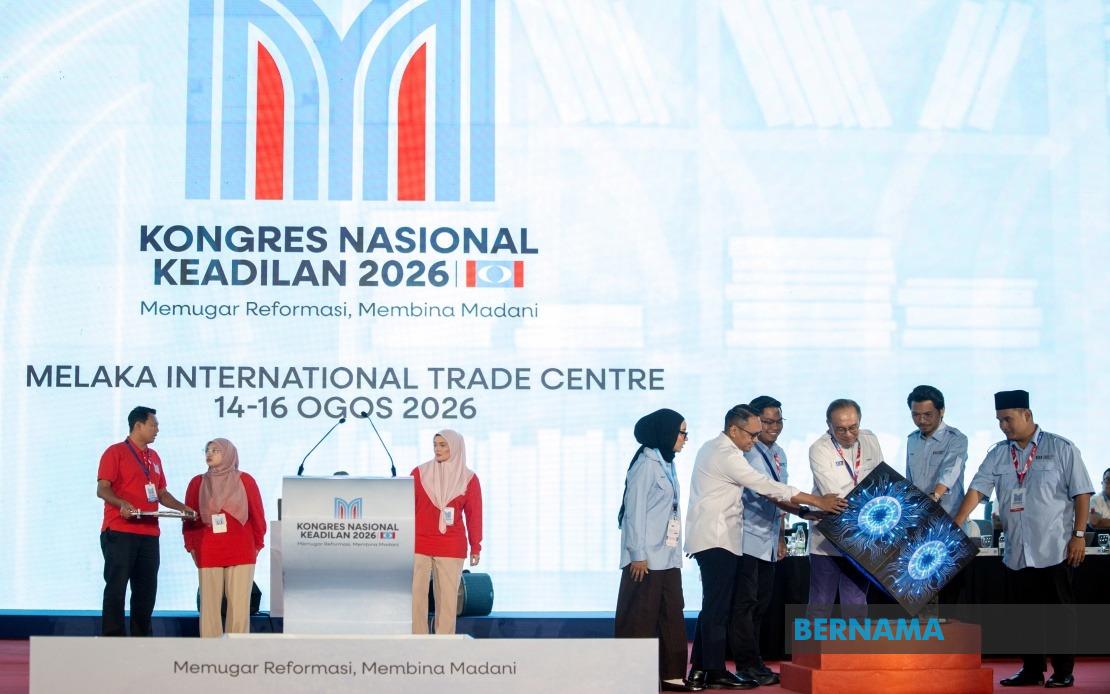
Prime Minister Datuk Seri Anwar Ibrahim has unveiled an ambitious intellectual framework for nation-building, launching a comprehensive publication by Parti Keadilan Rakyat's youth movement that signals his vision extends well beyond electoral politics. Delivered in Melaka, the Prime Minister positioned the 113-page document as a foundational text for contemporary governance, one that transcends the typical boundaries of party manifestos to address systemic challenges facing Malaysia's development trajectory.
Authored by Angkatan Muda Keadilan (AMK) chief Muhammad Kamil Ahmad Munim and executive committee member Ashraf Ahmad Hadi, the publication represents the party's intellectual repositioning at a moment when Malaysia grapples with legacy issues of institutional fragility, economic inequality and eroded public trust. The timing carries significance, coinciding with broader policy initiatives that Anwar has championed since assuming office, though the full context of concurrent government programmes remains understated in his public remarks.
Crucially, Anwar's framing of this initiative reveals a deliberate rhetorical strategy. He explicitly rejected what he termed "mere technocratic rhetoric" or "seasonal political slogans," suggesting frustration with superficial approaches to governance that have historically characterised Malaysian politics. Instead, he articulated a philosophy of "civilisational renewal"—a concept that positions development not as mechanistic economic expansion but as a moral and humanistic endeavour requiring spiritual grounding alongside material progress.
The emphasis on re-humanising national development carries particular weight in Malaysia's contemporary context. For decades, the nation's growth model has prioritised infrastructure and aggregate GDP metrics while grappling with persistent concerns about corruption, institutional capture and the erosion of ethical standards in public life. Anwar's language suggests an attempt to recalibrate what success means, placing moral integrity and intellectual rigour at the centre rather than peripheral to policy formulation.
Addressing AMK members directly, Anwar issued a pointed challenge to the younger generation, reminding them that political power represents not privilege but profound responsibility. His invocation of "piety and moral integrity" signals that he views the youth movement not merely as a future voting bloc or activist contingent but as custodians of a civilisational project. This framing implicitly critiques the performative activism sometimes visible in Malaysian youth politics, where social media engagement can substitute for substantive engagement with policy and institutional reform.
The Prime Minister's acknowledgement that the nation remains "scarred by past injustices and leakages" constitutes an unusually candid recognition of Malaysia's historical governance failures. Rather than glossing over these challenges, he positioned them as the very justification for why the current generation must demonstrate "extraordinary creativity, intellectual courage and spiritual resilience." This formulation avoids blame-shifting while establishing a clear moral imperative for systemic transformation.
The publication itself serves multiple functions within PKR's organisational architecture. As a cadre-building resource, it offers party members a coherent intellectual foundation, moving beyond personalities and short-term electoral calculations to ground political identity in historical consciousness and ideological coherence. The emphasis on appreciating the party's struggle history, understanding its foundational principles and internalising the concept of "Reformasi" suggests an attempt to consolidate institutional memory amid generational turnover.
For Malaysian readers beyond PKR's membership, this document signals Anwar's intellectual ambitions for his administration. The focus on principled governance, knowledge-based decision-making and spiritual-ethical dimensions reflects a governing philosophy that prioritises institutional legitimacy alongside policy effectiveness. In a region where populism and transactional politics remain potent forces, such emphasis on intellectual courage and moral foundations represents a distinctive positioning.
The document's aspiration to guide member development toward steadfast commitment to party mandates also reflects concerns within PKR about internal cohesion. Coalition governments in Malaysia have historically experienced defection and factionalisation, particularly when individual politicians calculate personal advantage against collective party interests. By investing in ideological formation and historical consciousness among youth cadres, the party leadership attempts to build institutional resilience against such centrifugal forces.
Moreover, the launch underscores Anwar's strategy to position PKR as Malaysia's intellectual and moral centre-left force, distinct from competing visions of governance offered by other coalitional partners or opposition groups. The emphasis on rational, knowledge-based solutions grounded in ethical frameworks appeals to educated urban constituencies while the spiritual-moral dimension resonates with Malaysia's Muslim-majority population, attempting to bridge secular and religious political languages.
The initiative also reflects broader anxieties about Malaysia's regional competitiveness. As Southeast Asian neighbours implement significant institutional and developmental reforms, Malaysian policymakers recognise that sustainable advantage requires not merely capital accumulation but cultivation of human capital, institutional capacity and moral authority. Anwar's framing positions youth engagement as integral to this competitive challenge.
Looking forward, the publication's impact will depend substantially on whether its principles translate into concrete policy implementation and institutional practice. Declarations of civilisational renewal risk becoming rhetoric without mechanisms ensuring implementation, particularly within Malaysia's complex federal structure and coalition governance environment. The test lies in whether AMK members and broader PKR cadres adopt these frameworks as operational guides or treat them as aspirational documents without enforcement implications.
Ultimately, Anwar's launch in Melaka represents an attempt to elevate Malaysian political discourse beyond transactional competition toward substantive engagement with civilisational purpose. Whether this intellectual repositioning can reshape Malaysian governance practice remains an open question, but the ambition itself distinguishes this approach from preceding administrations and suggests Anwar views his tenure as opportunity for foundational rather than merely administrative change.

