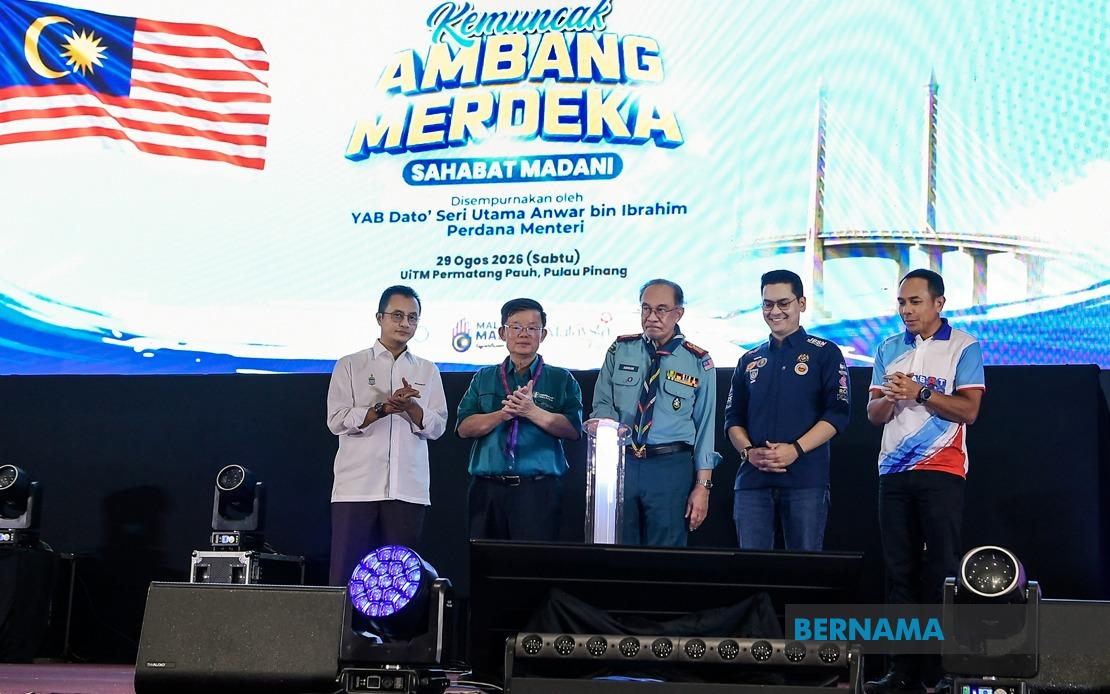
Prime Minister Datuk Seri Anwar Ibrahim has formally launched Sahabat MADANI, a national volunteer movement that has already mobilised over 11,000 citizens across the country. The programme was introduced at the Ambang Merdeka Sahabat MADANI 2026 event held at Universiti Teknologi MARA (UiTM) Permatang Pauh in Bukit Mertajam, marking a significant step in the government's broader Malaysia MADANI vision. With 11,060 volunteers registered nationwide, the initiative represents an attempt to translate reform commitments into tangible community action by creating structured avenues for citizen participation.
At its core, Sahabat MADANI functions as a coordinated network bringing together government agencies, volunteer organisations and local communities around shared development priorities. The Implementation Coordination Unit of the Prime Minister's Department emphasised that the movement transcends traditional divides by encouraging participation from individuals of different ethnic backgrounds, religious affiliations and social classes. This inclusive approach addresses a persistent challenge in Malaysian society: creating meaningful platforms where diversity becomes a source of collective strength rather than fragmentation. By institutionalising volunteering as a formal national movement, the government appears intent on embedding social cohesion as an operational principle rather than merely an aspirational statement.
The programme targets several interconnected social challenges that require sustained community engagement beyond conventional government delivery mechanisms. Sahabat MADANI volunteers focus on supporting economically vulnerable households, intervening in childhood education by tracking and assisting students who have abandoned formal schooling, generating employment and entrepreneurial pathways for youth, and providing rapid assistance during emergencies and natural disasters. These priorities reflect recognition that persistent poverty and inequality require not just top-down redistribution but active community mobilisation and peer-to-peer support systems that can respond more nimbly than bureaucratic structures. The emphasis on youth employment and business creation particularly signals concern about graduate unemployment and underemployment in Malaysia's competitive economy.
The volunteer movement operates under the umbrella of "Malaysia MADANI: Kesejahteraan Dinikmati," the government's flagship framework centred on shared prosperity and inclusive wellbeing. This positioning connects volunteerism directly to the administration's broader reform agenda, implying that national development depends not merely on policy changes but on cultivated civic virtue and active citizenship. By framing volunteer service as aligned with Malaysia's independence struggles and national values, the government attempts to elevate community service beyond charitable impulse to an expression of patriotic duty. This rhetorical move may prove significant in encouraging sustained participation, particularly among younger citizens seeking meaningful engagement beyond partisan politics.
The transparency and results-oriented language in official statements suggests the government recognises volunteer fatigue and public scepticism about grand initiatives that fail to deliver observable outcomes. Emphasis on "direct benefits," "actual needs" and "delivering results for the people" indicates recognition that volunteer motivation depends on demonstrable impact. Malaysian communities have witnessed numerous well-intentioned programmes that dissipated after ceremonial launches, generating cynicism about sustainability. The Sahabat MADANI framework explicitly commits to responsive coordination and tailoring interventions to specific community contexts, potentially addressing past criticisms of one-size-fits-all approaches.
The registration of 11,060 volunteers at launch provides both opportunities and challenges for programme momentum. This represents substantial initial interest, yet maintaining engagement and preventing the "fade-out" phenomenon common in volunteer movements requires sustained institutional support, meaningful work allocation and regular feedback loops demonstrating impact. The coordination burden falls significantly on the Implementation Coordination Unit and partner agencies to ensure volunteers receive appropriate training, deployment and recognition. In the Malaysian context, where volunteerism participation rates remain relatively modest compared to developed nations, cultivating long-term volunteer commitment requires deliberate capacity-building and institutional infrastructure.
For Malaysian and Southeast Asian readers, Sahabat MADANI merits attention as a test case in reconciling national unity rhetoric with practical, sustained action. Malaysia's plural society has historically experienced tensions between elite-level multicultural pronouncements and ground-level intergroup cooperation or mutual service. A volunteer movement that successfully mobilises individuals across ethnic and religious lines to engage in meaningful joint projects could establish valuable precedents and normalise cross-community collaboration around shared development objectives. Conversely, if the programme struggles with volunteer retention or fails to translate registrations into sustained community impact, it may deepen public cynicism about government reform commitments.
The initiative arrives at a moment when Malaysian civil society faces competing pressures. Rising partisan polarisation, economic anxieties and social fragmentation create both urgency for inclusive community platforms and obstacles to building trust across divides. Sahabat MADANI attempts to position volunteering as a depolarising force by encouraging collective action focused on tangible community improvement rather than ideological contestation. Whether this model proves effective depends partly on protecting the movement from partisan capture and ensuring it remains genuinely responsive to community-identified priorities rather than government-defined agendas.
The programme's emphasis on young people rejecting divisive sentiments and contributing their skills to national progress addresses particular demographic anxieties. Malaysian youth face intense pressures balancing education, employment and social participation in increasingly competitive conditions. Sahabat MADANI frames volunteer engagement as avenue for meaningful contribution beyond conventional career pathways, potentially appealing to young people seeking purpose and community connection. However, competing demands on youth time—including paid employment, education and digital engagement—mean the movement must offer compelling reasons for participation beyond patriotic appeals.
The launch also reflects broader Southeast Asian trends toward mobilising social capital for development objectives. Across the region, governments increasingly recognise that meeting development targets requires engagement beyond state capacity alone. Vietnam's community-based initiatives, Thailand's localised development approaches and Indonesia's neighbourhood volunteer networks all pursue similar logic of channelling civic energy toward specific development outcomes. Sahabat MADANI positions Malaysia within this regional conversation while adapting the model to local institutional contexts and social composition. Success or failure here may offer instructive lessons for neighbouring countries contemplating comparable programmes.
Institutional sustainability remains the critical test ahead. The Initial registration of 11,060 volunteers demonstrates latent demand for structured volunteering opportunities, but converting registrations into sustained, meaningful service requires investment in volunteer training, role clarity, recognition systems and organisational infrastructure. The coordination unit must navigate tensions between standardising volunteer activities for consistency while allowing sufficient flexibility for local adaptation and innovation. Building feedback mechanisms that demonstrate impact to volunteers and communities proves essential for maintaining morale and recruitment.
Moving forward, the programme's success will depend on rigorous monitoring and transparent reporting of outcomes rather than simply counting volunteer registrations. Communities will judge effectiveness based on whether vulnerable households receive genuine assistance, whether out-of-school children successfully re-engage education systems, whether youth employment initiatives generate sustainable opportunities, and whether disaster relief coordination genuinely saves lives and property. These concrete measures ultimately matter far more than programme expansion or political rhetoric. The government has staked significant symbolic capital on Sahabat MADANI as expression of its reform commitment; actual delivery will determine whether volunteerism becomes an enduring feature of Malaysian civic life or another well-intentioned initiative that gradually fades from public consciousness.

