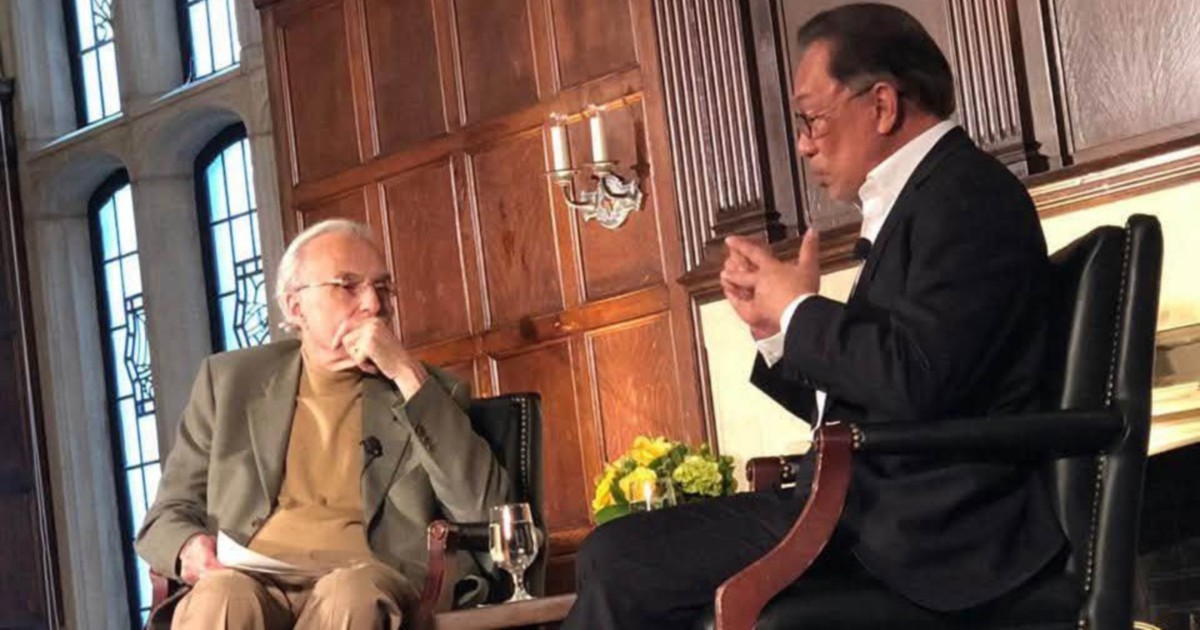
Prime Minister Datuk Seri Anwar Ibrahim has issued a formal expression of condolence following the passing of Professor John L. Esposito, widely acknowledged as one of the world's foremost authorities on Islamic civilisation and contemporary Muslim societies. The tribute underscores Malaysia's recognition of Esposito's extraordinary intellectual legacy that shaped decades of scholarly discourse on Islam at the international level.
Esposito's career spanning multiple decades established him as a pivotal figure in bridging cultural understanding between the Islamic world and the West during a period marked by considerable geopolitical tension and frequent misunderstanding. His work transcended the boundaries of academic specialisation, extending into policy advocacy and public intellectualism, where he consistently emphasised the diversity of Islamic thought and practice across global Muslim communities. This nuanced approach distinguished his scholarship from much of the polarised discourse that emerged in the late twentieth century.
The professor's influence on Malaysia itself holds particular significance, given the nation's position as a Muslim-majority democracy with substantial Muslim intellectual traditions and a growing role in international interfaith initiatives. Malaysian academic institutions and policy circles have long engaged with Esposito's frameworks for understanding Islam in contemporary governance, democratisation, and pluralism. His theoretical work provided credible scholarly grounding for discussions around Islamic governance models that accommodate democratic principles, a matter of direct relevance to Southeast Asian political contexts.
Esposito's body of scholarship addressed fundamental questions about the compatibility of Islamic teachings with modern state systems, individual rights, and participatory governance. Rather than treating Islam as a monolithic political ideology, he documented the multiplicity of Islamic movements, ranging from moderate reform-oriented groups to conservative traditionalists and various activist organisations. This analytical approach enabled deeper understanding of the heterogeneity within Muslim-majority societies, a perspective that resonates strongly in Malaysia's multicultural and multi-religious framework.
During the post-September 11 period, Esposito emerged as a prominent public intellectual who resisted simplistic narratives linking Islam itself to extremism and terrorism. His extensive research demonstrated that violent extremism represents a marginal phenomenon within global Islam, advocating instead for recognition of mainstream Muslim voices, governance traditions, and social movements. This intervention in public discourse was particularly valuable during a volatile geopolitical moment when scholarly authority became crucial in shaping international policy and public opinion.
The Georgetown University professor's institutional contributions included founding the Center for Muslim-Christian Understanding, an academic initiative designed specifically to foster scholarly exchange and research collaboration across religious traditions. This institution became a globally recognised hub for serious academic work on Islam, attracting scholars, policymakers, and religious leaders seeking evidence-based understanding of Islamic societies. The centre's interdisciplinary approach influenced how universities worldwide approached Islamic studies, moving beyond purely textual analysis towards engagement with contemporary political and social realities.
Malaysia's acknowledgment of Esposito's death through official condolences reflects the nation's appreciation for scholarship that contributes to global understanding of Islam beyond stereotypes and reductionist frameworks. As an Islamic country navigating complex relationships with Western powers, international organisations, and diverse religious communities, Malaysia has benefited intellectually from Esposito's work demonstrating that Islamic civilisation encompasses sophisticated political philosophy, legal traditions, and governance experiments worthy of serious academic study.
Esposito's prolific publishing record, encompassing numerous monographs, edited volumes, and articles, created an accessible body of work that influenced multiple generations of students, policymakers, and informed publics worldwide. His writing combined scholarly rigour with clarity of expression, making complex historical and contemporary phenomena comprehensible to educated general audiences without sacrificing intellectual depth. This commitment to public scholarship established him as an essential voice during moments when international understanding of Islam proved particularly fraught with misperception.
The scholar's death represents a significant loss for interfaith dialogue initiatives and Islamic studies globally. His legacy extends beyond academic circles, having shaped policy approaches toward Muslim-majority nations and Muslim minority communities in Western countries. For Malaysia specifically, Esposito's work provided intellectual resources for articulating a vision of Islam compatible with democratic governance, religious pluralism, and global engagement—positions central to the nation's self-conception and international positioning.
Esposito's contributions will undoubtedly continue influencing scholarship and policy discussions for decades ahead. His insistence on treating Islamic societies as complex, internally diverse, and capable of negotiating modernity on their own terms established enduring foundations for serious cross-cultural scholarship. Prime Minister Anwar's condolences acknowledge not merely the passing of an individual scholar but the loss of a voice that consistently advocated for sophisticated, evidence-based understanding in public discourse surrounding Islam and Muslims.

