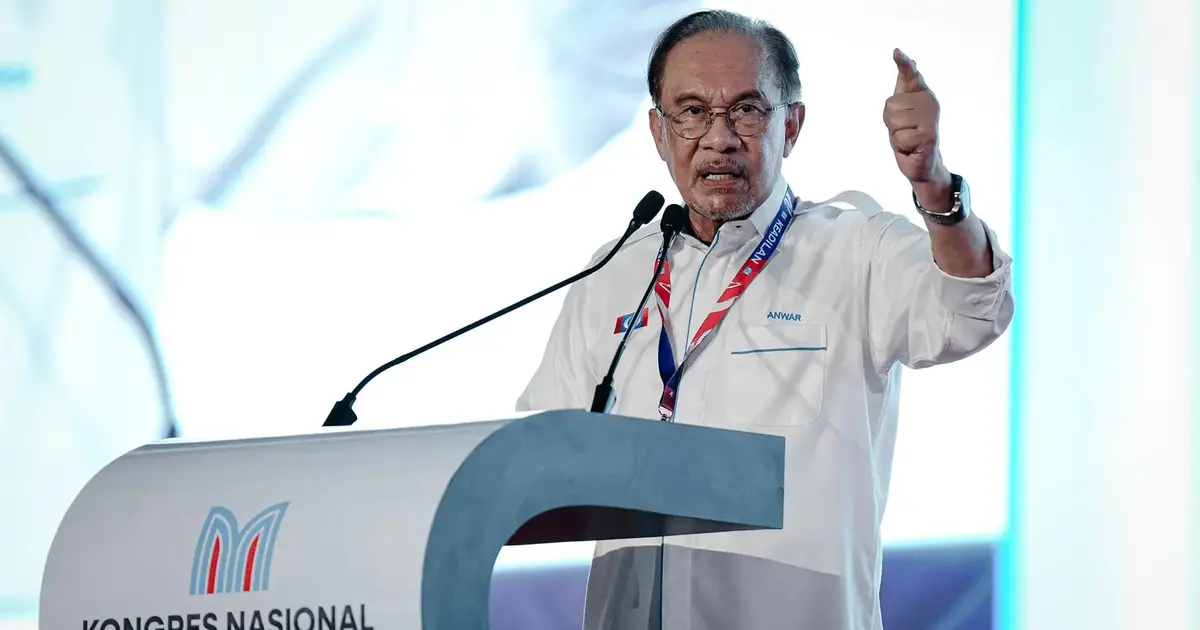
Prime Minister Anwar Ibrahim has moved to counter political accusations by announcing a nationwide allocation of RM1 million per parliamentary constituency, a move designed to address persistent criticism that his administration has been channelling development resources unequally between government and opposition-led areas.
The announcement comes as Anwar faces ongoing political pressure from both ruling coalition members and opposition figures over resource distribution. The programme represents an attempt to demonstrate equitable governance across all 222 parliamentary constituencies, regardless of the political affiliation of their representatives or state governments.
Responding directly to allegations that development funding has been withheld from opposition-controlled states, Anwar rejected the characterisation as inaccurate. Such claims have emerged repeatedly in Malaysian political discourse, with opposition parties arguing that their constituencies receive disproportionately lower allocations for infrastructure, education, and community development projects compared to areas represented by government members.
The timing of this announcement reflects broader political calculations in Malaysia's complex coalition landscape. Since the 2022 general election, the government has comprised an unusually broad political alliance that initially included cooperation with several opposition parties. The funding announcement suggests an effort to maintain political consensus and prevent further splintering of the coalition, particularly given recent tensions within the ruling partnership.
From a practical standpoint, the RM1 million per constituency allocation would distribute a total of RM222 million across the country if fully implemented. While not an enormous sum in Malaysia's federal budget context, the gesture carries symbolic importance in addressing perceptions of political bias in government expenditure. Constituency-level funds typically support local infrastructure improvements, community facilities, and development initiatives that directly impact constituents' daily lives and voting preferences.
The announcement also addresses a persistent tension between federal and state governments, particularly where opposition parties control state administrations. When different political parties govern at federal and state levels, disagreements over fund allocation and development priorities have historically created friction that affects ordinary Malaysians seeking basic services and infrastructure improvements. By providing direct parliamentary constituency funding, the federal government potentially circumvents state-level obstacles.
From a Southeast Asian perspective, Malaysia's experience illustrates broader challenges facing federal democracies managing partisan divisions across multiple levels of governance. Countries throughout the region grapple with similar questions about equitable resource distribution when political fragmentation occurs. The approach adopted by Anwar's government offers one model for maintaining governmental coherence and public legitimacy despite coalition diversity.
For Malaysian voters, particularly in opposition-led constituencies, such initiatives matter considerably in assessing whether their representatives can secure development benefits regardless of which party controls national government. Public perception of fairness in fund allocation significantly influences electoral behaviour and political trust. Repeated claims of unequal treatment, even if disputed by the government, can erode confidence in democratic institutions if left unaddressed.
The announcement also reflects economic realities facing Malaysia. With rising development expectations, limited federal resources, and competing priorities ranging from healthcare to education to economic development, decisions about fund distribution carry substantial consequences. Spreading allocations across all constituencies, while appearing equitable, may also indicate recognition that concentrated spending in government-held areas alone proves politically unsustainable.
Opposition parties will likely scrutinise how these funds are actually implemented and whether constituency allocation represents genuine additional spending or merely rebranding of existing budgets. The distinction matters considerably for assessing the announcement's practical impact. If genuinely new funding, the initiative represents a significant commitment; if reshuffled from existing allocations, the political value diminishes substantially despite the symbolic gesture.
The broader governance question underlying this announcement concerns the relationship between electoral success and resource access. Anwar's statement implicitly acknowledges that development funds should flow to all constituencies, not merely reward government-supporting areas. Whether implementation matches rhetoric will significantly influence Malaysian politics going forward and determine whether similar governance dilemmas in other Southeast Asian democracies become more or less tractable.

