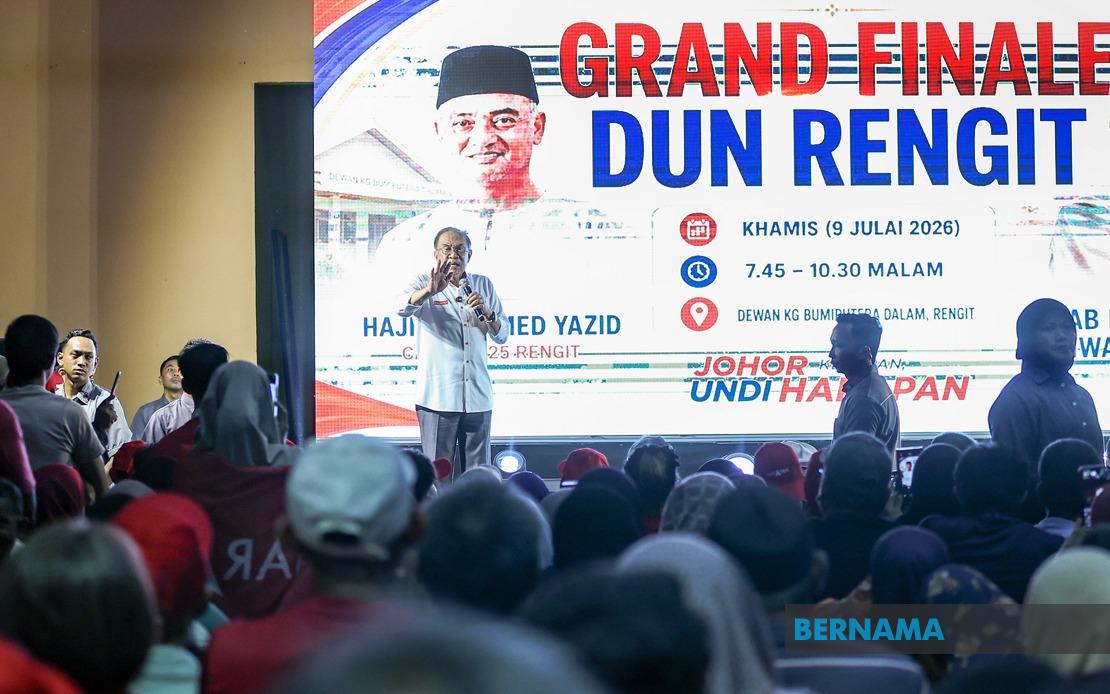
Prime Minister Datuk Seri Anwar Ibrahim has committed to resolving decades-old infrastructure deficiencies in Rengit, vowing that basic healthcare facilities and water supply disruptions affecting residents will be treated as urgent government priorities. Speaking at a Pakatan Harapan campaign rally in Batu Pahat on July 9, Anwar framed access to clean water and medical care not as aspirational goals but as fundamental rights that a developed state like Johor must guarantee without further delay.
The prime minister's remarks targeted the deteriorating condition of local health clinics, describing the paradox of treating sick people in facilities themselves in poor repair. His rhetoric underscored a broader campaign message: that infrastructure quality directly reflects a government's commitment to its citizens and its development credentials. For residents in Rengit who have endured inconsistent water supply and ageing medical infrastructure, the statement represented an attempt to link Pakatan Harapan's federal agenda with tangible improvements at the constituency level.
Anwar's visit to Rengit formed part of a three-event campaigning blitz across Johor on the eve of the 16th state election scheduled for Saturday. The tactical concentration of prime ministerial attention reflects the coalition's strategy of leveraging federal leadership to energise grassroots support and reassure voters that a Pakatan Harapan state government would have direct alignment with federal resources and decision-making. The Rengit event, branded as the 'Serumpun Kasih Sejiwa Harmoni Grand Finale', brought together party machinery and candidates to project unity and momentum in the final campaign stretch.
Accompanying Anwar were Sri Gading Member of Parliament Aminolhuda Hassan, who chairs Johor's Parti Amanah Negara (Amanah) division, and Rengit's Pakatan Harapan candidate Yazid Abu Bakar. The presence of Aminolhuda, representing a neighbouring federal constituency, signalled the coalition's emphasis on coordinated messaging across multiple electoral jurisdictions and the integration of federal and state political machinery. This coordination becomes particularly significant in Malaysia's federal system, where state governments must navigate relationships with a federal administration that controls major development funding and infrastructure projects.
Beyond infrastructure concerns, Anwar emphasised that housing, education, and healthcare must remain anchored as government priorities, establishing a framework through which voters could evaluate governance performance. His framing implicitly critiqued previous state administrations for failing to maintain basic service standards, positioning Pakatan Harapan as the custodian of efficient, citizen-centred governance. The message resonated with a longstanding voter concern in Malaysian constituencies: that elected representatives should be held accountable for delivering functional, well-maintained public services rather than merely announcing new projects.
The prime minister also issued a direct warning to government officials and community leaders, instructing them to exercise their responsibilities with integrity and refrain from exploiting their positions for personal enrichment. This anti-corruption rhetoric formed a consistent thread in Pakatan Harapan's messaging, appealing to voters fatigued by perceptions of governance abuse. In the Malaysian context, where public trust in institutions has been strained by high-profile scandals, such declarations attempt to differentiate the coalition on grounds of probity and transparency.
Anwar's exhortation to voters carried strategic weight: he urged constituents to elect representatives aligned with the federal government to ensure that development initiatives could proceed smoothly and effectively. This argument leverages the incentive structure inherent in Malaysia's parliamentary system, where state governments benefit considerably from cooperative relationships with the federal administration. A state administration aligned with federal leadership gains preferential access to development budgets, infrastructure contracts, and policy coordination, whereas divided government can result in bureaucratic friction and resource bottlenecks.
For the Johor contest, Pakatan Harapan is fielding candidates across all 56 state seats, with the coalition divided into three components: PKR contesting 20 seats, Amanah fielding 19 candidates, and DAP nominating 17 aspirants. This distribution reflects negotiated power-sharing arrangements within the coalition, with each component party securing territorial bases aligned with their organisational strengths and historical support bases. The relatively balanced distribution signals internal coalition cohesion, though seat allocation negotiations in multi-party coalitions often mask underlying tensions over perceived fairness and strategic positioning.
The election itself attracts 172 candidates across all three coalitions contesting for the 56 available seats, indicating competitive contests in many constituencies. This candidate density suggests that internal party contests during nomination processes were fiercely contested, and that the election will feature both inter-coalition rivalry and intra-coalition competition in certain seats. For Rengit specifically, the choice between Yazid Abu Bakar and other candidates will reflect broader voter assessments of which political grouping can best deliver on infrastructure pledges like those articulated by Anwar.
For Malaysian observers monitoring the Johor state election, the campaign dynamics reveal how federal and state politics remain deeply entwined in Malaysia's political economy. Anwar's appearance and specific pledges on local infrastructure underscore that state elections, while technically distinct from federal contests, have become occasions for federal leaders to signal commitment to particular regions and to mobilise support for aligned state administrations. The infrastructure deficiencies he cited in Rengit are neither unique nor inconsequential; similar water supply and healthcare facility issues persist across numerous Malaysian constituencies, making such pledges both broadly resonant and subjects of sustained scrutiny regarding implementation.

