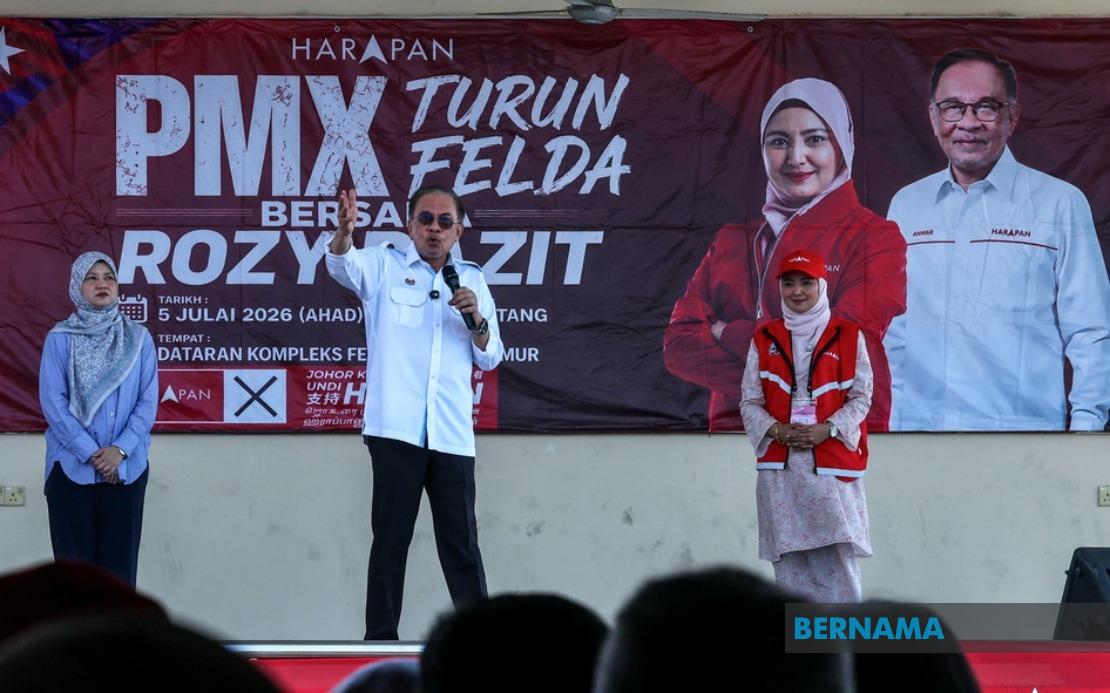
Prime Minister Datuk Seri Anwar Ibrahim has made a direct commitment to resolving the housing allocation crisis that has plagued the second generation of FELDA settlers for over two decades. Speaking during a community engagement event at Dataran Putra Felda Palong Timur in Segamat, Anwar emphasised that his administration regards this issue as a priority requiring urgent action before the end of his tenure as Prime Minister.
The federal land development scheme, which has historically provided smallholding opportunities and settlement support to rural Malaysians, faces a succession crisis. As the original settler generation ages, their children have struggled to secure comparable opportunities or housing allocations within the schemes, creating social tension and economic hardship for young families within FELDA communities. This intergenerational inequity has festered as successive administrations delayed addressing the structural deficiency.
Anwar acknowledged a fundamental constraint in federal authority: land administration and basic infrastructure provision fall squarely under state government jurisdiction according to Malaysia's constitutional framework. This division of power means the Prime Minister's office cannot unilaterally mandate solutions without buy-in from the 13 state governments, each with varying fiscal capacities and political priorities. Consequently, resolving the FELDA second-generation issue requires sustained negotiation and coordination across multiple levels of government.
The Prime Minister's public declaration at a grassroots gathering suggests an attempt to build political momentum by demonstrating federal commitment before key audiences. The event was attended by Selangor Menteri Besar and PKR vice-president Datuk Seri Amirudin Shari, Education Minister Fadhlina Sidek, and Deputy National Unity Minister and Segamat MP R. Yuneswaran, signalling a consolidated government presence designed to reinforce the seriousness of the commitment.
For Malaysian policymakers, the FELDA second-generation housing problem exemplifies the broader challenge of managing intergenerational wealth transfer and opportunity distribution within targeted development schemes. Many FELDA settlers built modest but stable livelihoods from their allocated smallholdings, yet the scheme's original design did not adequately accommodate demographic succession. As smallholdings remain relatively fixed in number and size, subsequent generations face diminished prospects unless deliberate policy innovation occurs.
The political stakes in resolving this issue extend beyond FELDA communities themselves. Rural constituencies, where FELDA settlements constitute significant electoral blocs, represent critical support bases for the ruling coalition. Failure to address a decades-old grievance risks alienating voters who feel abandoned by government institutions despite their historical alignment with development programmes. Conversely, demonstrable progress on housing allocations could strengthen government support in rural and semi-rural regions.
State cooperation presents a variable challenge across Malaysia's political landscape. Selangor, governed by the opposition PKR party, presents a different dynamic compared to states led by other parties. The presence of the Selangor Menteri Besar at this event underscores the cross-partisan nature of FELDA constituencies, though implementation will depend on whether states perceive sufficient incentive to allocate resources toward second-generation settler housing schemes when competing demands from general populations also demand attention.
Financially, addressing the second-generation housing issue requires either federal grants to states for land acquisition and infrastructure development, or regulatory frameworks incentivising private-sector involvement in FELDA settlement expansion. Both pathways carry budgetary implications at a time when Malaysia faces fiscal constraints from competing development priorities and debt servicing obligations. The government must demonstrate that dedicating resources to this scheme yields demonstrable returns in settler welfare and rural economic development.
The technical mechanisms for implementation remain largely unspecified in the Prime Minister's statement. Whether solutions involve expanding existing FELDA schemes, facilitating land transactions to settler families, providing housing subsidies, or establishing cooperative development arrangements will shape the effectiveness of any policy intervention. These decisions will require substantial engagement between FELDA authorities, relevant state governments, and settler communities to determine practical pathways forward.
For FELDA-dependent communities across Malaysia, particularly in Negeri Sembilan, Pahang, Perak, and Johor where settlement densities remain significant, this commitment carries genuine implications. Youth unemployment and rural-urban migration pressures intensify when opportunities contract, and addressing second-generation housing represents a tangible intervention point for stemming youth outmigration from FELDA areas while maintaining social cohesion within longstanding settler communities.
Anwar's explicit framing that settlement of this issue should occur during his premiership sets a measurable timeframe, though no specific targets or implementation dates were announced. This rhetorical commitment, coupled with ministerial attention from his FELDA portfolio holder, suggests the government intends pursuing substantive progress rather than indefinite postponement. However, translating political commitment into coordinated federal-state action within realistic budgetary constraints remains the genuine test of government capacity.

