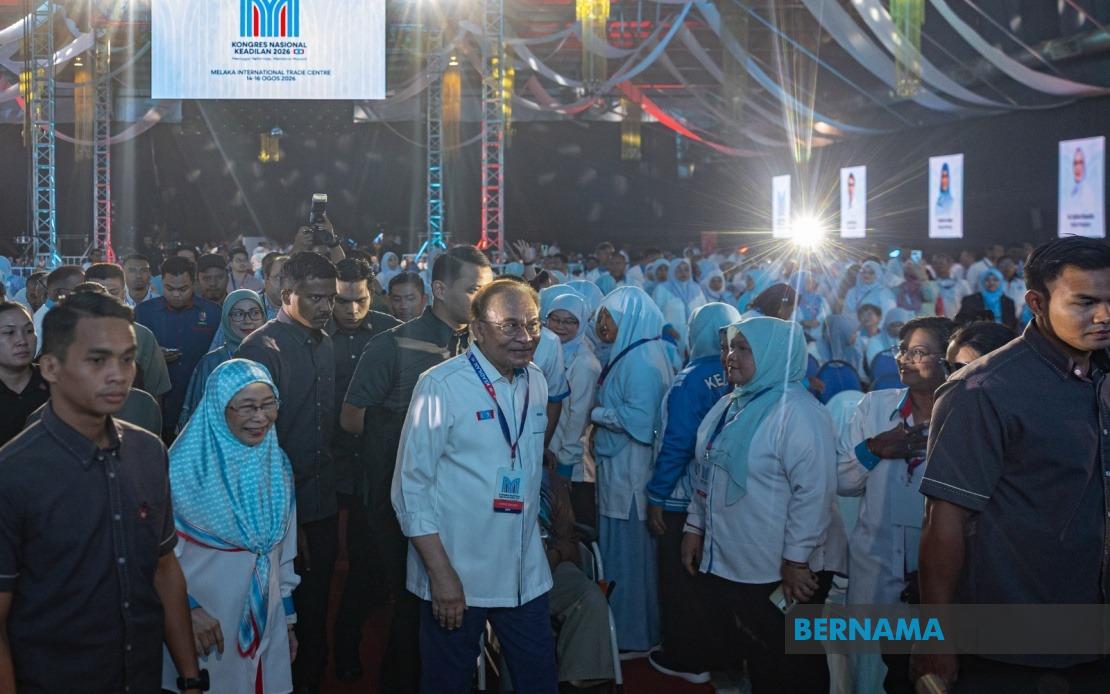
Prime Minister Datuk Seri Anwar Ibrahim has doubled down on his administration's commitment to sustaining the federal coalition partnership with UMNO-Barisan Nasional, framing the continued alliance as essential to Malaysia's political and economic trajectory. Speaking at the PKR National Congress 2026 in Melaka on August 16, Anwar articulated a vision of pragmatic governance in which ideological differences give way to shared objectives of national development and citizen welfare.
The remarks come against a backdrop of periodic tensions within the ruling coalition, where questions about the durability of the Unity Government have surfaced following recent political developments. Anwar's emphasis on deliberate decision-making reflects an acknowledgment that the fragility of multi-party coalitions requires careful stewardship, particularly in a political environment where opportunism and short-term factional gains can destabilise governance structures. His call for wisdom and careful consideration signals an awareness that Malaysia's coalition dynamics remain delicate and susceptible to disruption.
Central to Anwar's message is a rejection of what he characterises as personal ambition and emotionally-driven political calculation. By explicitly stating that decisions should not be motivated by individual interests, positional jockeying, or grievances, the Prime Minister appears to be signalling both to his PKR base and to coalition partners that the government's direction will be determined by technocratic and developmental priorities rather than identity politics or revenge politics. This framing is significant in the Malaysian context, where personality-driven factionalism has historically fractured political movements and compromised policy coherence.
The economic dimension of Anwar's position cannot be understated. By linking coalition stability directly to economic growth and prosperity, he positions continued cooperation with UMNO-BN not as a mere tactical manoeuvre but as a prerequisite for delivering tangible improvements in Malaysians' living standards. For a government grappling with inflation, wage stagnation, and uneven wealth distribution, this connection between political stability and economic performance carries considerable weight. A collapse of the federal coalition would likely trigger political uncertainty that could spook investors and destabilise financial markets, particularly given Malaysia's exposure to global economic volatility.
For UMNO and the broader Barisan Nasional, Anwar's public commitment offers reassurance that despite PKR's dominance in the ruling coalition, the traditional gatekeepers of Malaysian power—represented by UMNO's Malay-Muslim constituency and BN's institutional machinery—retain a permanent place at the governing table. This reassurance matters because UMNO's membership has periodically expressed anxiety about marginalisation or about being subordinated to Anwar's agenda. By emphasising continued partnership at the federal level, Anwar is effectively stating that the coalition is not a temporary arrangement pending PKR dominance but a foundational element of his governance model.
The timing of these remarks at the PKR National Congress is noteworthy, as it allows Anwar to address both party faithful and external audiences simultaneously. For PKR members who may harbour reservations about coalition with UMNO—a party many PKR supporters view as emblematic of the old regime—Anwar's insistence that such partnership serves broader national purposes attempts to reframe the arrangement from capitulation to pragmatism. This rhetorical move is critical for maintaining PKR party discipline and preventing the kind of internal fracturing that could weaken the coalition further.
Anwar's statement also reflects the structural realities of Malaysian coalition politics, where no single party possesses sufficient parliamentary strength to govern in isolation. PKR, while the nominal leader of the ruling coalition, relies on the support of UMNO, the Democratic Action Party (DAP), Amanah, and smaller components to maintain its parliamentary majority. Any rupture in this arrangement would immediately jeopardise the government's legislative agenda and could trigger a political crisis reminiscent of earlier periods of instability. By publicly recommitting to UMNO-BN cooperation, Anwar is attempting to insulate his government against scenarios of opportunistic party-switching or defection.
The implicit acknowledgment that "something has happened recently" suggests ongoing negotiations or disputes within the coalition that required clarification. Without specific details, Malaysian political observers have speculated about potential friction over ministerial positions, policy differences, or resource allocation. Anwar's response—to emphasise principles over personalities—is a standard diplomatic approach, but it also signals that the government intends to resolve disagreements through dialogue rather than ultimatums or confrontation.
For Southeast Asian observers and foreign governments that view Malaysia's political stability as important for regional security and economic integration, Anwar's reaffirmation of coalition commitment carries weight. A collapse of the Unity Government could trigger months of political turmoil and constitutional uncertainty, creating a vacuum that might invite external interference or complicate Malaysia's role in regional institutions such as ASEAN. By projecting continuity, Anwar is implicitly assuring the international community that Malaysia's foreign policy and security commitments remain on stable footing.
Looking forward, the durability of the Unity Government will ultimately depend on whether the underlying incentives for coalition members align with Anwar's articulated vision. If UMNO perceives that it is sacrificing too much—whether in terms of ministerial portfolio distribution, policy influence, or electoral prospects—pressure for coalition reconfiguration could intensify regardless of public affirmations of commitment. Conversely, if the coalition manages to deliver measurable economic improvements and wins the next general election with expanded parliamentary strength, the partnership could become self-reinforcing and institutionalised.
Anwar's emphasis on choosing stability and prosperity over personal considerations represents a deliberate effort to elevate the political conversation above the factionalism and personality cults that have historically dominated Malaysian politics. Whether this rhetorical commitment translates into sustained institutional cooperation will be tested by the practical challenges ahead, from managing economic headwinds to navigating the contentious politics of resource distribution within a multi-party framework that inherently contains conflicting interests and competing visions of national development.

