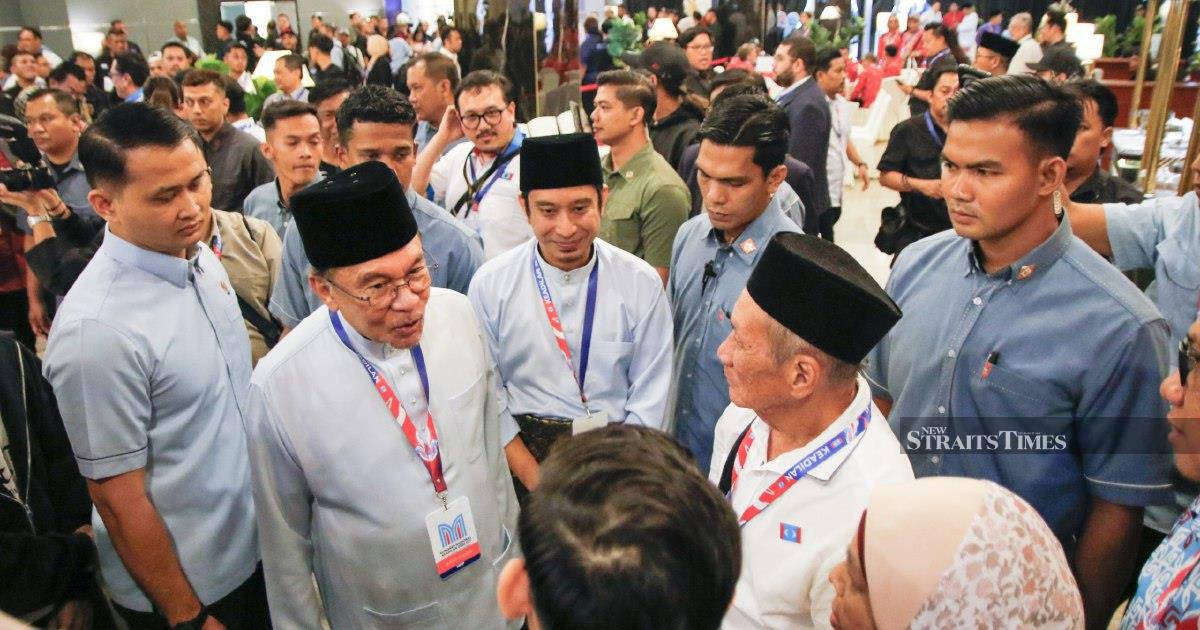
Prime Minister Datuk Seri Anwar Ibrahim sought to defuse mounting speculation about potential discord within Malaysia's top political leadership yesterday, categorically denying that relations between himself and Deputy Prime Minister Datuk Seri Dr Ahmad Zahid Hamidi had deteriorated. Speaking in Ayer Keroh, Anwar characterised the partnership between the two senior figures as solid and operationally sound, projecting an image of unity even as observers have grown increasingly attentive to signs of strain within the ruling coalition.
The timing of Anwar's clarification underscores persistent questions about stability within the federal government. Malaysia's political landscape has historically been vulnerable to fractious relationships between leaders, particularly when coalition partners from different parties occupy apex positions. The deliberate and public nature of Anwar's denial suggests that whispers about potential misalignment had reached sufficient volume to warrant immediate intervention.
The dynamics between Anwar's PKR and Zahid's UMNO, which form the backbone of the current Pakatan Harapan-led administration, have always represented a delicate equilibrium. These two parties, once bitter opponents, agreed to cooperate following the 2022 elections—a marriage of political convenience designed to prevent fragmentation. Any genuine rupture between their respective leaders would pose existential risks to governmental continuity and legislative coherence.
Zahid's position as Deputy Prime Minister carries considerable symbolic weight beyond its ceremonial dimensions. As UMNO president, he commands loyalty among lawmakers from the peninsula's largest Malay-based party, making him an indispensable pillar of the coalition's parliamentary majority. His contentment with his current station directly influences the stability of the government, a reality that likely prompted Anwar's proactive reassurances.
The broader context involves the perpetual negotiation between Anwar's efforts to consolidate executive authority and Zahid's expectation of meaningful influence over national policy and patronage networks. Malaysian politics has always revolved around such power-sharing arrangements, where premiers must balance the competing demands of coalition members while maintaining their own grip on governance. The public reaffirmation of partnership serves as both a genuine statement of functional collaboration and a signal to rank-and-file members of both parties that the government's internal compact remains honoured.
For Malaysian voters and regional observers, such reassurances carry practical implications. Government effectiveness—particularly on economic policy, infrastructure development, and service delivery—depends substantially on coherent leadership. Persistent infighting at cabinet level, even if unspoken, tends to filter down through bureaucratic channels, diluting the implementation of policy initiatives and creating bottlenecks in decision-making processes that affect ordinary citizens.
The statement also reflects the precarious mathematics of Malaysian parliamentary governance. With a slim majority, the government cannot afford open division among its senior representatives. Any visible crack in the leadership structure invites opportunistic manoeuvres from opposition parties seeking to exploit divisions or from backbench members contemplating defection. Anwar's clarification thus serves a vital stabilising function, reassuring nervous coalition partners and cautious MPs that the executive remains unified and capable of delivering legislative priorities.
These kinds of public denials have become almost ritualistic in Malaysian politics, appearing whenever the press or political observers note any deviation from seamless harmony. The frequency with which such statements become necessary often indicates, paradoxically, an underlying brittleness beneath the surface. That Anwar felt compelled to address the matter at all suggests the speculation had become consequential enough to require mitigation.
The phenomenon extends beyond personalities to encompass the broader challenge facing Malaysia's multiparty democracy. Coalition governments inherently generate friction because component parties maintain distinct ideological constituencies and internal power dynamics that do not always align with overall governmental objectives. Successfully managing such arrangements requires constant communication, negotiation, and calculated compromise—a reality that sometimes becomes visible to the public eye.
Moving forward, observers will watch for concrete indicators of whether stated unity translates into coordinated action on key initiatives. Policy announcements, budget allocations, and legislative priorities advanced by both the Prime Minister's office and the Deputy Prime Minister's portfolio will provide more reliable signals than verbal reassurances. In Malaysian governance, actions ultimately carry far greater weight than denials.
The reassessment of leadership cohesion also matters for Malaysia's international standing and regional stability. Foreign investors and regional partners monitor political stability closely when evaluating long-term commitments to Malaysian assets and initiatives. Persistent questions about governmental harmony could marginally elevate perception of political risk, potentially affecting the investment climate. Anwar's statement attempts to address such external concerns alongside domestic political management.
Ultimately, while the Prime Minister's public affirmation provides momentary clarity, the underlying tensions inherent to Malaysia's coalition structure will continue generating periodic anxiety. The sustainability of the current arrangement will depend less on rhetoric and more on whether Anwar and Zahid can continue calibrating their respective ambitions within a shared governmental framework.

