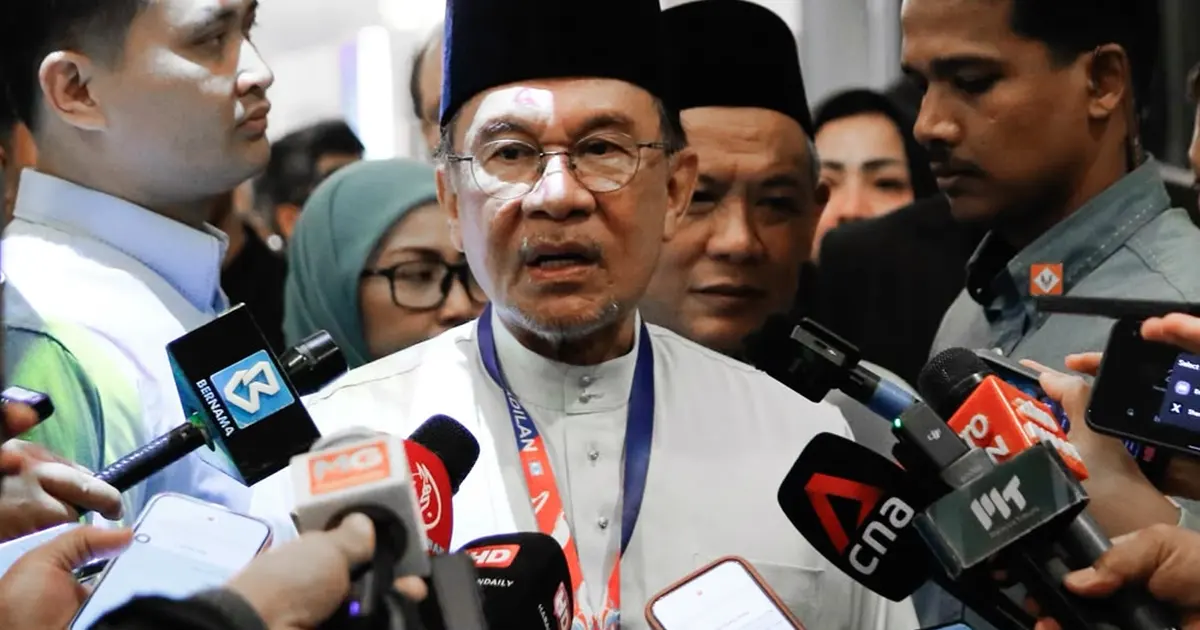
Prime Minister Anwar Ibrahim has moved to contain political friction within the ruling coalition by firmly denying that interpersonal trust issues exist between him and Deputy Prime Minister Zahid Hamidi, instead attributing critical remarks to differing philosophical approaches among coalition members.
The prime minister's clarification comes directly in response to observations made by Khairy Jamaluddin, the former Umno Youth chief, who had aired his concerns during a podcast appearance. Rather than validating Khairy's perspective as representative of cabinet-level thinking, Anwar positioned the remarks as Khairy's own interpretation, suggesting that the former youth leader and the government leadership occupy different vantage points when assessing the same political developments.
This carefully calibrated response underscores the delicate equilibrium that Anwar must maintain within Malaysia's multi-party government structure. The coalition that brought him to office comprises multiple political factions with sometimes competing interests and ideological leanings. By distinguishing between personal viewpoints held by individual members and the government's collective stance, Anwar appears intent on preventing localized disagreements from escalating into broader coalition tensions that could destabilise his administration.
Khairy's podcast comments had raised questions about the coherence of the Anwar-Zahid working relationship, matters of particular sensitivity given that both men hail from different political traditions and backgrounds. The two serve together at the apex of executive authority, and any perceived friction between them invites speculation about whether the coalition's policy coordination mechanisms are functioning smoothly. Such perceptions, if left unchecked, can undermine confidence among coalition partners and the general electorate regarding governmental stability.
Anwar's approach reflects a broader political communication strategy that acknowledges disagreement without amplifying it. By framing the disagreement as rooted in different perspectives rather than personal animosity or institutional dysfunction, he attempts to normalise the existence of diverse viewpoints within government while simultaneously maintaining that core decision-making remains unified. This nuance matters significantly in Malaysian politics, where coalition management has historically been as important to executive success as policy implementation.
The incident also highlights the particular position occupied by figures like Khairy, who despite stepping back from formal youth leadership roles, retain platforms and audiences through digital media. His podcast comments, which evidently reached enough prominence to warrant prime ministerial response, illustrate how contemporary Malaysian political discourse extends beyond parliamentary chambers and official statements into social media channels and independent platforms. This fragmentation of political communication venues creates both opportunities and risks for established leaders seeking to control narrative.
For the Deputy Prime Minister Zahid specifically, Anwar's defence represents valuable public affirmation of confidence in their working relationship. Having previously served prison time on corruption-related charges before his eventual acquittal and rehabilitation as a key coalition figure, Zahid remains a figure of considerable political complexity. Any perception that the prime minister harbours doubts about him could reactivate questions about his role within government and whether he commands genuine authority or merely occupies a titular position. Anwar's explicit dismissal of such concerns strengthens Zahid's standing within cabinet and among Umno's electoral base.
The exchange also touches on deeper questions about how coalition governments articulate their identity and purpose. When former party leaders like Khairy, who no longer hold executive office, make critical observations about government functioning, are they representing silent doubts within their party organisations, or are they simply offering individual commentary? Anwar's response implicitly argues for the latter interpretation, yet such distinctions can blur in political contexts where party structures and government structures overlap significantly.
Looking ahead, this incident may have implications for how other coalition members navigate the balance between internal party perspectives and public loyalty to the government. Khairy's willingness to voice concerns through public platforms suggests that coalition members retain some latitude to express critical views, yet Anwar's swift and direct response equally demonstrates that the prime minister will actively contest interpretations he views as misrepresenting the government's internal dynamics or his personal relationships with key cabinet ministers.
The episode underscores the ongoing challenge facing Malaysia's coalition government in presenting unity to the electorate while accommodating the legitimate policy debates and personality dynamics that characterise any multi-party administration. As Anwar continues navigating these tensions, his ability to respond firmly to suggestions of internal discord while respecting coalition members' right to individual perspectives will likely remain crucial to maintaining governmental stability and coalition cohesion throughout his tenure.

