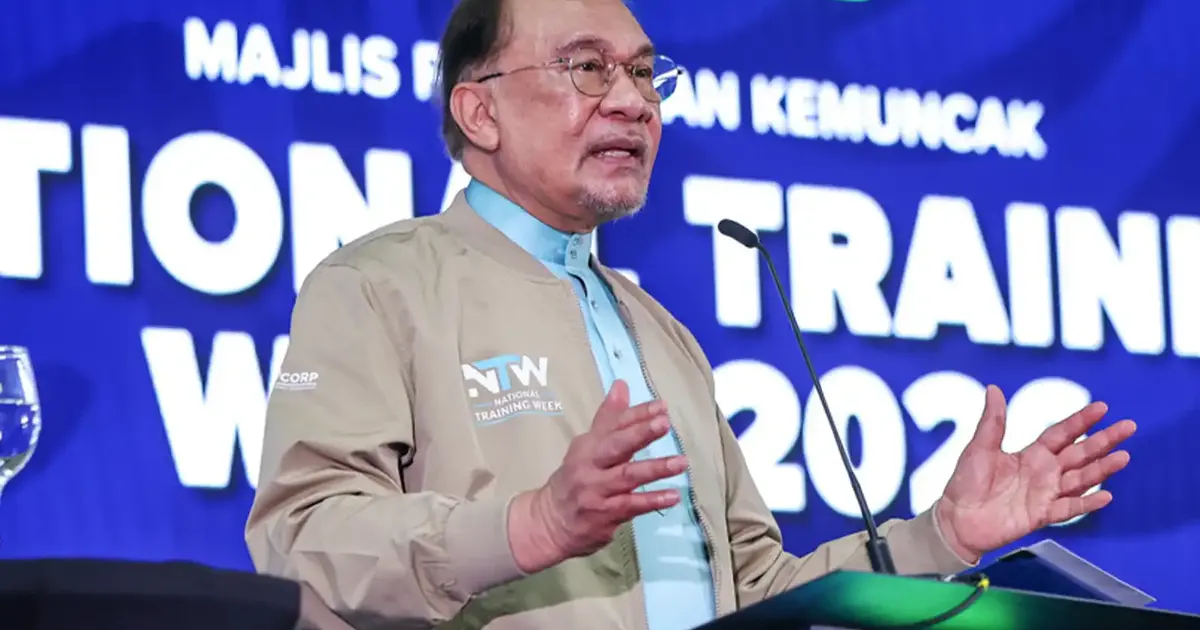
Prime Minister Anwar Ibrahim has rebuked remarks made regarding the patriotism of Malaysia's Chinese and Indian communities, defending their standing as steadfast members of the national fabric. The premier's intervention signals mounting tension within ruling coalition ranks over sensitive matters touching on ethnicity and constitutional loyalty, matters that typically require careful navigation in Malaysia's plural society.
Anwar's defence came in response to statements attributed to Kedah Menteri Besar Muhammad Sanusi Md Nor that questioned or cast doubt upon the dedication of non-Malay Malaysians to the nation. Such observations touch directly on one of Malaysia's foundational political anxieties—the question of belonging and allegiance among communities that comprise roughly 40 per cent of the population combined. The PM's sharp reaction underscores his determination to counter narratives that marginalise or stigmatise citizens by ethnicity.
The premier emphasised that Malaysian Chinese and Malaysian Indian citizens consistently demonstrate their respect for the Federal Constitution, the supreme law binding all inhabitants. This framing grounds loyalty not in primordial identity categories but in adherence to agreed civic institutions—a legalistic rather than communal approach that has long represented the constitutional settlement Malaysia negotiated at independence. By invoking the constitution explicitly, Anwar positioned his argument within the framework that all communities theoretically accept.
The dispute carries particular weight given the fragile composition of Malaysia's current governing coalition. Perikatan Nasional, which controls Kedah, operates as part of a broader multi-ethnic political arrangement that requires careful balance. When senior figures within coalition components make statements touching ethnic fault-lines, they risk destabilising the delicate equilibrium upon which the government rests. Anwar's public rebuke suggests the PM views such rhetoric as threatening to coalition cohesion and broader national stability.
Malaysia's history demonstrates the inflammability of discourse around ethnic loyalty. The social contract underpinning the 1957 independence settlement attempted to define belonging through a bargain—Malays would accept citizenship for all communities in exchange for constitutional recognition of Malay-Muslim privileges. Seventy years later, periodic questioning of non-Malay commitment to the nation resurrects anxieties that the bargain might unravel, even though economic interdependence and generational change have substantially transformed Malaysian society.
Anwar's intervention also reflects his personal political trajectory. As a leader who has positioned himself as representing inclusive multiculturalism against more communally-fractured alternatives, the PM has stakes in maintaining a narrative of shared belonging. His previous detention and the role of various ethnic communities in supporting his rehabilitation have shaped his political identity. Public defense of non-Malay loyalty aligns with his political brand and base.
The timing of this dispute also matters in Malaysia's political calendar. Coalition stability remains contested, with periodic defections and realignments threatening government majority. Statements that alienate non-Malay voters or MPs risk pushing fence-sitters toward opposition benches. For Anwar, defending non-Malay communities serves both principled and tactical purposes—reinforcing the coalition's multiracial character while signalling to non-Malay constituencies that they retain voice within the governing arrangement.
Sanusi's Kedah government, controlled by Perikatan Nasional rather than Anwar's PKR-led faction, occupies a distinct political space. The Kedah menteri besar's remarks may reflect not accidental insensitivity but calculated positioning toward his own political base, where communal appeals resonate strongly. This dynamic—where coalition partners speak differently to different constituencies—creates tensions that the PM's public rebuke attempts to manage.
For Malaysian readers, this episode illustrates an ongoing tension in national politics. Despite rhetorical commitments to unity, politicians periodically test the boundaries of acceptable discourse around ethnicity and belonging. Each such instance prompts repositioning by other leaders, creating a public conversation that simultaneously reaffirms founding principles while revealing their fragility. Anwar's defense of non-Malay loyalty functions as damage control and as a statement about how the PM wishes his government to be understood.
The constitutional framework Anwar invoked remains the neutral ground upon which Malaysian multiracialism technically rests. Yet constitutions derive meaning from political actors' interpretations and the investment diverse groups maintain in them. By explicitly connecting non-Malay citizens to constitutional loyalty, Anwar sought to recentre the conversation on legal obligations and shared civic identity rather than ethnically-rooted questions of belonging that carry far greater volatility.
Looking forward, this disagreement within ruling coalition ranks highlights the persistent challenge of managing ethnic sensitivities in Malaysian politics. While Anwar's intervention represents the dominant voice within federal leadership, it does not necessarily settle the matter within communities or within the broader political ecosystem where Perikatan Nasional and other players maintain influence. The episode demonstrates that questions of loyalty and belonging remain contested, despite over six decades of independent nationhood.

