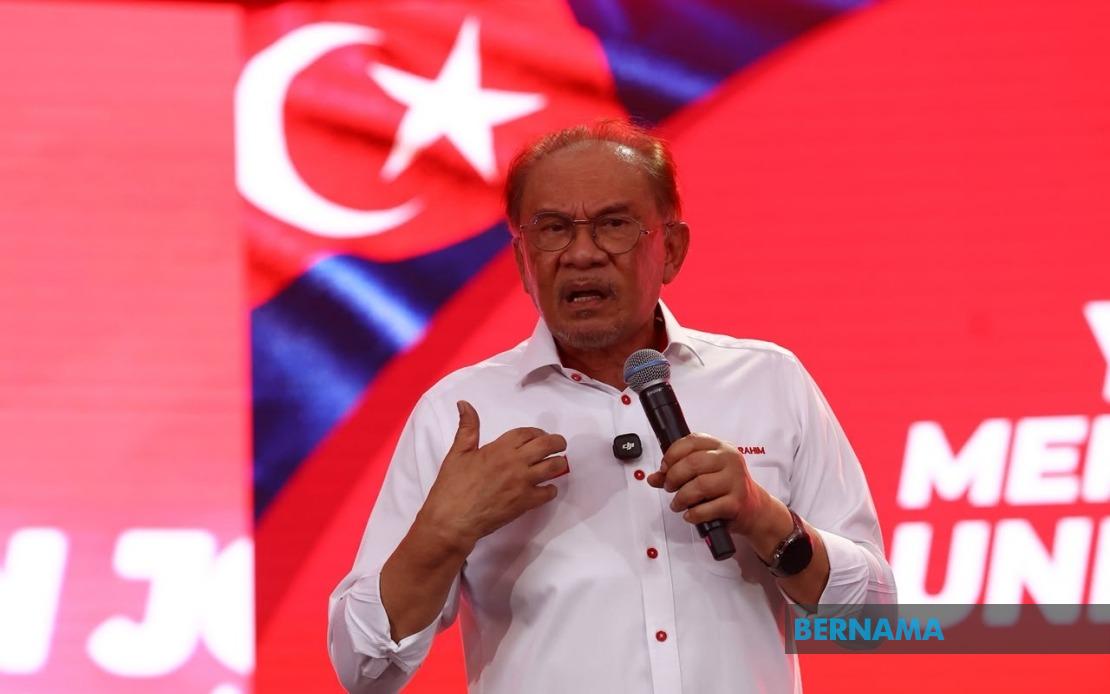
Prime Minister Datuk Seri Anwar Ibrahim has firmly rejected social media claims suggesting he acquired a luxury BMW vehicle for private purposes, calling the allegations baseless and deliberately misleading. Speaking during a campaign event in Senggarang, Batu Pahat on July 9, the premier addressed the growing speculation with uncharacteristic directness, questioning why detractors would circulate false information about his vehicle ownership when the facts were already in the public domain.
The controversy centres on a BMW previously associated with the prime minister's official transport, which online commentators alleged was a newly purchased personal acquisition despite Anwar's well-documented public messaging around poverty alleviation and anti-corruption. Anwar's response was two-fold: first, he categorically denied the purchase claim, emphasising that the vehicle in question was not new but rather an existing asset within the government fleet. This distinction matters considerably in Malaysian political discourse, where accusations of elite excess and misappropriation of public resources remain potent weapons in campaign season rhetoric.
Equally significant was Anwar's elaboration on the Mercedes-Benz vehicle he currently uses for official duties. The premier revealed that the luxury sedan was bestowed upon him as a personal gift by His Majesty Sultan Ibrahim, King of Malaysia—a detail that fundamentally reframes the narrative around his transport arrangements. Rather than claiming personal ownership, however, Anwar stated that he deliberately registered the vehicle under the Prime Minister's Department, a bureaucratic choice that signals his intent to treat even royal gifts as state assets rather than personal property.
This decision to register the royal gift through official channels rather than his personal name carries symbolic weight within Malaysia's contemporary political environment. The move appears calculated to preempt precisely the sort of accusations now circulating online, demonstrating what Anwar presented as a principled distinction between his conduct and that of other senior leaders. In his remarks, he drew an implicit contrast with unnamed predecessors or rivals, suggesting that where others might "siphon off and steal the people's money," his approach prioritises institutional accountability and public interest over personal enrichment.
The Prime Minister's Department and the Ceremonial and International Conference Secretariat Division released a formal statement on Monday affirming that the BMW in question represented existing government infrastructure rather than a fresh procurement. According to this official clarification, the vehicle falls within BIUPA's management portfolio and was designated specifically for official government logistics purposes. This bureaucratic confirmation lends institutional weight to Anwar's personal denial, though it does not entirely extinguish the underlying question of why such vehicles merit significant public expenditure when fiscal constraints elsewhere require austerity measures.
Anwar's comments came during the 'Yok! Meriahkan Johor! Undi Harapan' programme, a Pakatan Harapan campaign initiative aligned with mobilisation efforts for the 16th Johor state election. The timing reveals how vehicle ownership narratives have become intertwined with electoral strategy in Malaysia's contemporary political landscape. Campaign events now routinely address such allegations, suggesting that accusations of executive extravagance resonate sufficiently with voters to warrant direct prime ministerial response. This dynamic underscores the heightened sensitivity around government spending and leadership conduct that characterises post-2018 Malaysian politics.
The event drew attendance from senior coalition figures including Communications Minister Datuk Fahmi Fadzil, who also serves as Pakatan Harapan's communications director. The presence of ministerial personnel at what was ostensibly a campaign rally reflects how closely integrated government and party machinery have become, particularly during electoral periods. Alongside Fahmi Fadzil were coalition candidates contesting three state seats: Onn Abu Bakar for Senggarang, Mohd Khuzzan Abu Bakar for Semerah, and Felicia Poh Rui Ling for Penggaram.
Packatan Harapan is contesting all 56 seats in the Johor state assembly, with polling scheduled for Saturday. This comprehensive electoral engagement represents the coalition's determination to consolidate its position in one of Malaysia's most significant state governments. The vehicle controversy, though seemingly peripheral to substantive policy questions, illustrates how easily campaign narratives can be derailed by unverified social media claims during tight election schedules. For a coalition already navigating complex electoral mathematics and internal coalition dynamics, such distractions carry measurable strategic costs.
The broader context involves sustained public scrutiny of governmental spending and leadership accountability that has intensified since Malaysia's 2018 political transition. Citizens and opposition figures have grown more willing to interrogate official vehicle acquisitions and asset management practices, particularly when those assets carry prestige markers associated with luxury brands. Anwar's administration has ostensibly embraced greater transparency in some areas, yet controversies like this one demonstrate how official explanations sometimes struggle against the velocity and reach of social media allegations.
The distinction between new and existing assets, between personal registration and departmental registration, between gift and purchase—these technical differentiations form the architecture of Anwar's rebuttal. Yet from a communications perspective, such nuances may insufficiently address underlying voter concerns about executive conduct and resource allocation. The fact that such questions require prime ministerial intervention during campaign season suggests that public confidence in automatic institutional safeguards remains fragile.
Looking forward, this episode illuminates persistent challenges facing Malaysia's political leadership across the spectrum: the difficulty of controlling narratives in digitally distributed information environments, the continued salience of anti-corruption messaging even as formal safeguards are implemented, and the capacity of ostensibly technical administrative matters to become flashpoints in electoral competition. For observers tracking the trajectory of Malaysian governance and political culture, such moments reveal the ongoing tension between aspirations toward institutional professionalism and the reality of high-stakes partisan contestation.

