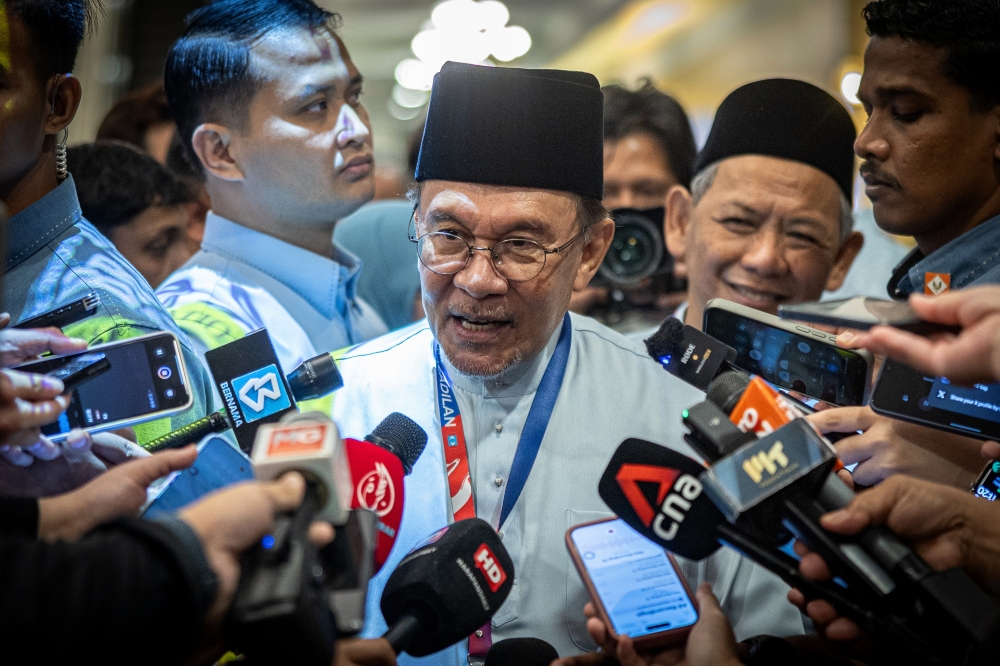
Prime Minister Datuk Seri Anwar Ibrahim has moved to quell persistent speculation about internal tensions within Malaysia's ruling coalition, dismissing recent claims by senior politician Khairy Jamaluddin that discord exists between his administration and Deputy Prime Minister Zahid Hamidi. Speaking in Melaka on August 15, Anwar reiterated his commitment to addressing governance challenges through dialogue and consensus-building rather than public confrontation, underscoring a leadership philosophy that has become increasingly central to his political identity.
The Prime Minister's intervention follows comments attributed to Khairy suggesting cracks within the coalition partnership, a narrative that has periodically surfaced in Malaysia's fractious political landscape. Rather than engage in detailed rebuttals, Anwar chose to emphasise the peaceful nature of his approach to coalition management, implicitly rejecting the framing that internal disagreements necessarily indicate fundamental instability. This measured response reflects a deliberate communication strategy designed to reassure investors, international partners, and domestic stakeholders that Malaysia's political establishment remains functional despite occasional policy disagreements.
Anwar's relationship with Zahid, the Deputy Prime Minister and President of the United Malays National Organisation (UMNO), represents a linchpin holding together the broader Pakatan Harapan-UMNO coalition that governs Malaysia. Any significant rupture between these two figures would threaten the stability of the government and potentially trigger early elections. The Prime Minister's public affirmation of their working relationship therefore serves a crucial stabilisation function, signalling to cabinet members, party grassroots, and international observers that the administration retains sufficient cohesion to deliver on policy commitments.
The recurring speculation about coalition tensions reflects deeper structural fragilities within Malaysia's multi-party governing arrangement. The coalition brings together ideologically distinct parties—Pakatan Harapan comprises social democrats and reform-minded figures, while UMNO represents a more conservative, Malay-Muslim-centric political tradition. These fundamental differences occasionally surface as disagreements over economic policy, religious affairs, or the pace of institutional reform. Managing these tensions without allowing them to spiral into government-threatening crises requires constant negotiation and strategic communication.
Anwar's invocation of a "peaceful path" carries particular symbolic weight given Malaysia's recent political history. The country has experienced numerous instances of coalition collapse, early elections, and transitions driven by behind-the-scenes maneuvering rather than democratic mechanisms. By publicly committing to dialogue-based conflict resolution, Anwar positions himself as a stabilising force distinct from predecessors whose tenures were marked by political machinations. This positioning appeals to technocratic elites concerned about economic uncertainty and international investors seeking predictable governance.
The timing of Anwar's remarks matters considerably, emerging as Malaysia navigates external economic headwinds including regional supply chain disruptions and global monetary tightening. Coalition stability directly impacts the government's ability to implement economic reforms, attract foreign direct investment, and maintain policy continuity. Any perceived weakness in the ruling partnership tends to amplify currency volatility and investor hesitation. By publicly cementing relationships with key coalition partners, the Prime Minister addresses these economic dimensions of political stability.
Khairy Jamaluddin, the former Health Minister and prominent UMNO intellectual, occupies a distinctive position within Malaysia's political ecology. His observations about coalition dynamics carry weight partly because he is regarded as an insider with access to senior party discussions. His comments reportedly suggesting friction may reflect genuine concerns circulating within UMNO ranks about the balance of power within the coalition, or alternatively may have been strategic messaging aimed at reasserting UMNO's relevance within a government dominated by Pakatan figures. Anwar's dismissal of these claims, coupled with affirmation of his relationship with Zahid, implicitly validates UMNO's continued importance to the governing arrangement.
The broader significance of this exchange extends beyond immediate cabinet dynamics. Malaysia's coalition government represents an experiment in post-election power-sharing that defies conventional two-party competition models. Success or failure of this arrangement will influence how Southeast Asian democracies manage deeply polarised electorates and ideologically fragmented party systems. Should the Malaysian coalition eventually collapse or deteriorate significantly, regional observers would likely conclude that sustaining multi-bloc governing arrangements across extended periods proves untenable, encouraging countries facing similar political fragmentation toward more authoritarian or majoritarian solutions.
Anwar's philosophical emphasis on peaceful conflict resolution also signals something about his personal political brand and legacy aspirations. Having experienced political imprisonment and years in opposition, the Prime Minister appears invested in demonstrating that Malaysia can be governed through reasoned debate and institutional procedures rather than the factionalism and character-driven conflicts that have historically dominated Malaysian politics. This aspirational dimension to his messaging matters as much as the immediate coalition management objective, creating a narrative space in which ordinary Malaysians might imagine governance conducted differently than historical precedent suggests.
Looking forward, the sustainability of the present coalition arrangement depends substantially on whether underlying policy disagreements can be managed through the institutional and communication mechanisms Anwar champions. Economic performance will likely prove decisive—sustained growth and improved living standards would validate his peaceful approach and strengthen his authority within both his own party and the broader coalition. Conversely, economic stagnation would intensify factional pressures and make Anwar's dialogue-based consensus-building approach appear increasingly inadequate, potentially reviving more aggressive coalition jockeying.

