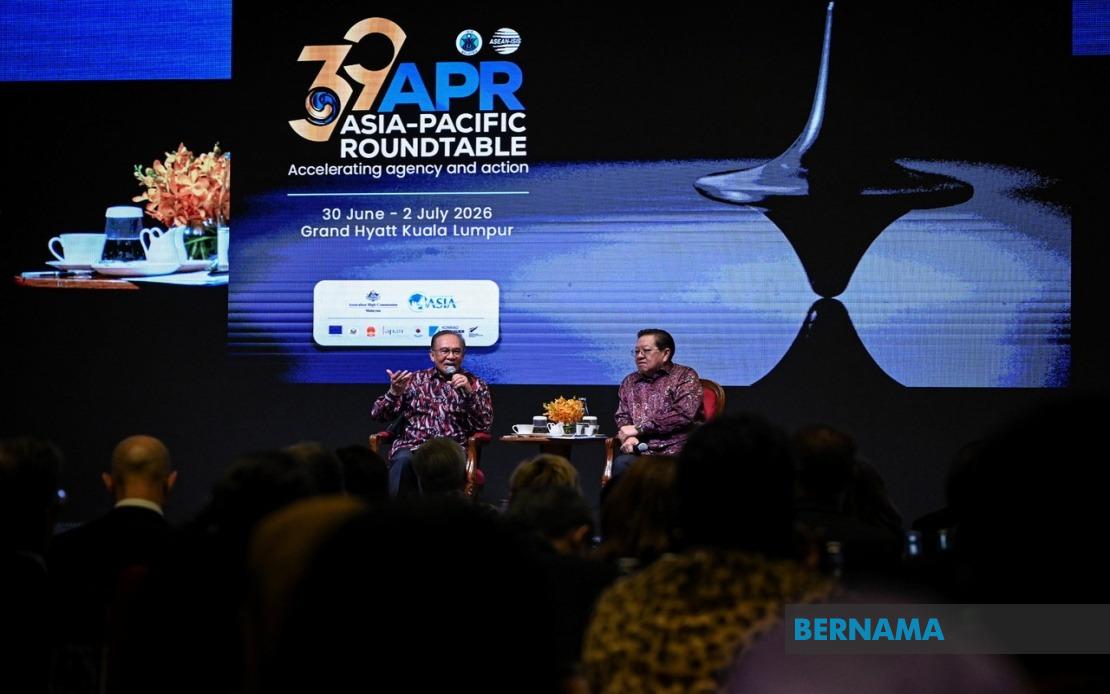
Prime Minister Datuk Seri Anwar Ibrahim has firmly pushed back against the pervasive narrative that military confrontation in the South China Sea is an inescapable outcome, asserting instead that regional stability depends on sustained dialogue, institutional trust, and principled adherence to international legal frameworks. Speaking during a question-and-answer segment at the 39th Asia-Pacific Roundtable in Kuala Lumpur on Thursday, Anwar articulated Malaysia's pragmatic approach to maritime tensions that have long troubled Southeast Asian capitals, framing the region's disputed waters not as a powder keg awaiting ignition but as a zone where competing interests can be managed through statecraft and good faith negotiation.
The Prime Minister's remarks represent a deliberate counterweight to alarmist assessments that have gained traction in strategic analyses and international media coverage. Anwar acknowledged the existence of maritime disagreements but demonstrated confidence that these disputes need not escalate into military confrontation, citing Malaysia's own experience of substantive and constructive engagement with Beijing. His personal interactions with President Xi Jinping and Premier Li Qiang have reportedly yielded diplomatic exchanges characterised by mutual respect rather than acrimony, according to his account. Anwar underscored that despite the existence of overlapping territorial claims and resource competition, Malaysia-China relations have remained robust without descending into serious friction or provocative standoffs.
Central to Anwar's argument is the assertion that China has publicly endorsed the United Nations Convention on the Law of the Sea, the fundamental legal instrument governing maritime rights and responsibilities globally. This endorsement, Anwar suggested, provides a shared reference point for resolving differences and establishes mutual expectations for behaviour in disputed zones. Additionally, the ongoing negotiation of an ASEAN-China Code of Conduct represents collaborative progress toward establishing explicit rules of engagement that can mitigate misunderstandings and prevent miscalculation. Rather than treating this process as symbolic gesturing or a stalling tactic, Anwar framed it as meaningful architecture for peaceful coexistence that deserves continued support and momentum.
The Prime Minister explicitly cautioned against the proliferation of narratives that sensationalise the prospect of regional warfare. Such discourse, he suggested, risks becoming self-fulfilling when it unduly influences policy decisions, military procurement strategies, and threat perceptions among governments. Anwar called for ASEAN to maintain unwavering commitment to its established diplomatic traditions and mechanisms, which have successfully preserved peace across the bloc for decades despite the region's considerable diversity and occasional bilateral tensions. This institutional memory and proven track record, he argued, should inform current approaches to South China Sea management rather than worst-case scenario planning dominating strategic thinking.
Anwar identified a critical success factor in ASEAN's historical ability to manage conflicts: the habit of direct communication among regional leaders who can address emerging issues before they metastasise into formal disputes. This personal diplomacy channel, he suggested, remains underutilised and under-appreciated in contemporary discussions of Southeast Asian security architecture. When leaders maintain regular contact and cultivate relationships of mutual understanding, differences can be compartmentalised and prevented from poisoning the broader relationship. The centrality of human relationships to regional stability, rather than institutional mechanisms alone, underscores the importance of investment in sustained high-level engagement.
Beyond the South China Sea specifically, Anwar extended his diplomatic optimism to other historical disputes affecting Southeast Asia. He welcomed Cambodia and Thailand's commitment to continuing border negotiations, characterising their decades-old boundary disagreements as legacies of colonialism rather than contemporary geopolitical conflicts. This framing is analytically important because it suggests that many territorial disputes in the region have deep historical roots unconnected to present-day great power competition, and therefore are amenable to settlement through patient diplomacy rather than military posturing. Historical framing can actually facilitate resolution by depoliticising disputes and situating them within a shared regional narrative of decolonisation and nation-building.
The Prime Minister expressed confidence that sustained dialogue and reciprocal trust would ultimately enable Cambodia and Thailand to achieve peaceful settlement of their border issues. This optimism, while not naive about the genuine complexity involved, reflects a belief that time and continued engagement favour resolution over indefinite stalemate. For Malaysian and broader Southeast Asian audiences, this message carries particular resonance given that Malaysia itself has successfully managed bilateral maritime boundaries with neighbours including Thailand and Singapore through negotiated agreements that, while not entirely satisfying all parties, have prevented serious tension and maintained economic and security cooperation.
Anwar's remarks also gestured toward a broader reform agenda affecting global institutions and multilateral arrangements. He signalled that Malaysia and ASEAN would continue advocating for institutional reforms at the United Nations and World Trade Organisation, institutions that shape the rules governing international commerce and security. This agenda acknowledges that regional peace cannot be secured in isolation but depends on equitable and legitimate global governance structures that command the consent of developing nations. Southeast Asian countries have long felt that these institutions, established in the post-1945 order, insufficiently represent their interests and voice, and that modernisation of these bodies is essential for sustained international stability.
The substance of Anwar's position reflects Malaysia's particular strategic interests and geopolitical positioning. As a maritime nation with significant economic dependence on freedom of navigation and as a country with its own South China Sea claims, Malaysia has incentives to avoid military escalation that could disrupt trade, investment, and regional prosperity. Yet the Prime Minister's emphasis on dialogue and institutional frameworks transcends mere national interest and speaks to a broader Southeast Asian conviction that the region's future depends on managing great power competition through established mechanisms rather than allowing regional space to become a theatre for external power struggles.
For Malaysian policymakers and the broader ASEAN community, Anwar's articulation of a dialogue-centred approach provides intellectual and political cover for continued engagement with China despite American pressure for more confrontational stances toward Beijing. The argument that conflict is neither inevitable nor desirable offers a middle path that many Southeast Asian governments prefer, enabling continued economic cooperation with China while maintaining security partnerships with Western powers. This balancing act, always delicate, requires consistent messaging that conflict is not predetermined and that peaceful coexistence remains achievable.
The emphasis on ASEAN unity and institutional mechanisms also reflects recognition that individual Southeast Asian nations lack the military capacity to resist Chinese pressure if it materialises, making collective action and diplomatic solidarity essential. By stressing the success of ASEAN's conflict management record and the centrality of dialogue, Anwar reinforces institutional arrangements that give smaller nations greater voice and protection than bilateral arrangements with major powers would provide. This institutional emphasis is as much about protecting Southeast Asian interests in the evolving regional order as it is about promoting abstract principles of peaceful coexistence.

