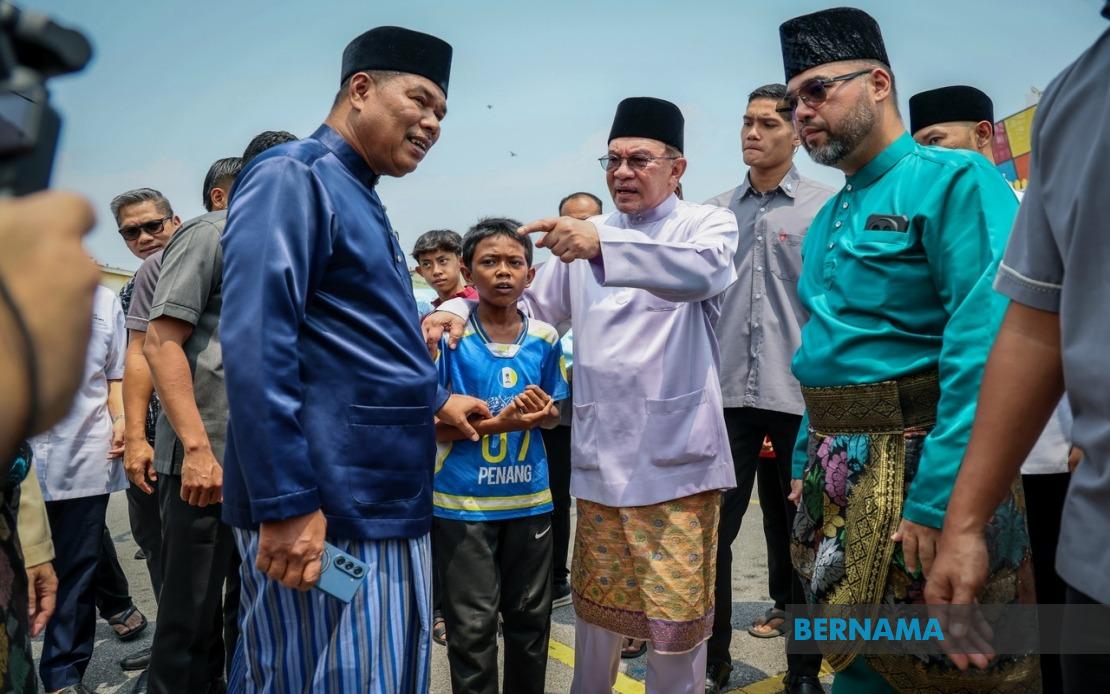
Prime Minister Datuk Seri Anwar Ibrahim has made clear that the corruption investigation and subsequent legal proceedings against former Human Resources Minister Datuk Seri M. Saravanan are strictly a matter for the country's independent anti-corruption and prosecutorial agencies, not his office. Speaking after Friday prayers at Masjid Sembilang in Butterworth on August 28, Anwar drew a firm boundary between his executive role and the judicial process, emphasising that once cases enter the formal investigation and prosecution stage, they fall outside his purview entirely.
The Prime Minister's statement came in response to media questions about a letter Saravanan had submitted to him regarding his ongoing legal troubles. Anwar clarified that he intends to defer completely to the Malaysian Anti-Corruption Commission (MACC) and the Attorney-General's Chambers (AGC) on all matters pertaining to the former minister's case. This measured approach reflects broader principles of institutional separation that the government has sought to establish and maintain in its anti-corruption efforts since taking office.
Saravanan himself had previously emphasised that his letter to the Prime Minister carried no request for preferential treatment or case dismissal. Instead, the former minister framed his communication as an opportunity to present his perspective on the allegations against him, a distinction that underscores the delicate balance between maintaining access to high office and respecting due process. The distinction, however subtle, appears designed to protect both parties from suggestions of impropriety or political interference in what constitutes a serious criminal matter.
Just hours before Anwar's remarks, Saravanan appeared before the Kuala Lumpur Sessions Court, where he entered a not guilty plea to three separate corruption charges. These charges relate to alleged financial improprieties totalling RM1.097 million and are specifically linked to the approval processes governing foreign worker quotas. The specificity of the allegations—centring on administrative decisions that fall directly under the purview of the Human Resources Ministry—adds weight to the seriousness of the accusations and the need for thorough investigation.
The foreign worker quota system represents a critical economic lever in Malaysia, affecting labour supply across multiple sectors and influencing bilateral relationships with source countries. Any suggestion of corruption in this domain carries implications beyond the individual case, touching on governance integrity, Malaysia's international standing on anti-corruption measures, and investor confidence in the fairness of administrative processes. This broader context makes the separation between political oversight and prosecutorial independence particularly important.
Anwar's approach reflects a deliberate effort to insulate the Prime Minister's office from accusations of either political vendetta or protective intervention. By consistently redirecting questions about Saravanan's case to MACC and AGC, the government positions itself as committed to allowing independent agencies to function without interference. This stance carries particular significance given Malaysia's historical challenges with judicial independence and political influence over prosecutions—concerns that have been central to the country's anti-corruption reform agenda.
The MACC, as the primary investigative body, holds responsibility for determining whether the evidence warrants prosecution. The Attorney-General's Chambers, meanwhile, manages the actual legal proceedings and maintains discretion over case strategy and sentencing recommendations. By explicitly placing authority with these institutions, Anwar signals confidence in their institutional integrity while simultaneously protecting his administration from potential criticism from either direction—accusations of persecution or allegations of complicity.
For Malaysian observers and those monitoring the country's governance trajectory, these moments of institutional clarity matter significantly. The separation between the Prime Minister's political authority and the independence of prosecutorial bodies represents a foundational principle of democratic accountability. Repeated affirmations of this principle, particularly in high-profile cases involving senior former government officials, contribute to building a political culture where such boundaries are understood and respected rather than treated as obstacles to overcome.
The implications extend across the region as well. Malaysia's approach to handling senior-level corruption cases influences perceptions of governance quality that affect foreign investment, regional diplomatic relationships, and the broader Southeast Asian conversation about accountability standards. Countries throughout the region facing their own challenges with corruption watch how established regional economies manage sensitive cases involving former ministers, using these examples to calibrate their own institutional approaches.
As Saravanan's case proceeds through the courts, the distinction between political leadership and judicial process will likely become increasingly significant. Future proceedings may generate additional scrutiny and pressure, but Anwar's consistent positioning—that these matters belong properly with MACC and AGC—establishes a clear framework for understanding where responsibility and authority lie. This clarity, while perhaps frustrating to those seeking rapid resolution or political leverage, serves the longer-term institutional health that anti-corruption reform efforts seek to achieve.

