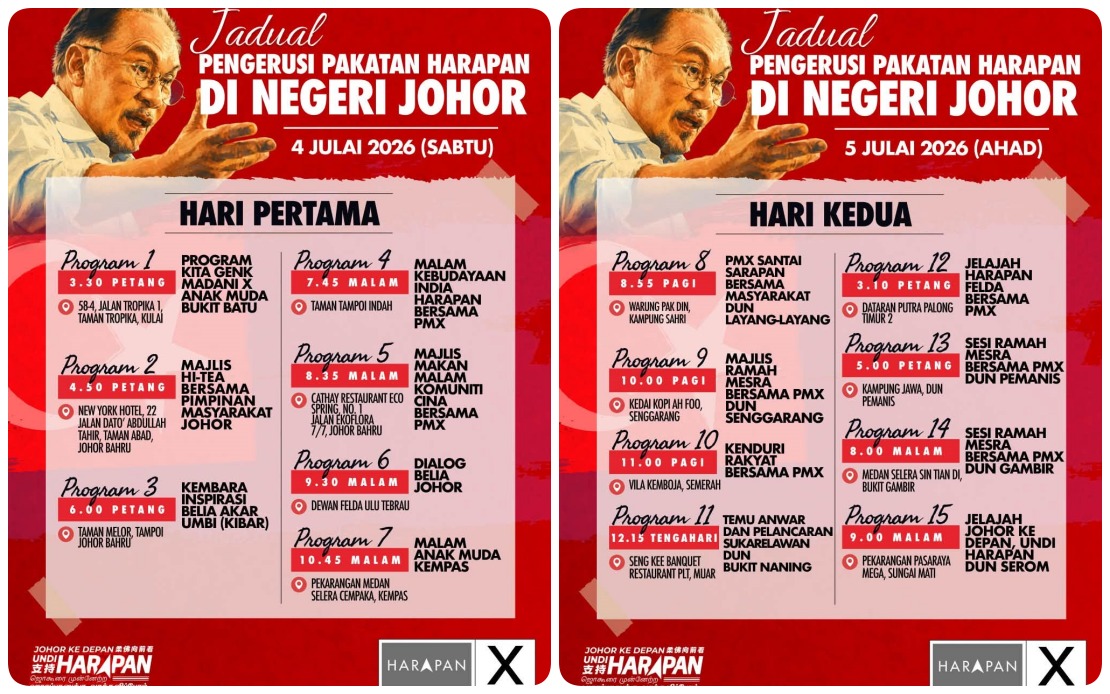
Prime Minister Anwar Ibrahim is throwing his considerable political weight behind Pakatan Harapan's campaign for the 16th Johor state election, embarking on a gruelling seven-event itinerary across the southern state to energise the coalition's grassroots machinery and shore up support among key voter demographics. The whirlwind tour, detailed on his official Facebook page, underscores the strategic importance PH places on recapturing or consolidating influence in Johor, traditionally a stronghold of Barisan Nasional and more recently a contested battleground between competing political forces.
The timing of Anwar's intensive campaign blitz reflects the compressed timeline leading to the July 11 polling day, leaving political parties little room for error in their final push to mobilise supporters. His schedule demonstrates a calculated approach to voter engagement, blending traditional community outreach with targeted appeals to younger constituents who have emerged as increasingly influential in recent Malaysian electoral contests. By condensing multiple events into a single day, Anwar projects momentum and underscores his personal commitment to the coalition's electoral prospects, a symbolism not lost on party activists and candidates nervously preparing for the ballot.
Among the planned engagements is a high tea reception with Johor community leaders scheduled for 4.50 pm at a hotel in Johor Bahru, a format designed to facilitate one-on-one interactions with influential figures across business, civic, and social sectors. Such gatherings typically serve dual purposes: allowing the Prime Minister to understand local grievances and concerns while simultaneously offering attendees direct access to the nation's top elected official. For many community leaders, particularly those from smaller towns and suburban areas, such encounters carry symbolic weight in their own networks and can translate into tangible political goodwill.
Particularly significant is Anwar's planned attendance at a Johor Youth Dialogue session at Felda Ulu Tebrau Hall at 9.30 pm, targeting a demographic that has demonstrated unpredictable voting patterns and selective engagement with traditional political campaigns. Youth voters have proven critical in recent Malaysian elections, swinging marginal constituencies and providing the electoral arithmetic that determines coalition viability. By personally engaging young citizens in dialogue format rather than delivering prepared speeches, Anwar adopts an interactive approach intended to address their specific policy concerns around employment, education, cost of living and digital opportunities.
Packatan Harapan's organisational footprint in this contest reflects the coalition's determination to contest comprehensively across Johor's political terrain. The coalition is fielding candidates across all 56 state assembly seats, with the burden distributed among its three component parties: PKr contributing 20 candidates, Amanah fielding 19, and DAP standing 17 representatives. This allocation represents a careful negotiation among coalition partners attempting to balance historical performance, demographic representation, and factional considerations within each party structure. The distribution suggests Amanah and DAP have secured reasonable allocations despite their smaller parliamentary footprints, reflecting PH's commitment to inclusive coalition politics.
The broader electoral landscape for this state election encompasses 172 candidates competing across the 56 constituencies, creating a highly fragmented political environment where voter choice extends well beyond the traditional two-bloc competition. This proliferation of candidates, many representing independent campaigns or smaller parties, could significantly impact vote splitting and seat distribution outcomes. In constituencies where PH candidates face strong independent challenges or candidates from splinter movements, the ability to consolidate support becomes paramount, making Anwar's personal campaigning efforts particularly strategic in generating momentum that might translate to higher turnout among coalition-aligned voters.
The electoral calendar imposes its own pressures on all contesting parties. Early voting occurs on July 7, just three days before the main election, compressing the already-tight campaign period further. Many voters, particularly urban professionals and government employees, will cast ballots during the early voting window, meaning campaigns must peak in intensity immediately. Anwar's decision to maintain such an ambitious schedule demonstrates awareness that these preliminary days essentially determine the election's final outcome, as early voters will represent a significant portion of the overall vote share in Malaysia's modern electoral context.
For Anwar personally, the Johor campaign represents more than routine coalition business. The state has historically tested his political influence and legitimacy as Prime Minister, and demonstrable campaign success there would substantially reinforce his authority within both PH and the broader national political structure. Conversely, disappointing electoral results could embolden internal critics and raise questions about coalition cohesion ahead of the next federal election cycle, making this seemingly state-level contest carry considerable national implications for the stability of the current government.
Beyond the immediate electoral arithmetic, Anwar's hands-on campaigning style reflects his understanding that Malaysian voters increasingly expect direct engagement from senior leaders rather than relying on intermediaries or media coverage alone. The seven events scheduled for a single day, while physically demanding, communicate seriousness of purpose and personal investment in the outcome. This approach contrasts with more distant, scripted political campaigns and potentially resonates with voter segments seeking authentic connection with their leaders rather than purely transactional political relationships.
The coalition's campaign messaging during this period will likely emphasize governance achievements, development initiatives, and policy contrasts with opposition parties, while Anwar's personal appearances serve to humanize these broader campaign themes and generate local enthusiasm. Each community engagement creates multiple opportunities for social media amplification and grassroots word-of-mouth marketing, extending the campaign's reach far beyond those physically present at each venue. In the social media age, a single photograph of Anwar engaging with constituents can generate significant online engagement among younger voters and party supporters.

