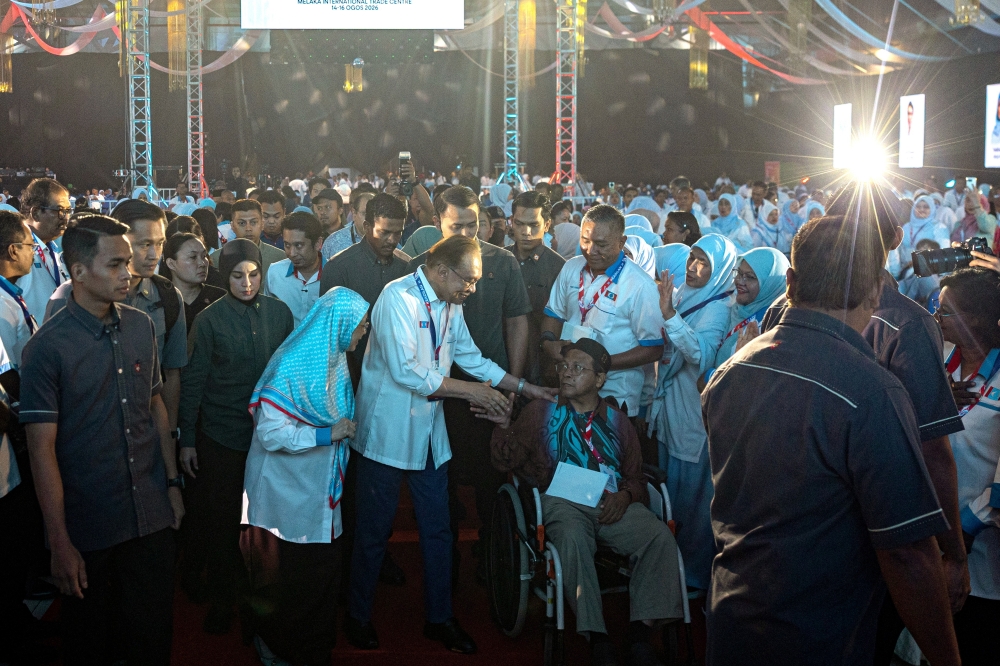
Prime Minister Anwar Ibrahim addressed PKR delegates in Melaka on Friday, emphasising that the party's approach to Umno must be grounded in pragmatism and the interests of ordinary Malaysians rather than driven by resentment or emotional responses to past tensions. Speaking as both premier and party president, Anwar outlined principles he believes should govern complex political calculations involving Malaysia's largest Malay-Muslim party, reflecting the delicate balancing act his administration must maintain across a fractured political landscape.
The statement carries significant weight given the historical animosity between PKR and Umno, rooted in decades of rivalry and competing claims to represent Malay-Muslim interests. For much of their political lives, both Anwar and Umno operated in opposing camps, with accusations of wrongdoing and political persecution marking their relationship. His call for decisions to prioritise welfare demonstrates an effort to transcend personalised grievances and forge a more functional, transactional approach to governance.
Anwar's remarks underscore the complex realities of Malaysian coalition politics in the post-2022 era. Following the 2022 general election, no party commanded an outright parliamentary majority, forcing pragmatic alliances across traditional divides. The inclusion of Umno within the Barisan Nasional government coalition, alongside PKR-led Pakatan Harapan, creates inevitable friction and requires constant calibration to prevent the administration from fracturing along old fault lines.
The emphasis on welfare rather than anger carries practical implications for Malaysian governance. Health policy, education provision, subsidies for essential goods, and infrastructure development affect all Malaysians regardless of party affiliation. When leadership prioritises emotion over evidence-based policymaking, vulnerable populations suffer disproportionately. Anwar's framing suggests recognition that petty political scoring damages the capacity to deliver tangible improvements in citizens' lives, particularly among lower-income groups who benefit most from targeted welfare programmes.
Such positioning also reflects broader Southeast Asian patterns where coalition-building across ideological divides has become increasingly necessary. Indonesia, Thailand, and the Philippines have all wrestled with similar challenges of managing former enemies within shared governing arrangements. The success or failure of these experiments directly influences whether democracies in the region can deliver effective administration or descend into perpetual gridlock.
For PKR specifically, maintaining party unity around welfare-focused principles rather than anti-Umno sentiment becomes strategically important. The party draws support from diverse constituencies including urban professionals, younger voters, and segments of the Malay-Muslim community who might otherwise drift towards Umno. If PKR is perceived as collaborating with Umno primarily through gritted teeth and residual anger, it risks alienating those who joined the party hoping for genuine transformation rather than mere circulation of elites.
Anwar's formulation also acknowledges uncomfortable truths about Malaysian politics. Umno, despite its electoral decline from dominance, remains structurally powerful through entrenched networks in the civil service, state governments, and traditional constituencies. No national government can function effectively against sustained Umno obstruction. Accepting this reality and choosing cooperation based on shared governance interests rather than fantasised victory represents political maturity, even if it disappoints activists who dream of definitively defeating Umno.
The timing of these remarks matters as well. Coalition governments frequently experience internal strains as election cycles approach and constituent parties manoeuvre for position. By establishing that decisions regarding Umno will be measured against welfare criteria rather than partisan anger, Anwar attempts to create a framework that transcends opportunistic calculations. This reduces leverage for hardliners within PKR who might push for confrontation for tactical advantage.
Regionally, Malaysia's approach to managing Umno within a broader coalition influences how neighbouring countries perceive Malaysian governance capacity. International investors, development partners, and markets respond positively to stable, predictable administration. Signals that leadership prioritises pragmatic problem-solving over festering grievances enhance Malaysia's reputation as a functioning democracy capable of mature political accommodation, contrasting with narratives of Southeast Asian instability.
Yet tension remains inherent in this approach. Anwar's base includes many who suffered through Umno dominance or who joined PKR specifically to challenge Umno's political hegemony. Demanding they subordinate their legitimate resentment to welfare calculations requires continuous reinforcement and explanation. The risk exists that repeated messages about prioritising welfare over emotion could be interpreted as dismissive of genuine historical wrongs or current power imbalances.
Moving forward, Anwar's framework will be tested constantly as specific policy decisions emerge. Whether the government genuinely subordinates short-term coalition maintenance to long-term welfare interests or merely uses welfare rhetoric to justify expedient compromises with Umno will become apparent through concrete implementation. Citizens will judge whether the measured, non-angry approach actually delivers improved living standards or merely provides dignified cover for continued elite accommodation.
Ultimately, Anwar's message to PKR delegates reflects recognition that Malaysian governance success depends less on vanquishing ideological opponents and more on building functional institutions that serve citizens consistently. Whether emotions can truly be subordinated to principle in practice remains an ongoing test of both leadership quality and the broader health of Malaysian democracy.

