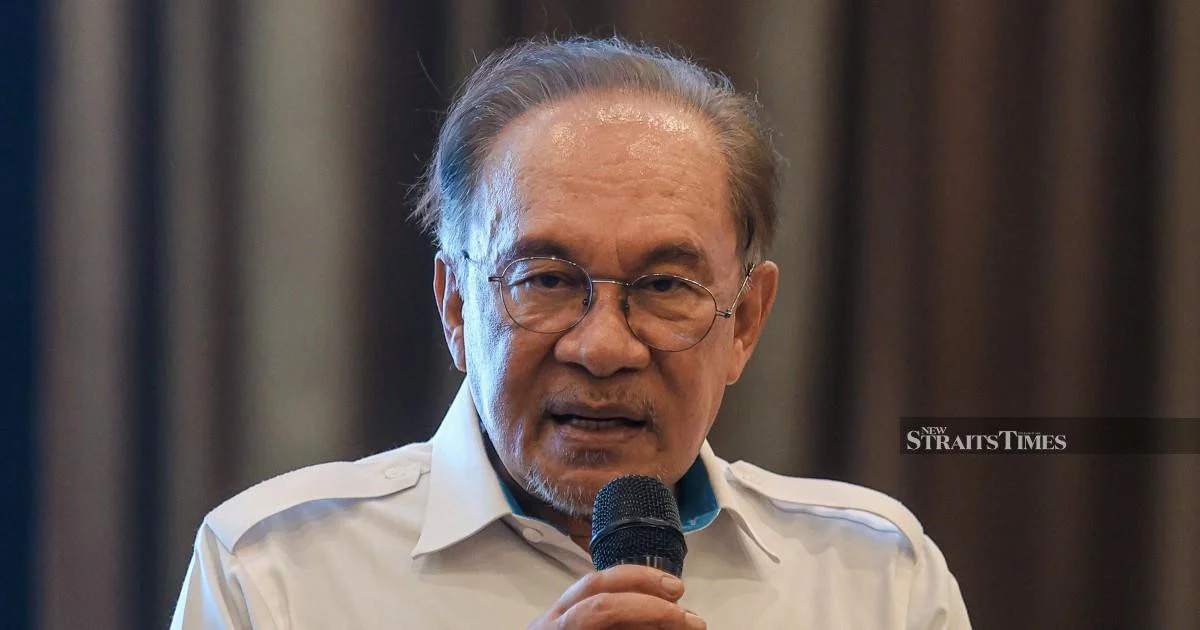
Prime Minister Datuk Seri Anwar Ibrahim has mounted a sharp attack on political figures across the country who cynically harness racial supremacy narratives to consolidate power and accumulate personal wealth. Speaking in Johor Baru, Malaysia's second-largest city and a historically significant political battleground, Anwar characterised such conduct as a fundamental betrayal of the nation's founding pluralistic principles and democratic institutions.
The Prime Minister's remarks represent an escalation in his ongoing rhetorical campaign against what he identifies as exploitative political behaviour. By explicitly singling out the instrumentalisation of racial sentiment for individual advancement, Anwar is signalling his administration's commitment to deprioritising identity-based mobilisation in favour of performance-based governance. The distinction matters considerably in the Malaysian context, where racial and religious sensitivities have historically served as powerful electoral triggers and continue to shape political calculation across parties.
Anwar's language extends beyond the politicians themselves to encompass the networks of family members and business associates—commonly described as cronies in Malaysian political discourse—who benefit from such arrangements. This framing suggests that racial supremacy rhetoric serves a functional economic purpose within patronage systems, enriching narrow circles while claiming to represent broader communal interests. The indictment implies that divisive speech functions as camouflage for self-interested accumulation rather than as genuine ideological conviction.
The timing of these comments from Malaysia's highest executive office carries strategic weight. Johor Baru serves as headquarters of the state government and represents territory where multiple political forces compete for influence and resources. By delivering this critique in such a location, Anwar ensures high local media coverage whilst simultaneously testing political narratives in a state where demographic diversity and economic considerations influence voter preferences alongside identity questions.
Within Malaysia's fragmented political landscape, accusations of exploiting racial sentiment resonate differently depending on which coalition is being referenced. Opposition parties have occasionally levelled similar charges against the ruling coalition, whilst government-aligned figures have made comparable claims about opposition movements. Anwar's positioning as a reformist Prime Minister allows him to occupy higher moral ground by attacking the phenomenon generically, though specific constituencies may interpret his remarks as directed toward particular rivals.
The Prime Minister's intervention also reflects broader concerns about democratic backsliding and the quality of public discourse. When racial supremacy rhetoric becomes instrumentalised purely for factional advantage, the reasoning goes, it degrades national cohesion and increases the baseline temperature of intercommunal tension, potentially creating conditions where calculated provocations generate disproportionate social friction. By framing such behaviour as corrupt rather than merely disagreeable, Anwar invokes language of institutional integrity rather than mere policy preference.
Understanding the regional context proves essential for interpreting these remarks. Southeast Asia contains multiple states where racial and religious nationalism has intensified in recent years, sometimes with troubling consequences for minority communities. Malaysia's history includes periods where racial politics turned volatile, and contemporary observers worry about normalisation of extremist rhetoric across multiple countries in the region. Against this backdrop, high-profile denunciations of cynical racial mobilisation from the Prime Minister carry symbolic weight beyond domestic partisanship.
However, the effectiveness of such critiques depends partly on perceived consistency and institutional follow-through. Malaysian voters and international observers will evaluate whether Anwar's government translates rhetorical commitments against racial supremacy into concrete policy, enforcement action, and institutional reform. Establishing credible mechanisms to prevent and sanction exploitative racial discourse requires more than executive criticism; it demands legislative clarity, prosecutorial independence, and commitment across governing structures.
The economic dimensions of Anwar's argument merit particular attention. By linking racial supremacy exploitation to crony enrichment, the Prime Minister connects divisive speech to material inequality and institutional capture. This approach appeals to voters concerned about inequality and corruption alongside those anxious about communal harmony. It suggests that reducing reliance on racial rhetoric might correlate with improving governance quality and reducing corrupt patronage networks—a framing that broadens the coalition potentially supporting his position.
Looking forward, whether Anwar's administration can build institutional mechanisms to translate these sentiments into durable change remains uncertain. Malaysia's political system contains countervailing forces—constitutional protections for racial and religious privileges, federalism enabling subnational divergence, and deeply rooted patterns of identity-based mobilisation—that constrain rapid transformation of political culture. Sustained pressure from the executive office, combined with party discipline and legislative action, would be required to produce meaningful shifts in how political competition operates across the country.

