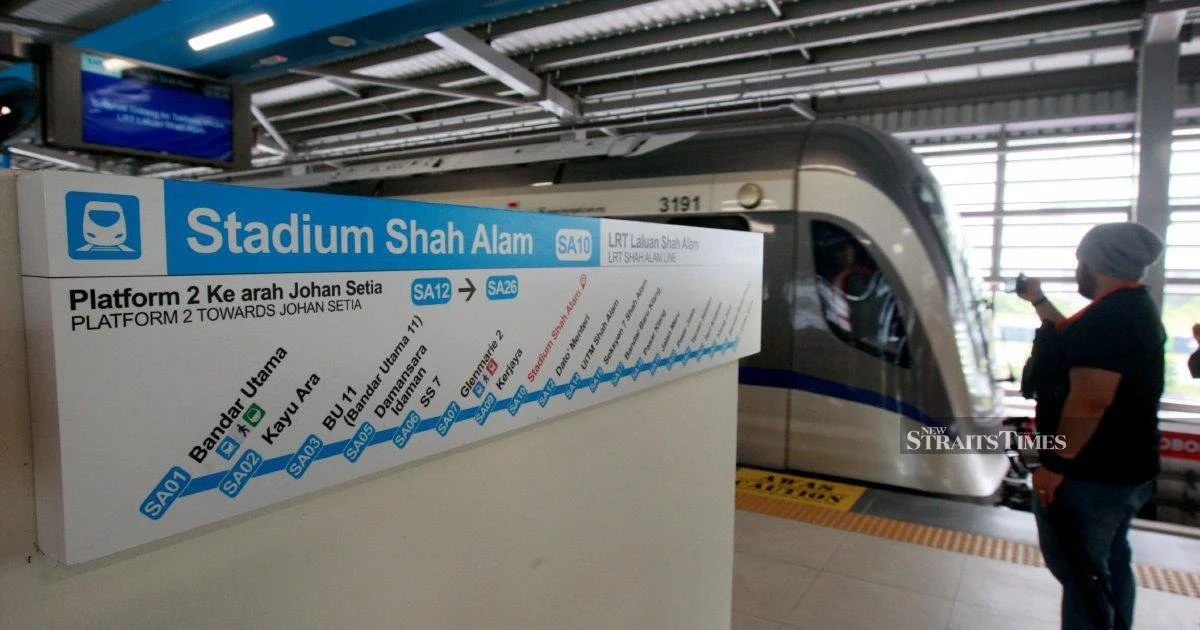
Prime Minister Datuk Seri Anwar Ibrahim will officiate the opening of the Light Rail Transit Line 3 (LRT3) Shah Alam extension on Sunday, paving the way for regular operations to commence the following day. The much-anticipated inauguration represents a milestone in the Klang Valley's ongoing efforts to expand its public transport infrastructure and reduce traffic congestion in one of Malaysia's most densely populated regions.
The LRT3 Shah Alam line extends the existing rapid transit network to serve the Selangor state capital and surrounding areas, connecting commuters to the broader metropolitan transport ecosystem. This expansion addresses long-standing demand for improved connectivity in Shah Alam, which has experienced substantial residential and commercial growth over the past decade but has remained underserved by high-capacity public transport options compared to other parts of the Klang Valley.
The project reflects the government's commitment to developing mass rapid transit infrastructure as a cornerstone of urban planning and economic development strategy. By improving rail connectivity, the initiative aims to encourage modal shift away from private vehicles, thereby easing traffic pressures on already congested highways and arterial roads serving the region. The timing of the launch aligns with broader national efforts to make public transport more accessible and attractive to commuters across Malaysia's major metropolitan areas.
LRT3's expansion carries particular significance for commuters in Shah Alam and surrounding municipalities who have long faced limited options for rapid, reliable transit to employment centres and commercial hubs. The new stations will integrate with existing transport networks and planned future extensions, potentially creating opportunities for seamless journey connectivity across the wider Klang Valley metropolitan region. Such integration is critical for establishing a comprehensive transport ecosystem that can effectively serve the needs of millions of daily commuters.
From an economic perspective, the line extension is expected to unlock development potential in areas adjacent to new stations, potentially stimulating property investment and business activity. Transit-oriented development around LRT3 Shah Alam stations could encourage higher-density residential and commercial development patterns that reduce urban sprawl and create vibrant mixed-use communities. Such concentrated development near transport nodes represents a more sustainable approach to urban growth compared to dispersed, car-dependent sprawl.
The project also carries implications for Selangor's positioning as a major economic hub within Southeast Asia. Improved transport infrastructure enhances the state's attractiveness to businesses, investors, and skilled workers, contributing to competitiveness and economic dynamism. As regional competition for talent and investment intensifies, the quality of urban infrastructure, including public transport, increasingly influences location decisions by multinational corporations and knowledge-intensive enterprises.
The LRT3 Shah Alam extension forms part of a broader modernization programme for public transport across the Klang Valley, though Malaysia's rapid transit development remains considerably behind comparable Southeast Asian cities. While Singapore's extensive MRT and LRT networks and Bangkok's BTS and MRT systems serve as benchmarks of regional development, the Klang Valley's transit infrastructure has historically lagged due to funding constraints and planning complexities. This latest extension represents incremental progress toward closing that gap.
The inauguration ceremony on Sunday will serve as a symbolic moment for the administration's transport agenda, demonstrating tangible delivery of infrastructure projects that directly impact daily life for millions of Malaysians. For the Prime Minister, the event provides an opportunity to showcase government commitment to modernizing urban amenities and addressing transport challenges that have persistently frustrated commuters and constrained economic efficiency in the region.
Looking ahead, the successful operation of the LRT3 Shah Alam line will provide valuable operational data and lessons for ongoing and future rapid transit projects across Malaysia. Performance metrics, passenger demand patterns, and cost recovery figures will inform planning for additional extensions and new lines being considered for other metropolitan areas. The project thus functions as both a direct solution to regional transport needs and a case study for expanding Malaysia's rapid transit footprint more broadly.
For residents and workers throughout Shah Alam and the surrounding Selangor hinterland, the line's commencement represents a tangible improvement in mobility options and connectivity to the broader Klang Valley economic region. Commute times between Shah Alam and key employment centres in central Kuala Lumpur and the Petaling Jaya corridor should decrease substantially, enhancing quality of life and potentially boosting productivity across the metropolitan workforce. The infrastructure investment thus carries both immediate and longer-term implications for regional economic performance and urban livability.