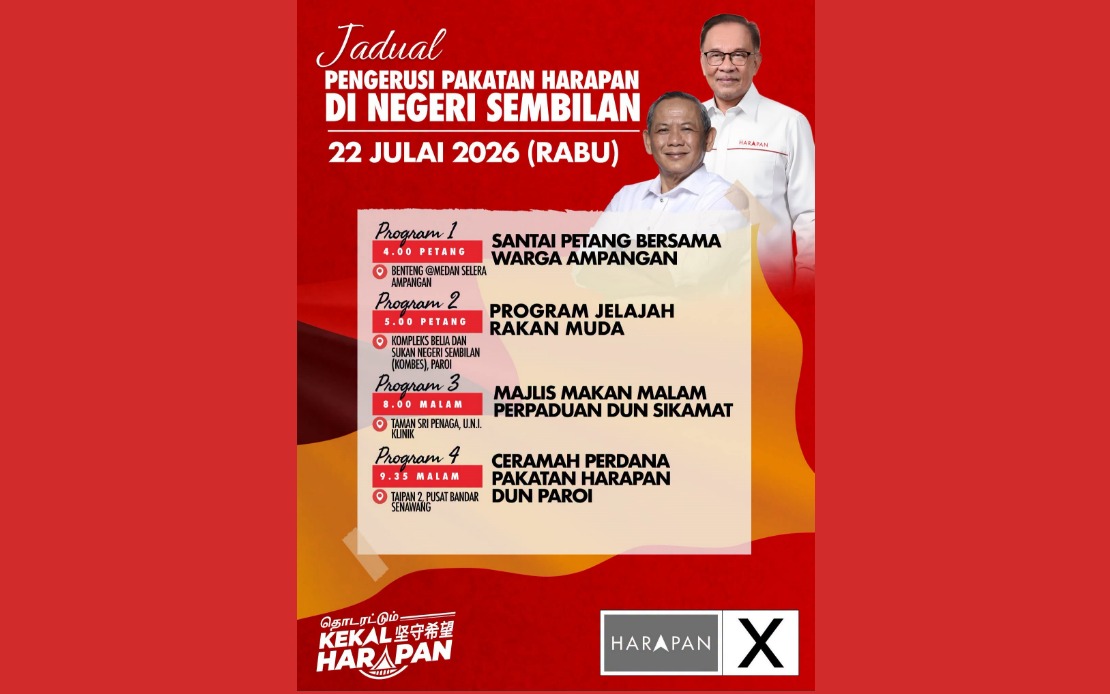
Prime Minister Datuk Seri Anwar Ibrahim will deploy significant political capital in Negeri Sembilan today, embarking on a focused campaign day designed to energise Pakatan Harapan's efforts as the coalition seeks to maintain its grip on the state government. The high-profile appearance on the fifth day of active campaigning underscores the importance of the Negeri Sembilan contest and signals PH's determination to consolidate momentum during a critical phase of the election cycle.
Anwar's schedule encompasses four separate engagements spanning the afternoon and evening, with stops planned in the constituencies of Ampangan, Paroi, Sikamat and Senawang. This geographical concentration demonstrates a tactical focus on key battleground areas that are likely to determine the overall outcome. The variety of events—ranging from grassroots community gatherings to youth-focused programmes and a major coalition rally—reflects a comprehensive approach to voter engagement across different demographic segments.
The Prime Minister will commence his itinerary at 4 pm with an informal gathering titled Santai Petang Bersama Warga Ampangan at Benteng @ Medan Selera Ampangan, a venue selection suggesting outreach to everyday residents in casual settings. This format allows for direct interaction and conversation, enabling Anwar to communicate directly with constituents about PH's vision without the formality of traditional political structures. By choosing a community food court venue, the coalition aims to position itself as approachable and integrated within local life.
Following this initial engagement, Anwar will move to the Negeri Sembilan Youth and Sports Complex in Paroi at 5 pm for the Jelajah Rakan Muda programme, a deliberate targeting of younger voters. This demographic has historically been crucial in recent Malaysian elections, and PH's explicit programming for youths indicates recognition of their electoral importance and distinct policy interests. Youth engagement has become increasingly central to electoral strategy across Southeast Asia as younger generations demand greater accountability on issues like economic opportunity, climate action and democratic participation.
Later in the evening, Anwar will attend a unity dinner in the Sikamat constituency, an event format traditionally designed to strengthen internal coalition cohesion and demonstrate unified support across PH's three component parties. Such gatherings serve dual purposes—reinforcing party discipline internally while publicly signalling strong alliance unity to external observers and voters who may be evaluating the reliability and stability of a potential government.
The campaign day will culminate with Anwar's participation in a major PH ceramah—the Malay term for a political talk or rally—at Pusat Bandar Senawang in the Paroi area. This event represents the traditional centrepiece of Malaysian electoral campaigns, where large crowds gather to hear senior party figures articulate policy positions and attack opponents. The ceramah format remains particularly potent in Malay-majority constituencies and among older voters who value the oratorical tradition.
Anwar's personal involvement aims to amplify PH's newly launched manifesto, which was unveiled on Monday with ten core commitments targeting state-level development and social inclusion. The manifesto represents PH's attempt to shift the election narrative toward specific governance promises rather than abstract ideological debates. By having the Prime Minister personally champion these pledges, the coalition seeks to invest them with greater credibility and demonstrate that commitments made during campaigns will receive top-level political attention if PH retains power.
The coalition is mounting a comprehensive contest in Negeri Sembilan, fielding candidates in all 36 state assembly seats. The internal allocation reflects established power-sharing arrangements: PKR will contest 16 seats, DAP eleven, and Amanah nine. This distribution mirrors the broader three-party coalition structure, though the dominance of PKR—which holds the majority of available seats—reflects Anwar's party's emergence as PH's largest component and his personal leadership of the coalition nationally.
The electoral timeline remains fixed, with the Election Commission confirming that early voting will occur on July 28, providing opportunities for voters unable to participate on the main polling day. The August 1 election date has been set, giving voters and parties approximately one week from this campaign day to finalise their electoral choices. For PH, this compressed timeframe necessitates intensive campaigning to cement voter commitment, particularly in marginal constituencies where outcomes remain genuinely competitive.
Anwar's presence in Negeri Sembilan carries particular weight given that the state has been governed by PH since the 2018 general election, with Datuk Seri Aminuddin Harun serving as Menteri Besar. The expectation is that voters will evaluate PH's track record in delivering on previous promises and whether the state has visibly improved under coalition stewardship. A defeat in Negeri Sembilan would represent a significant blow to PH's confidence heading toward the next federal general election, which remains more than two years away but already shapes contemporary political calculations.
For Malaysian observers and regional analysts monitoring PH's political trajectory, today's campaign activities will signal whether the coalition can maintain enthusiasm and organisation despite the challenges of governing nationally. The Negeri Sembilan election serves as an important test of PH's electoral machinery and grassroots support base. Strong performance would vindicate Anwar's leadership and provide momentum for future contests, while a disappointing result would invite questions about whether PH's national government has delivered sufficiently visible improvements in living standards and governance quality to justify continued electoral support.

