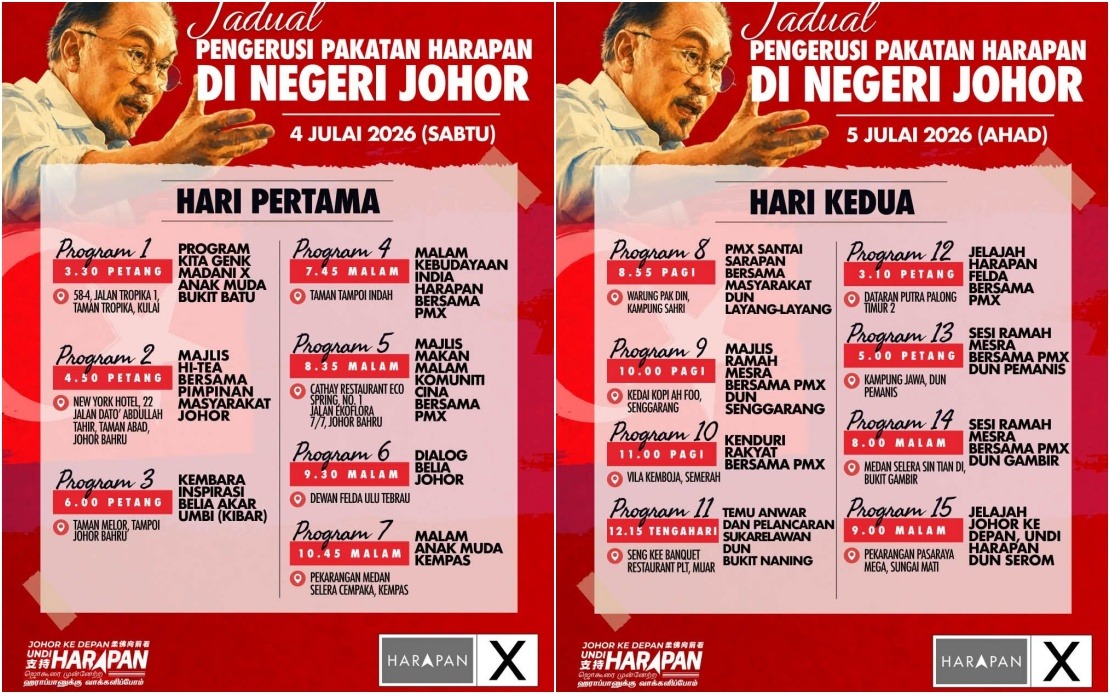
Pakatan Harapan chairman Datuk Seri Anwar Ibrahim is mounting a comprehensive ground campaign across Johor this weekend, with a packed schedule of 15 separate programmes designed to energize coalition machinery and connect with voters across multiple constituencies. The intensive push underscores the strategic importance PH places on the 16th Johor state election, scheduled for July 11, with early voting set for July 7. Through his social media appeal, Anwar has invited all Johor residents to participate in the weekend's activities, signalling an open-door approach that extends beyond party loyalists to engage the broader electorate.
The weekend itinerary reveals a carefully choreographed strategy targeting diverse voter demographics and geographic coverage across the state. Beginning Saturday afternoon in Kulai with the Kita Genk MADANI x Anak Muda Bukit Batu programme at 3:30 pm, Anwar will move through a succession of community gatherings designed to address specific constituencies and interest groups. The sequential timing—with events staggered roughly one hour apart through the evening—suggests a deliberate effort to maximize media coverage and allow sufficient time for authentic interaction with voters at each location, rather than superficial appearances.
Cultural and communal engagement forms a central pillar of the weekend's programming. The inclusion of dedicated events such as the Harapan Indian Cultural Night and the Chinese Community Dinner reflects recognition that Johor's electorate encompasses significant minority communities whose support remains crucial for PH's electoral prospects. By pairing these cultural platforms with prominent PH figures, the coalition signals respect for these communities' distinct identities while positioning itself as an inclusive political force. This approach demonstrates awareness that the 2023 general election's outcome partly reflected shifting support patterns among Indian and Chinese voters, making concentrated weekend efforts to reconnect meaningful.
The Saturday evening schedule reveals particular intensity, with four events packed between 7:45 pm and 10:45 pm—ranging from cultural celebrations to community dinners to youth-focused dialogues. This concentration suggests that organizers anticipate larger evening turnouts when working Johor residents are more available. The emphasis on youth engagement through dedicated young adult programmes and dialogue sessions underscores PH's recognition that younger voters, particularly those aged 18-40, represent a volatile demographic that cannot be taken for granted in a competitive state contest.
Sunday's schedule shifts to morning and midday activities, beginning with grassroots breakfast sessions at 8:55 am in the Layang-Layang constituency and progressing through meet-and-greet sessions, communal feasts (kenduri), and volunteer launches. This early momentum-building approach typically precedes peak weekend activity and allows Anwar to establish visible presence before other political actors dominate Sunday's news cycles. The deliberate spacing of activities across morning and afternoon, followed by a concluding evening event in Sungai Mati at 9 pm, suggests recognition that sustaining visible leadership presence throughout the day keeps momentum alive across successive news bulletins.
Geographically, the 15 programmes span multiple Johor constituencies, with specific mention of Kulai, Tampoi, Kempas, Layang-Layang, Senggarang, Semerah, Bukit Naning, Pemanis, Gambir, and Serom areas. This distribution indicates an effort to provide representation across urban centres, semi-urban zones, and rural Felda settlements, acknowledging that PH must maintain competitive presence across Johor's varied socioeconomic landscape. The repeated references to Felda areas—including dedicated Felda community sessions—suggests particular focus on rural constituencies where PH's rural support network requires reinforcement and where opposition parties have traditionally performed strongly.
The 56 PH candidates competing across the 56 state assembly constituencies represent the full slate of coalition-sponsored contestants. By dedicating an entire weekend of personal appearances to support these candidates, Anwar is making a calculated statement about PH's confidence in its Johor prospects and the importance leadership attachment plays in candidate credibility. For lesser-known candidates without prior legislative experience, Anwar's personal endorsement and physical presence at campaign events provides crucial legitimacy and media amplification that grassroots machinery alone cannot generate.
The timing of this intensive campaign push, occurring exactly one week before polling day and four days before early voting commences, represents a critical juncture in Johor's electoral cycle. Election commission regulations typically intensify scrutiny of campaign activities as voting nears, making weekend scheduling before the formal campaign cooling-off period a strategically sound choice. Anwar's decision to dedicate his entire weekend—foregoing other national commitments—sends a symbolic message to PH members and supporters that the Johor election commands his personal priority and merits maximum organizational resources.
For Malaysian observers monitoring federal-state political dynamics, the Johor state election carries implications extending beyond state-level governance. Johor, as Malaysia's second-largest state by population and economy, represents crucial testing ground for public sentiment toward the federal PH-led government. Electoral performance here could influence PH's confidence heading into potential future national contests and would signal whether federal government initiatives have successfully translated into state-level support. Conversely, a weak Johor showing could energize opposition parties and complicate PH's national political positioning.
The coalition's strategy of deploying its highest-ranking national leader for intensive state campaign activity reflects competitive recognition that Johor cannot be conceded to opposition forces, particularly given previous electoral patterns where Umno-led administrations have held state control for extended periods. PH's determination to reverse this through maximum leadership engagement demonstrates that despite controlling Putrajaya, the coalition remains focused on state-level competition and views Johor as a genuine pickup opportunity rather than a secondary concern.
From a regional Southeast Asian perspective, Malaysia's state elections continue showcasing democratic participation at scale, with Johor's 56 constituencies attracting serious political engagement and large-scale campaign mobilization. The weekend's planned activities represent one nation's approach to democratic campaigning—emphasizing direct politician-voter interaction, communal celebration integration, and rapid geographic coverage. This model contrasts sharply with other regional democracies employing different campaign intensities and methodologies.
The public invitation extended through Anwar's Facebook announcement to all Johor residents—regardless of party affiliation—represents a deliberate inclusivity message. By framing weekend activities as opportunities for broad civic participation rather than exclusively partisan exercises, PH attempts to position itself as a government representing all Johor residents while simultaneously mobilizing its core support base. Success in Johor on July 11 would validate this approach and potentially encourage similar strategies in future electoral contests.

