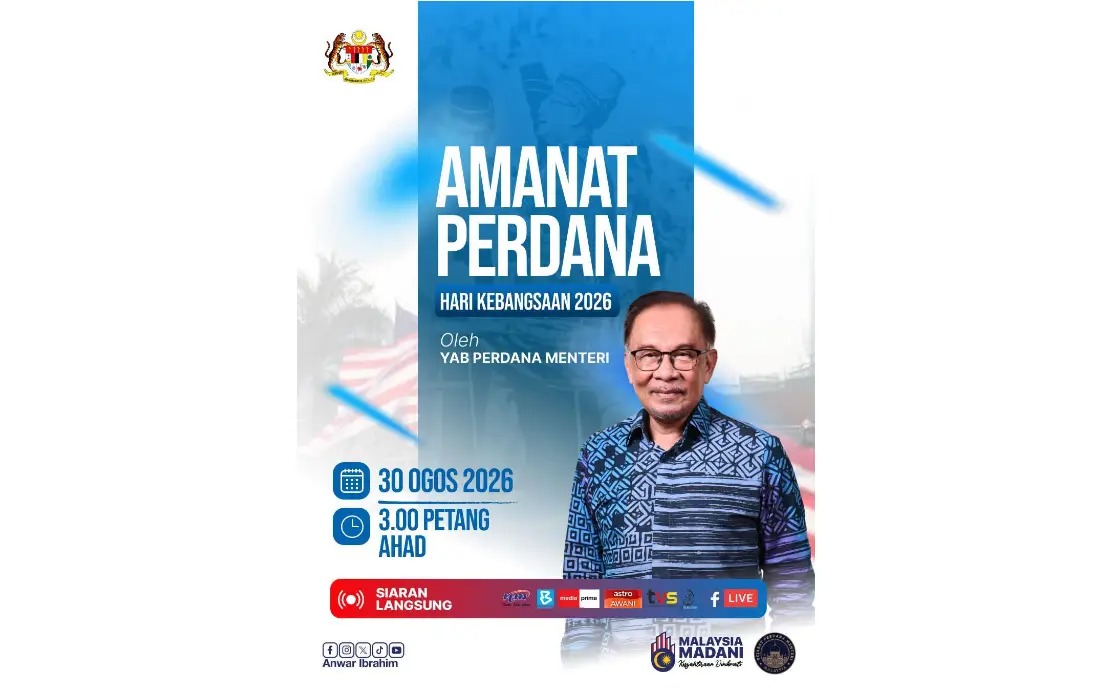
Prime Minister Datuk Seri Anwar Ibrahim is set to deliver the National Day address at the Putrajaya International Convention Centre (PICC) tomorrow afternoon, with plans to announce multiple significant policy initiatives alongside reflections on the nation's nearly seven-decade journey since independence. The speech represents a key moment for the government to outline its vision and priorities as Malaysia continues to navigate complex economic and social challenges in the post-pandemic environment.
Through a Facebook statement, Anwar indicated that his address would directly engage with matters that resonate deeply with ordinary Malaysians—issues centred on their immediate concerns, quality of life, and the opportunities available to them and their families. This approach signals an attempt to connect the symbolic occasion of National Day with concrete governance priorities that affect citizens on a day-to-day basis, rather than treating the event as purely ceremonial.
The Prime Minister emphasised the importance of historical memory and generational consciousness, noting that the passage of nearly seven decades since Merdeka warrants reflection on the enormous sacrifices made by previous generations. His framing acknowledges that those who secured independence—through struggle, physical hardship, and in some cases loss of life—established the foundation upon which contemporary Malaysia stands. This narrative serves to contextualise current challenges within a longer historical arc, encouraging citizens to view their own role as custodians of a hard-won national project.
Central to Anwar's message is the concept of intergenerational responsibility. By explicitly directing attention to what the current generation owes to Malaysia's independence, he is articulating a vision wherein today's citizens and leaders are not merely beneficiaries of past struggles, but active participants in sustaining and deepening the meaning of national sovereignty. This framing has particular resonance for younger Malaysians, who may view independence as a historical fact rather than an ongoing commitment requiring their engagement and sacrifice.
Anwar's call for unity and rejection of divisive rhetoric assumes heightened significance in the Malaysian context, where multi-ethnic and multi-religious composition has been both a defining characteristic and, at times, a source of tension. His explicit rejection of "any incitement that could fuel hatred among people of different races and religions" appears to address contemporary concerns about polarisation in public discourse, online spaces, and political competition. The emphasis on preserving peace and public well-being through unity suggests recognition that social cohesion is not automatic but requires conscious effort and leadership.
The timing of these messages is noteworthy, arriving at a period when Malaysian politics continues to experience fragmentation and when various communities have expressed concerns about inclusive governance and representation. National Day provides a platform for the Prime Minister to reset the national conversation around shared values and common purpose, potentially countering narratives of division that circulate elsewhere. By using this high-visibility occasion to champion unity, Anwar is attempting to reclaim the symbolic authority of National Day as an occasion for reaffirming the social contract upon which the nation was founded.
For Southeast Asian observers, Malaysia's National Day address carries regional significance given the country's role as a major economy and democratic player within ASEAN. How Anwar frames Malaysia's challenges and aspirations can influence regional dialogue on governance, development, and the balance between unity and diversity in multiethnic societies—issues that resonate across the region. Thailand, Indonesia, and other ASEAN members grapple with similar questions of social cohesion and generational renewal.
The announcement of "key initiatives" also suggests that this will not be a purely rhetorical or ceremonial address. Governing parties often use National Day platforms to unveil policy announcements, reforms, or programmes, providing a patriotic framework within which new initiatives are received. The specific nature of these initiatives remains undisclosed, but their announcement during the National Day address indicates their strategic importance to the government's political messaging and policy agenda.
For Malaysian citizens and businesses, the initiatives announced tomorrow could carry practical implications ranging from economic policy to social programmes or institutional reforms. Investors, civil society organisations, and community leaders will likely scrutinise both the substance of announcements and the broader vision articulated by the Prime Minister. The address thus functions as both a symbolic reaffirmation of national values and a mechanism through which government priorities are communicated to domestic and international audiences.
The emphasis on National Day as an occasion for collective reflection also reflects a broader global trend in which democratic leaders use national celebrations to address social division and call for renewed commitment to shared principles. Anwar's approach—balancing historical memory with present responsibility and future vision—represents an attempt to render National Day meaningful beyond ceremonial markers. Whether the announced initiatives successfully translate patriotic sentiment into tangible improvements in citizens' lives remains to be seen, but the framing suggests a conscious effort to bind symbolic unity with substantive governance.
As Malaysia continues to develop economically and navigate geopolitical shifts, the question of what independence means in contemporary terms becomes increasingly complex. Anwar's address offers an opportunity to articulate how the nation understands its sovereignty, its responsibilities to its citizens, and its place within the regional and global order. The call for unity and the promise of new initiatives signal a government seeking to reinvigorate national purpose and demonstrate that independence, nearly seven decades on, remains a living commitment rather than a historical achievement to be passively inherited.

