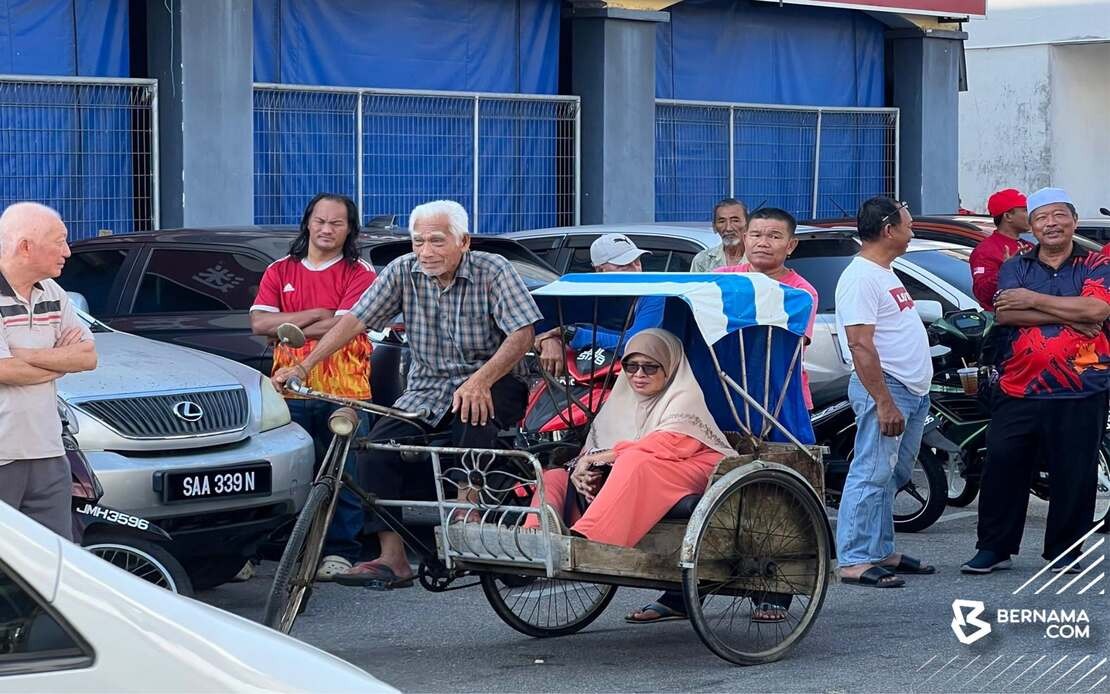
Prime Minister Datuk Seri Anwar Ibrahim has publicly acknowledged the dedication of an elderly couple from Batu Pahat, expressing genuine appreciation for their determination to see him during a recent visit to the Johor district. The Premier took to social media to convey his gratitude towards Abdul Razak Pelangga, 86, who made the effort to transport his wife, Jamilah Samsudin, 64, by traditional trishaw from their village home to meet him, despite ultimately missing the opportunity for a personal encounter.
The touching encounter unfolded during Anwar's campaign activities in the Senggarang state constituency, timed to coincide with broader electoral movements in Johor. Learning of the Prime Minister's intended visit to a local coffee shop for a breakfast meet-and-greet programme, Abdul Razak made a deliberate choice that exemplifies the kind of civic engagement and personal sacrifice that political leaders often highlight when celebrating grassroots support. Rather than relying on motorised transport that would have presented parking complications in the modest township, he selected the more traditional mode of transport—a decision that both honoured local culture and reflected pragmatic community thinking.
In his Facebook message, Anwar acknowledged the symbolism and effort implicit in the gesture, offering both thanks and an apology for the missed opportunity to meet face-to-face. He extended well-wishes for the couple's health and prosperity, framing the encounter within an Islamic context by invoking divine blessings. The Prime Minister suggested that future meetings might materialise, signalling openness to continued engagement with constituents during subsequent visits to the region.
The imam of Masjid Raudhatul Jannah Parit Bugis, who serves the couple's community, subsequently explained the reasoning behind Abdul Razak's choice of transport. Despite having access to alternative vehicles, the elderly man had consciously opted for the trishaw as a practical solution to parking challenges that would arise during peak hours in Senggarang's town centre. This detail reveals how ordinary Malaysians often navigate the gap between wanting to participate in public life and managing the infrastructure realities of smaller towns where vehicle congestion and limited parking remain persistent challenges.
The incident resonates within Malaysia's political landscape as a microcosm of the relationship between elected officials and their constituencies. In an era when political engagement increasingly occurs through digital channels and staged events, spontaneous encounters between leaders and citizens—however brief or incomplete—carry symbolic weight. The public sharing of such moments through social media amplifies their meaning, transforming a missed breakfast meeting into a narrative about civic participation and the value placed on ordinary citizens' efforts.
Anwar's prominence as Prime Minister, combined with his active engagement in state-level politics through campaign activities, has kept him highly visible in Malaysian public consciousness. His willingness to make himself accessible through informal breakfast stops and community programmes reflects a political strategy that emphasises personal connection and ground-level engagement. Such activities carry particular significance in smaller towns like Senggarang, where direct political contact may be less frequent than in urban centres.
The Johor political context adds another layer to this encounter. The state has emerged as crucial terrain in Malaysian electoral competition, with significant implications for national coalition politics. Campaign activities in constituencies like Senggarang represent efforts to build momentum and demonstrate political presence ahead of electoral contests. Ordinary citizens' responses—whether through formal participation or spontaneous gestures like Abdul Razak's trishaw journey—constitute part of the grassroots feedback mechanism through which political leaders assess public sentiment.
Cultural and generational dimensions also merit consideration. Abdul Razak, at 86 years old, represents a generation whose engagement with leadership often reflects more traditional notions of respect and deference. The trishaw itself carries cultural resonance as a form of transport increasingly rare in modern Malaysia, yet still present in smaller communities. His wife's desire to see the Prime Minister, which motivated the entire expedition, reflects how political figures and state leadership remain sources of significance and interest across different age groups and demographic segments.
The broader implications of such moments extend beyond individual anecdotes. They illustrate the persistent importance of in-person political engagement in Malaysian democracy, despite digital platforms' growing prominence. They also highlight how citizens in smaller towns and rural areas maintain their own relationships with national politics, often requiring greater effort and commitment than their urban counterparts. Anwar's public acknowledgment of Abdul Razak's effort therefore serves a dual purpose: genuine appreciation for a constituents' dedication and recognition of the value citizens place on direct access to their leaders.
The incident underscores how political leadership in Malaysia continues to operate within frameworks that emphasise accessibility and responsiveness to ordinary citizens. While the couple ultimately did not achieve their primary objective of meeting the Prime Minister face-to-face, the subsequent public recognition of their effort through official social media channels transformed the outcome into something approaching symbolic success. For Abdul Razak and Jamilah, the gesture itself—and its public acknowledgment—may have constituted the more meaningful reward than a brief personal encounter would have provided.

