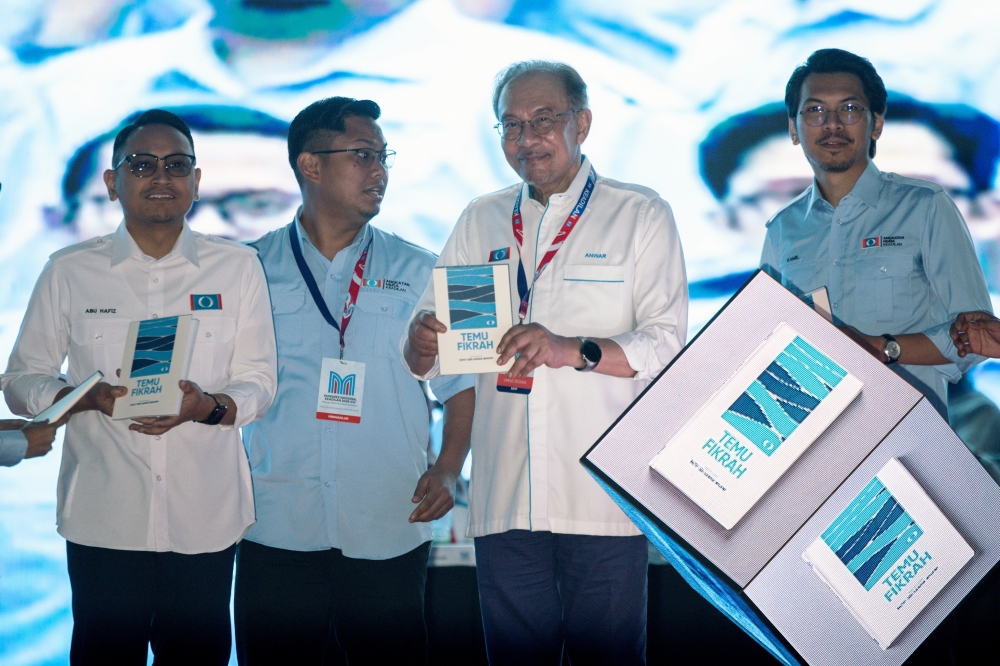
Prime Minister and Parti Keadilan Rakyat (PKR) president Datuk Seri Anwar Ibrahim has launched Temu Fikrah, a comprehensive manifesto and operational manual designed to guide PKR Youth activists in their political work and ideological development. The document, unveiled in Melaka, represents an attempt by the ruling coalition's de facto opposition within government to crystallise its values and strategic direction for a new generation of party members increasingly navigating Malaysia's fractious political landscape.
Temu Fikrah—which translates as "Gathering of Ideas"—frames itself as more than conventional party literature. The document bridges the conceptual gap between high-level political manifesto and practical grassroots guide, attempting to instil both philosophical coherence and operational clarity among youth cadres. This dual approach reflects Anwar's broader strategy of deepening PKR's organisational capacity while maintaining ideological distinctiveness within the Pakatan Harapan coalition and the wider Madani administration.
The three pillars underpinning Temu Fikrah—courage, creativity, and Madani governance—signal PKR Youth's positioning as reformist yet constructive. Courage here encompasses willingness to challenge conventional thinking and entrenched interests; creativity implies adaptive, context-sensitive problem-solving rather than rigid ideology; and the Madani framework references the government's overarching commitment to democratic institutions, economic inclusion, and anti-corruption measures. Together, these elements form a coherent narrative designed to appeal to younger activists dissatisfied with status-quo politics but also committed to incremental institutional change.
For Malaysian political observers, the timing and substance of Temu Fikrah carry significance. PKR Youth has historically served as both recruitment pipeline and innovation laboratory within the party. By formalising its ideological parameters now, at a moment when Malaysia's coalition government faces fragmentation pressures and electoral uncertainty, Anwar signals investment in long-term party cohesion and succession planning. The document's emphasis on structured thinking reflects lessons learned from internal party conflicts and the need for clearer internal communication protocols.
The Madani governance component deserves particular attention for regional audiences. Since taking office in November 2022, Anwar's coalition has articulated Madani as an alternative to both the previous Perikatan Nasional government's nationalist-Islamist emphasis and Barisan Nasional's conventional conservatism. Temu Fikrah operationalises this vision at the grassroots, translating abstract governance philosophy into concrete guidance for party activists involved in community organising, policy advocacy, and electoral campaigning. This represents an attempt to prevent Madani from remaining merely rhetorical.
Creativity as a political value deserves examination within Malaysia's specific context. For decades, Malaysian politics has been characterised by institutional sclerosis, personality-driven factionalism, and resistance to innovative governance models. PKR's elevation of creativity as a core principle—and its extension to youth activists—suggests recognition that conventional methods of political mobilisation and service delivery no longer suffice. This openness to experimentation could inform how the party approaches economic policy, digital governance, and community engagement.
The courage pillar reflects deeper anxieties within PKR's base. Activists often report feeling constrained by coalition arithmetic and the need for compromise with Pakatan Harapan partners, particularly the Democratic Action Party and Amanah. Temu Fikrah's emphasis on courage may serve partly to reassure youth members that principled stands remain possible within coalition governance, even as coalition discipline remains essential. This balance—between principled advocacy and pragmatic power-sharing—represents one of the defining tensions within Malaysian opposition-cum-government politics.
For Southeast Asia more broadly, Temu Fikrah exemplifies how centre-left and reformist parties across the region are adapting to demographic and technological change. The document's apparent embrace of digital organising, evidence-based policymaking, and inclusive decision-making reflects patterns visible in Thai, Indonesian, and Philippine progressive movements. Yet Malaysia's specific constraints—entrenched Islamist competition, ethnic-based electoral mathematics, and institutional fragmentation—shape how universally these principles can be applied.
The launch in Melaka carries symbolic weight. The state has been a PKR stronghold and the site of significant party organisational work. Choosing this venue suggests Anwar's confidence in Melaka-based leadership and PKR's grassroots machinery, while also grounding an ideological document in concrete party infrastructure. This attention to symbolism reflects sophisticated political communication strategy, where every public act conveys meaning about party priorities and geographic emphasis.
Implementation challenges will likely emerge. Transforming manifesto principles into consistent activist behaviour across diverse state and local contexts requires sustained leadership attention, training programmes, and accountability mechanisms. Malaysian political parties have historically struggled with institutionalisation, with charismatic leaders and factional networks often overriding formal structures. Whether Temu Fikrah can catalyse genuine organisational change or functions primarily as aspirational messaging remains to be seen.
The document also positions PKR Youth within broader debates about Malaysian youth political engagement. Younger voters display lower partisan loyalty and greater issue-driven voting behaviour than their parents' generation. By articulating a coherent vision of creativity, courage, and Madani governance, Temu Fikrah attempts to articulate why PKR matters to voters less invested in historical independence-era narratives or ethnic-based politics. This generational repositioning may prove crucial to the coalition's long-term viability.
Moving forward, observers should watch how PKR leadership reinforces Temu Fikrah through party training, candidate selection, and policy advocacy. Will the document influence how PKR Youth candidates approach electoral contests? Will it reshape internal party debate? Will it catalyse meaningful programme innovation? These questions will determine whether Temu Fikrah represents genuine institutional evolution or becomes merely another archived party publication.

