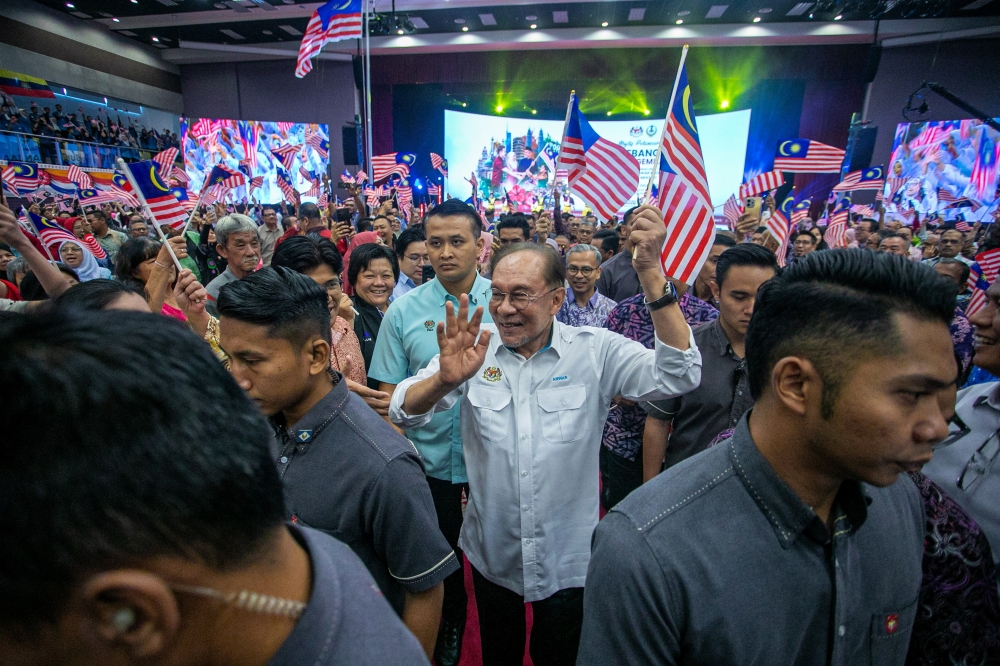
Prime Minister Datuk Seri Anwar Ibrahim has issued a carefully calibrated message to government ministers and senior officials, urging them to pursue campaign activities freely whilst remaining mindful of institutional boundaries and public expectations. Speaking in Ipoh on July 19, Anwar acknowledged the legitimate role of political campaigning in Malaysia's democratic system, yet stressed that those holding public office must exercise restraint to preserve the integrity of government institutions and public trust.
The reminder comes at a time when the line between party politics and government administration often blurs, particularly during campaign periods when officials face competing demands from their ministerial portfolios and party machinery. Anwar's message reflects an attempt to balance the grassroots reality of Malaysian politics—where officials are simultaneously public servants and party members—with the institutional imperative to keep government machinery neutral and credible.
For Malaysian readers familiar with the tensions that frequently surface during electoral campaigns, Anwar's statement addresses a recurrent concern about the proper use of government resources and the behaviour of officials who hold dual roles. Ministers and government leaders occupy positions of significant influence, commanding institutional resources, media access, and public platforms that can easily be converted into campaign assets. The Prime Minister's clarification signals that whilst political engagement is acceptable, it must not compromise the separation between governance and campaigning.
The timing of Anwar's remarks suggests a proactive effort to establish clear parameters before campaign misconduct becomes widespread. Rather than waiting for violations to occur and subsequently investigating them, the Prime Minister has chosen to set expectations upfront. This preventive approach reflects lessons learned from previous electoral cycles where allegations of misuse of government machinery generated public controversy and damaged institutional credibility.
In the Malaysian context, where government dominance in the political system has historically created advantages for ruling parties, such reminders carry particular weight. Opposition parties and civil society organisations routinely scrutinise whether government officials deploy their positions unfairly during campaigns. By publicly articulating these boundaries, Anwar attempts to pre-empt accusations of institutional abuse and demonstrate governmental commitment to fair electoral conduct.
The distinction Anwar draws between permissible campaigning and improper conduct likely encompasses several practical considerations. Officials should presumably be able to attend party events, make campaign speeches, and mobilise supporters during their personal time. However, using government vehicles, facilities, or personnel for campaign purposes, or leveraging official platforms to advance party interests, would cross the line he has outlined. Such clarity becomes especially important in a federal system like Malaysia's, where state and federal officials often work in overlapping jurisdictions.
For Southeast Asia more broadly, Anwar's approach reflects a broader challenge facing elected officials in the region: maintaining democratic legitimacy whilst occupying powerful positions. Countries across the region grapple with similar tensions between political dynamism and institutional integrity. Malaysia's experience, where questions about the appropriate conduct of government officials during elections frequently surface, provides instructive lessons for neighbouring democracies managing comparable dynamics.
The effectiveness of Anwar's directive will ultimately depend on implementation and enforcement. Clear guidance at the highest level is necessary but insufficient without corresponding accountability mechanisms. Government integrity commissions, electoral watchdogs, and civil service oversight bodies must translate these principles into concrete enforcement, investigating complaints and ensuring consequences for violations. Without such mechanisms, public statements about proper conduct risk becoming merely symbolic gestures.
Moreover, the broader political environment shapes how officials interpret such guidelines. If party leadership visibly rewards officials who blur boundaries and punishes those who maintain strict separation between governance and campaigning, frontline officials will receive contradictory signals regardless of prime ministerial statements. Anwar's message therefore requires consistent reinforcement from party structures and institutional leadership.
For Malaysian voters, such reminders also underscore the importance of electoral vigilance. Citizens and civil society organisations should actively monitor whether government officials respect these boundaries during campaign periods. Public scrutiny and transparent reporting create informal accountability that complements formal enforcement mechanisms, making violations more costly for those tempted to cross the line.
Looking ahead, this statement may establish a benchmark against which government conduct during future campaigns will be measured. Opposition parties will likely reference Anwar's July 19 remarks when alleging misconduct, whilst government supporters will cite them as evidence of institutional probity. The statement thus becomes part of Malaysia's evolving discourse on democratic governance and institutional accountability.
Ultimately, Anwar's exhortation reflects a recognition that democratic systems depend not merely on formal rules but on the restraint and integrity of those wielding power. Whether government officials internalise and follow through on this guidance will significantly influence public confidence in Malaysian institutions and the perceived fairness of future electoral competitions.

