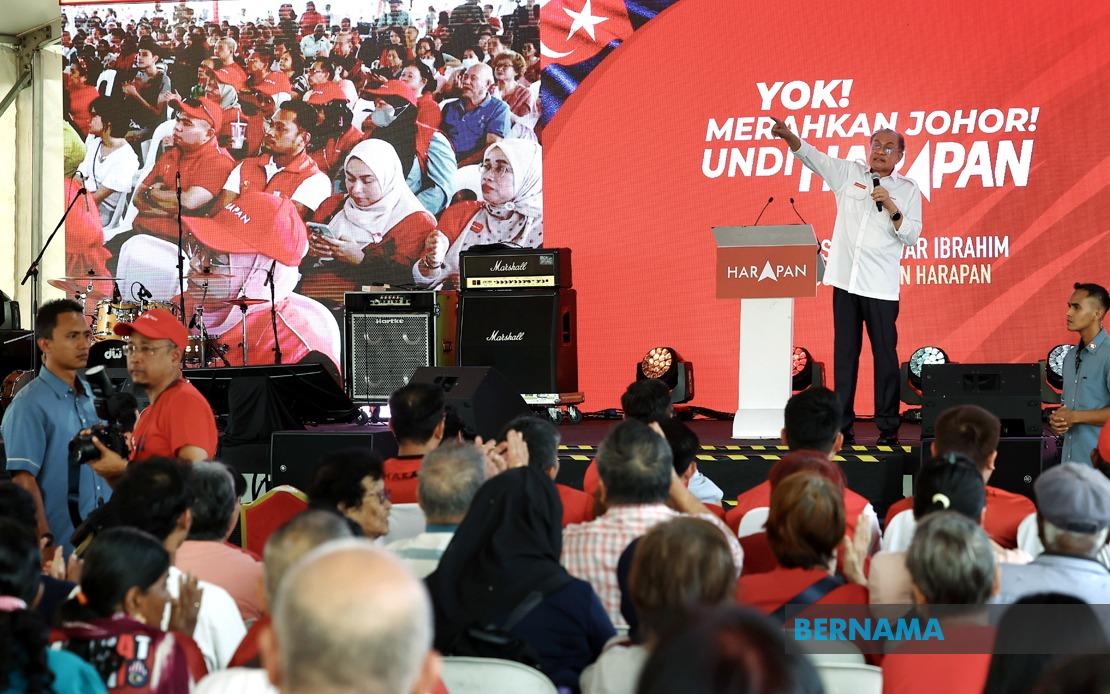
Prime Minister Datuk Seri Anwar Ibrahim made an impassioned plea to candidates vying for seats in the Johor state election, urging them to abandon the political exploitation of Datuk Seri Najib Razak's incarceration and instead concentrate on substantive matters affecting ordinary Malaysians. Speaking at a Pakatan Harapan campaign event in Kulai on July 10, Anwar conveyed frustration with the persistent weaponisation of the former prime minister's legal predicament, suggesting that continued reference to Najib's prison sentence had become counterproductive to serious political discourse.
The Prime Minister's intervention reflects mounting concern within the ruling coalition that relentless criticism of Najib, rather than strengthening PH's electoral position, may be backfiring by overshadowing a more forward-looking agenda centred on economic recovery and social welfare. Anwar's remarks signal an attempt to steer the campaign narrative away from the tumultuous politics of the past decade towards contemporary challenges that resonate with voters. His comments came as PH gears up for what promises to be a closely contested state ballot in one of Malaysia's most economically significant regions.
Anwar employed stark language to convey his message, asserting that Najib's current imprisonment should render further discussion of his case irrelevant to the electoral process. The phrasing "leave him alone" underscored the Prime Minister's belief that continuing to invoke Najib's name during campaigning represents a distraction from genuine governance priorities. Yet his immediate pivot to the 1MDB scandal demonstrated that while Anwar wishes to retire the subject as campaign fodder, the financial consequences of that episode remain inescapable for national finances.
The lingering shadow of 1Malaysia Development Berhad constitutes perhaps the most potent reason why Anwar cannot entirely escape the past, despite his exhortations to his political opponents. The state investment fund became synonymous with unprecedented corruption and misappropriation during the previous administration, resulting in monumental fiscal obligations that continue to constrain government spending decades later. Anwar's reference to the RM51 billion debt burden illustrates how deeply embedded this liability remains in Malaysia's economic landscape, serving as a perpetual reminder of institutional failures under the previous regime.
By highlighting the opportunity cost of servicing 1MDB obligations, Anwar sought to reframe the debate around institutional accountability without dwelling on Najib's personal circumstances. His enumeration of postponed public investments—schools, hospitals, road infrastructure, and poverty alleviation programmes—conveyed the tangible human consequences of the scandal in language that ordinary voters could readily comprehend. This rhetorical strategy attempted to separate legitimate criticism of systemic corruption and its economic fallout from what Anwar characterised as needless personalisation of political competition.
The Johor election campaign provided the backdrop for these remarks, occurring as the state prepares for polling that will significantly influence the broader political trajectory within Malaysia's second-largest economy. Anwar's appeal reflected sensitivity to how opposition parties, particularly those sympathetic to Najib's earlier administration, might weaponise claims that PH had politicised his case. By voluntarily calling for restraint, the Prime Minister attempted to occupy the moral high ground and position his coalition as focused on governance rather than revenge politics.
The presence of Youth and Sports Minister Mohammed Taufiq Johari, along with other PH figures and candidates, at the Yok! Merahkan Johor! Undi Harapan event underscored the coordinated nature of PH's campaign machinery in the state. These gatherings serve multiple purposes—energising party supporters, building grassroots momentum, and projecting unity among coalition partners. Anwar's intervention at such an event carried added weight, signalling that party leadership remained vigilant regarding campaign messaging and tone.
The tension underlying Anwar's plea reflects a deeper ambivalence within Malaysian politics about how to process the legacy of the previous administration. The 1MDB scandal represented one of Malaysia's most significant governance crises, yet continuously revisiting the matter during elections risks exhausting voter patience and confirming perceptions that political competition has become mired in recrimination. Conversely, abandoning reference to documented institutional failures might appear to minimise their gravity and suggest complicity with those responsible.
Anwar's framing attempted to navigate this quandary by acknowledging that while Najib's sentence must be respected and the case closed from a legal standpoint, the economic ramifications of the underlying corruption demanded continued governmental attention and public understanding. The debt servicing obligations represented not a matter of personal vendetta but of fiscal stewardship—an obligation to deploy limited national resources effectively rather than directing them toward obligations incurred through dishonesty.
For Malaysian voters, particularly those in Johor, Anwar's intervention offered a signal that the incoming campaign would prioritise bread-and-butter issues affecting household welfare and community development. The explicit mention of schools, hospitals, and road infrastructure addressed the material concerns of most constituents far more directly than continuing controversy over a singular high-profile conviction. This recalibration reflected strategic recognition that electoral victories ultimately derive from voter perceptions regarding competent governance rather than historical grievance management.
The appeal also carried implicit criticism of opposition forces likely to invoke Najib's detention as evidence of purported persecution or selective justice. By preemptively discouraging such rhetoric from all quarters, Anwar sought to deny opponents a readily available talking point while positioning PH as committed to institutional dignity and forward momentum. Whether this rhetorical initiative would prove effective remained uncertain, given that Najib's supporters continued to frame his case through the prism of political victimisation regardless of official exhortations toward restraint.

