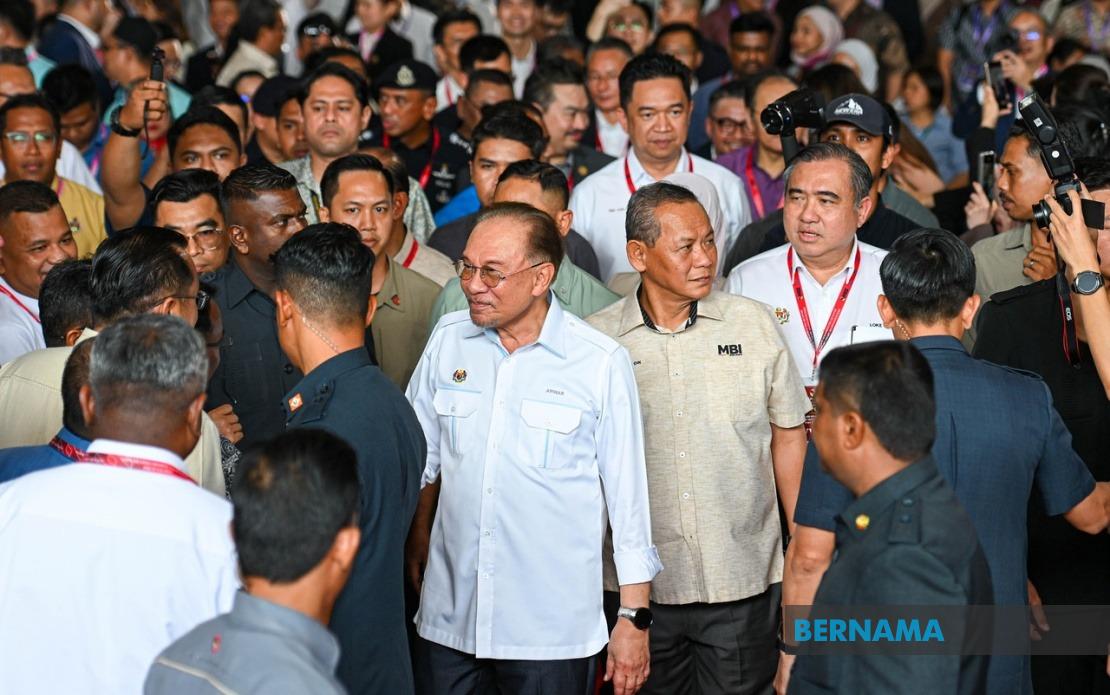
Prime Minister Datuk Seri Anwar Ibrahim has made a direct appeal to Melaka DAP to shelve its decision to exit the state government, hoping to preserve stability in the administration and avoid disrupting ongoing development efforts. Speaking in Port Dickson on July 14, the Pakatan Harapan chairman emphasised that maintaining administrative continuity should take precedence over internal party disagreements, particularly as the state approaches the next election cycle.
The urgency of Anwar's intervention reflects the delicate balancing act required to keep Melaka's ruling coalition intact. The PM indicated he had already engaged in discussions with DAP secretary-general Anthony Loke and Melaka Chief Minister Datuk Seri Ab Rauf Yusoh, signalling that behind-the-scenes negotiations remain active. By asking the party to temporarily shelve its withdrawal announcement, Anwar appeared to be buying time for a broader resolution that might address the underlying grievances without fracturing the coalition.
Melaka DAP's decision to quit came swiftly following the passage of constitutional amendments in the state legislative assembly that would enable the appointment of nominated assemblymen. Party chairman Khoo Poay Tiong framed the withdrawal as a principled stand against what the party views as an assault on democratic values and electoral integrity. The mechanism for appointing rather than electing representatives runs counter to DAP's ideological foundation, making the party's protest not merely a tactical manoeuvre but a test of institutional principles.
The constitutional amendment in Melaka represents a broader trend in Malaysian politics where ruling coalitions have sought to stabilise governments through mechanisms that bypass electoral contestation. For DAP, historically a vociferous advocate for democratic reform, accepting such measures would represent a significant compromise of its political identity. However, the timing and pace of the party's withdrawal decision also suggest internal tensions within Pakatan Harapan that extend beyond this single issue.
Anwar's measured response acknowledges the legitimacy of disagreement within coalition partners while framing such disputes as manageable within a larger framework of cooperation. His remarks that component parties need not agree on every issue, provided they align on core economic and welfare policies, reflect a pragmatic understanding of how multi-party governments function. Yet this formulation also hints at the precarious nature of Melaka's current administration, where three parties hold differing visions for governance.
The development agenda Anwar referenced has real weight in Melaka's political economy. The state has positioned itself as a crucial node in Malaysia's southern corridor development strategy, with projects like infrastructure investments and industrial modernisation requiring stable administrative oversight. Any disruption to state government operations could complicate ongoing initiatives and dampen investor confidence in the region's governance stability.
For Malaysian readers tracking coalition politics, this episode illuminates the structural vulnerabilities of Pakatan Harapan at the state level, where numerical thin majorities sometimes depend on the continued participation of ideologically distinct parties. Unlike federal arrangements where coalition partners can sometimes operate with greater autonomy, state governments demand tighter coordination and shared decision-making. When a party feels its core principles are violated, withdrawal becomes not merely a political tactic but an assertion of institutional integrity.
The constitutional amendment mechanism itself warrants scrutiny in the Malaysian context. Nominated assemblymen, while sometimes justified as technical specialists or representatives of overlooked communities, have historically been used to shore up fragile majorities or reward political loyalists. DAP's opposition reflects broader questions about democratic representation that resonate across Southeast Asia, where the tension between elected legitimacy and administrative effectiveness remains contested.
Anwar's appeal for postponement rather than outright opposition to DAP's concerns suggests he recognises the party's position has merit while hoping for a negotiated settlement. This approach prioritises coalition stability over ideological purity, a calculus that may frustrate DAP's base but reflects the realities of managing multi-party governments where withdrawal by one component could trigger cascading political consequences. If Melaka's government falls, opposition parties would be well-positioned to construct an alternative majority.
The broader implications for Malaysia's political landscape depend partly on whether Anwar's intervention succeeds in forestalling DAP's exit. A sustained withdrawal would weaken Pakatan Harapan's footprint in an important state and potentially embolden other coalition partners to press demands. Conversely, if DAP reverses course, it signals that internal negotiations can still resolve fundamental disagreements, though at potential cost to the party's democratic credentials among its support base.
For Malaysian observers, this situation underscores why coalition management remains perhaps the most taxing aspect of contemporary Malaysian governance. Unlike single-party administrations, multi-party governments must constantly negotiate and renegotiate the boundaries of acceptable policy and procedure. Melaka's current crisis, though ostensibly about constitutional amendments and nominated seats, ultimately reflects deeper questions about whether disparate political entities can maintain unity of purpose when core principles collide.

