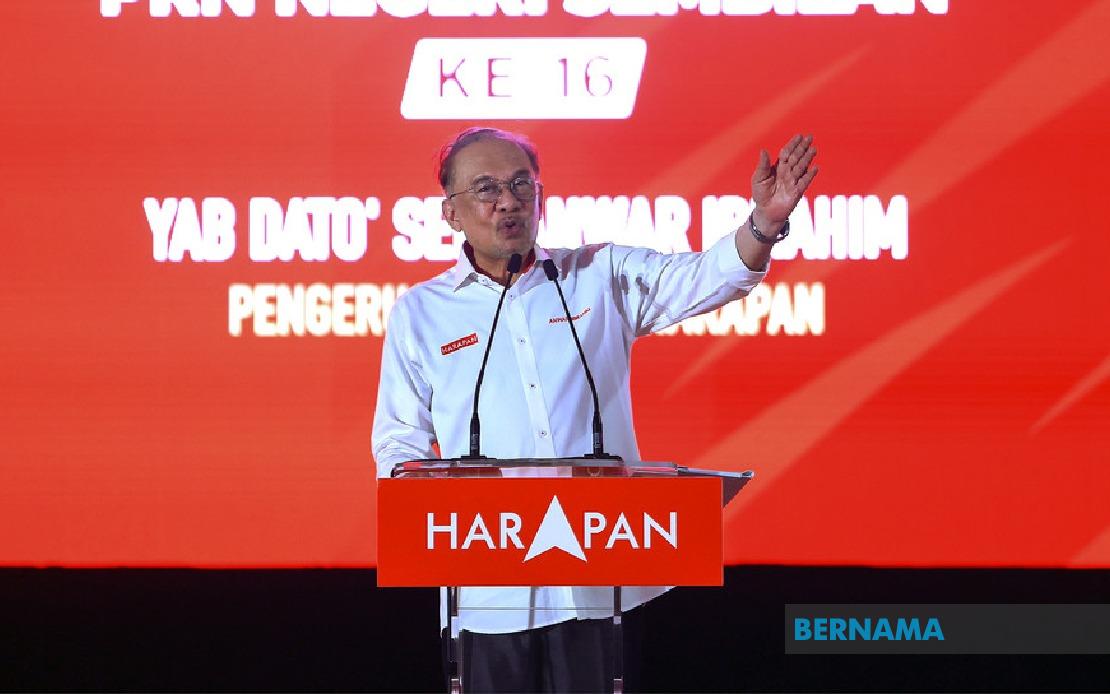
Prime Minister Datuk Seri Anwar Ibrahim is making a direct appeal to voters in Negeri Sembilan to maintain their support for Pakatan Harapan (PH) in the state election scheduled for August 1, framing the decision as critical to sustaining development momentum that has been built over recent years. Speaking through a Facebook post ahead of the nomination period, Anwar emphasised that voter confidence in the coalition remains the cornerstone of economic progress and administrative stability in the state.
The timing of Anwar's intervention reflects the high stakes surrounding the 16th Negeri Sembilan state election, coming at a period when the federal government is eager to consolidate its position in key states. The appeal carries particular weight given Anwar's dual role as Prime Minister and chairman of Pakatan Harapan, positioning his statement as both a personal endorsement and an official party directive. His choice to communicate through social media underscores the modern political landscape in which direct messaging to voters has become as important as traditional campaign rallies.
A cornerstone of Anwar's argument centres on the collaborative relationship between the state government under Menteri Besar Datuk Seri Aminuddin Harun and the federal administration. According to Anwar, this partnership has successfully delivered multiple development initiatives that would not have been possible under a divided political structure. The coordination between Kuala Lumpur and Seremban has allegedly streamlined funding approval processes and allowed for more efficient resource allocation, benefits that Anwar contends could be jeopardised if the state switches political hands.
Anwar's framing of Menteri Besar Aminuddin Harun as a leader of integrity and humility serves a dual strategic purpose. It elevates the incumbent state leader as a symbol of clean governance while simultaneously allowing the Prime Minister to distance himself from any potential criticism, presenting Aminuddin as the face of Negeri Sembilan's administration. This approach reflects broader Pakatan Harapan messaging about ethical governance, particularly relevant given Malaysia's ongoing efforts to rebuild institutional trust following previous administrations' scandals.
The development narrative that Anwar highlights resonates with Malaysian voters across multiple states where similar appeals have been made. Infrastructure projects, healthcare facilities, and educational institutions serve as tangible evidence of government performance, and in Negeri Sembilan, where economic diversification has been a policy priority, such projects take on heightened significance. The risk of halting progress midway—a metaphor Anwar explicitly employs—suggests that abandoning Pakatan Harapan would result in stalled initiatives and wasted investment.
From a Southeast Asian perspective, Anwar's campaign strategy reflects democratic practices common across the region, where incumbent governments leverage development achievements as election-winning credentials. However, it also highlights the vulnerability of coalition politics in Malaysia, where state-level electoral outcomes can reshape the broader political landscape and potentially affect federal government stability. A loss in Negeri Sembilan would represent a symbolic setback for Anwar's administration, even if the state's 36 seats remain comparatively modest within the larger national parliament.
The election timeline outlined by the Prime Minister—with nominations on Saturday, early voting on July 28, and polling on August 1—provides a compressed campaign period during which messaging intensity typically increases. Anwar's early public intervention suggests Pakatan Harapan is treating the race seriously and mobilising senior leadership to energise grassroots support. This approach indicates either confidence in the coalition's position or concern about competitive threats, likely from Perikatan Nasional, which has been gaining traction in several states.
For Malaysian readers, particularly those in Negeri Sembilan, the key takeaway centres on the tradeoff between continuity and change. Voters must weigh whether maintaining the current state-federal alignment offers sufficient benefits to outweigh potential alternatives, or whether new leadership could deliver comparable or superior governance outcomes. The development argument fundamentally rests on the assumption that a change in state government would disrupt federal funding flows and project implementation—an assertion that opposition parties would naturally contest.
Anwar's invocation of religious language—Alhamdulillah and Insya-Allah—reflects the cultural and spiritual dimensions of Malaysian political communication, reinforcing his appeal across diverse demographic groups. This linguistic choice, common among Malay-Muslim majority audiences, serves to ground his political argument within a framework of faith-based values, suggesting that supporting Pakatan Harapan aligns with principles of trustworthiness and communal welfare.
The broader implications for Malaysian politics extend beyond Negeri Sembilan itself. State elections serve as indicators of shifting voter sentiment and test various campaign strategies that parties may later deploy in federal contests. Success in Negeri Sembilan would strengthen Anwar's position within Pakatan Harapan and validate his coalition-building approach, while a disappointing result could embolden faction leaders questioning the current leadership structure. The stakes, therefore, transcend regional boundaries and directly impact the trajectory of Malaysian national politics over the coming years.

