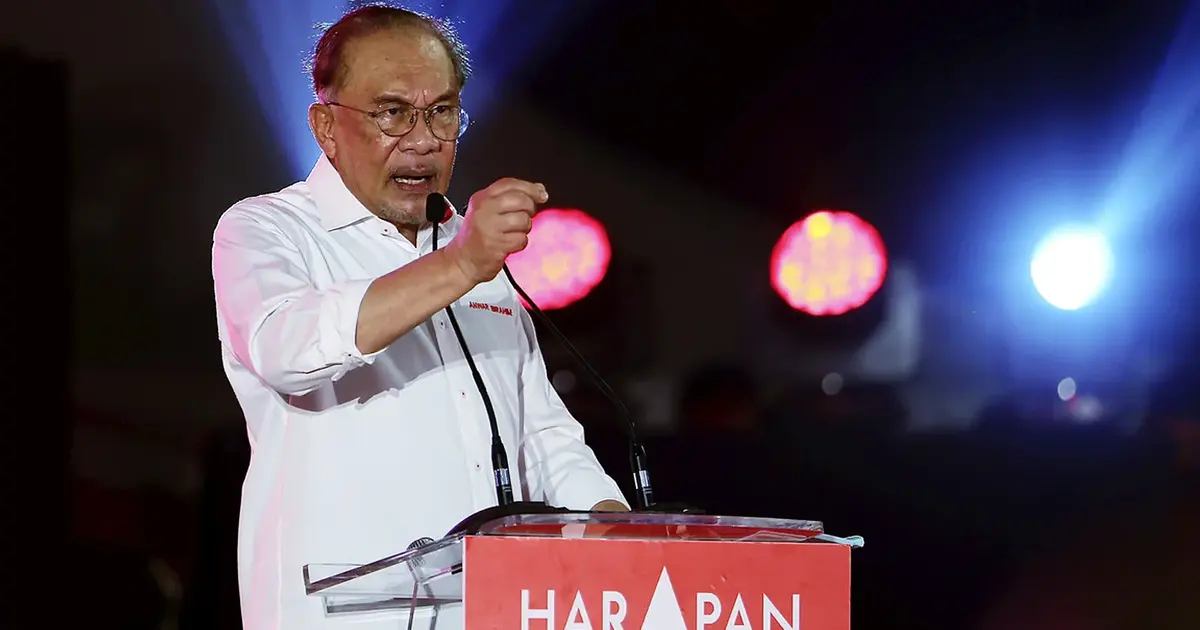
Prime Minister Anwar Ibrahim, in his capacity as Pakatan Harapan chairman, has issued a pointed appeal to contesting parties to refrain from entangling Negeri Sembilan's royal establishment in the upcoming state election campaign. The warning reflects growing concerns within the coalition about the potential misuse of sensitive constitutional and institutional matters for electoral advantage during what is expected to be a closely contested political battle in the state.
Anwar's intervention marks an attempt to establish boundaries around what should constitute legitimate campaign discourse in Negeri Sembilan. By explicitly cautioning against the politicisation of royal matters, the Prime Minister is effectively signalling that while robust policy debate and criticism of governance are acceptable election features, the institution of the monarchy and related constitutional questions should remain beyond the pale of partisan campaigning. This distinction underscores a particular Malaysian political sensitivity, where the role and prerogatives of the Malay rulers have historically transcended conventional party politics.
The timing of Anwar's statement carries significance in the broader context of Negeri Sembilan politics. The state, with its unique governance structures centred on the Yamtuan Negeri system, has experienced considerable political turbulence in recent years. The involvement of royal matters in electoral contests threatens to escalate tensions and potentially inflame communal sensitivities at a moment when political stability is already fragile. Anwar's appeal thus represents an effort to prevent the emergence of a dangerous precedent where constitutional institutions become ordinary campaign fodder.
From a Pakatan Harapan perspective, the call for restraint carries particular weight. The coalition, which has prided itself on institutional reform and democratic renewal, risks credibility damage if its own members or affiliated parties are perceived to be exploiting royal or constitutional issues for electoral purposes. By publicly setting this boundary, Anwar attempts to position the coalition as the custodian of constitutional propriety, thereby claiming moral authority in the campaign.
For opposition parties, the warning carries implicit consequences. Any attempt to leverage royal or institutional matters could invite swift criticism for breaching an established norm, potentially damaging their electoral prospects among voters who respect the monarchy and value institutional stability. This dynamic effectively constrains the campaign space available to all parties, but it does so with the implied endorsement of the sitting Prime Minister, giving his position considerable gravitational force.
Negeri Sembilan's unique constitutional framework makes the royalty issue particularly sensitive compared to other Malaysian states. The role of the Yamtuan Negeri, the monarch of the state, encompasses significant ceremonial and in certain contexts substantive powers that distinguish governance in the state from other federally administered regions. The intricate relationship between the state's royal institution and state government operations means that any campaign rhetoric targeting either entity risks touching sensitive nerves and unsettling delicate constitutional equilibria.
Historically, Malaysian elections have occasionally witnessed attempts to weaponise royal or religious matters, with mixed but often destabilising consequences. Anwar's preemptive statement aims to head off such tactics before they take root, setting expectations among campaign operatives and grassroots activists that crossing this particular line carries reputational and potentially electoral costs. The effectiveness of such appeals depends largely on whether all major contesting parties accept the implicit consensus and police their own ranks accordingly.
The appeal also reflects sophisticated campaign management. Rather than waiting for problems to emerge and then responding reactively, Anwar has moved to shape the campaign environment proactively. This approach demonstrates awareness that once royal issues enter campaign discourse, they become difficult to contain, with spillover effects potentially undermining political stability across broader society. Prevention, in this calculus, proves far preferable to damage control.
Regional observers will note that Anwar's statement comes amid broader Southeast Asian concerns about democratic backsliding and institutional erosion. Malaysia's approach to maintaining boundaries around sensitive constitutional matters even during intensely competitive elections offers a counterpoint to other regional trajectories. The fact that a sitting Prime Minister can still command sufficient influence to establish such norms speaks to residual institutional strength, though the very need to issue such warnings suggests vulnerabilities requiring monitoring.
For voters in Negeri Sembilan, the Prime Minister's intervention offers implicit guidance about which kinds of campaign appeals merit serious consideration and which represent concerning departures from democratic norms. Whether this translates into actual voter behaviour remains uncertain, but the framework it establishes shapes the terrain on which the election will be contested, potentially protecting certain matters from the usual rough-and-tumble of electoral politics.
The effectiveness of Anwar's appeal will ultimately be tested in the coming weeks as campaigns intensify. Should all major parties respect this boundary, it will represent a significant moment of institutional self-restraint in Malaysian politics. Conversely, any violations will rapidly demonstrate whether such appeals carry sufficient weight to deter determined political actors from pursuing advantage through institutional matters.

