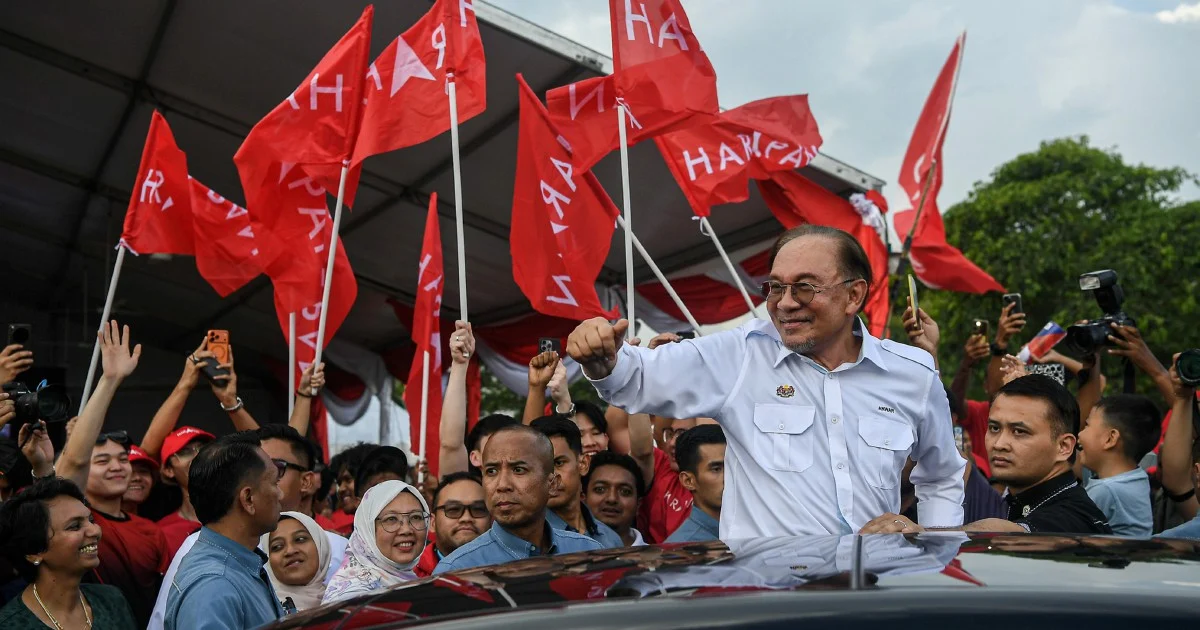
Speaking in Segamat, Pakatan Harapan chairman Datuk Seri Anwar Ibrahim launched a pointed criticism at political opponents who refuse to engage publicly with the Democratic Action Party, characterising their stance as fundamentally at odds with democratic norms and voter sentiment. The remarks underscore deepening tensions within Malaysia's complex political landscape, where DAP's prominence in the ruling coalition continues to provoke resistance from certain quarters despite the coalition's electoral victories.
Anwar's intervention reflects a recurring challenge facing PH: consolidating its diverse membership while countering narratives that delegitimise partnership with DAP, particularly among constituencies with entrenched reservations toward the party. Such criticisms often transcend ordinary political disagreement, touching on identity politics and religious sensitivities that resonate deeply across the Malaysian electorate. By reframing the issue as one of respecting democratic outcomes rather than defending DAP per se, Anwar positions the argument on firmer institutional ground.
The refusal by certain politicians to share platforms with DAP—whether at rallies, press conferences, or public forums—represents a form of political ostracism that carries symbolic weight beyond mere tactical avoidance. It signals to voters that a party is beyond the pale of legitimate political participation, a messaging strategy that can corrode confidence in inclusive governance. Anwar's critique suggests that such behaviour undermines not just PH's cohesion but Malaysia's broader democratic culture, which depends on contestants accepting the legitimacy of elected representatives and their parties.
DAP's position as PH's largest component party in Parliament, particularly following recent electoral performances, makes it impossible to sideline without fundamentally weakening the coalition's governing capacity. The party's representatives hold key ministerial and shadow positions, and their exclusion from public discourse creates practical governance challenges. When political actors decline to share platforms with DAP members, they effectively veto substantive engagement on policy matters where cross-party consultation might otherwise yield productive outcomes.
Anwar's comments arrive amid a broader reassessment of Malaysian politics following recent elections, which demonstrated voter willingness to support DAP-led or DAP-inclusive campaigns despite persistent concerns about the party's secular credentials and urban-centric base. The electoral mathematics suggest that voters, while expressing reservations about specific policies or approaches, ultimately prioritised government stability and the coalition's policy platform over abstract objections to DAP's participation. Anwar's invocation of voter respect transforms this electoral reality into a moral argument: if voters chose PH knowing DAP was central to it, respecting those voters means accepting DAP's legitimacy.
The controversy also reflects Malaysia's persistent struggle with political inclusivity. The country's federal system, diverse electorate, and competitive party ecosystem create natural fissures along religious, ethnic, and ideological lines. However, stable democracy requires mechanisms for bridging these divides—mechanisms that fundamentally depend on all major parties treating one another as legitimate competitors rather than existential threats. Politicians who refuse to share platforms effectively reject this foundational principle, signalling that their opposition runs deeper than policy disagreement.
For PH more broadly, Anwar's intervention serves a strategic purpose beyond the immediate messaging battle. It establishes a clear principle that coalition membership entails accepting all constituent parties' legitimacy, effectively setting a baseline for internal cohesion. This matters because PH's stability depends partly on preventing member parties from pursuing parallel political strategies that contradict their coalition commitment. When partners publicly stigmatise DAP, they create space for other members to adopt similar tactics toward different targets, potentially unravelling the coalition's internal consensus.
The practical implications extend to Southeast Asia's broader political context, where Malaysia remains a bellwether for how religiously and ethnically diverse democracies manage coalition governance. If major coalitions can sustain themselves despite one member party facing sustained delegitimisation campaigns by ostensible partners, Malaysian democracy's resilience faces serious questions. Conversely, if coalition partners can establish shared norms of mutual acceptance and equal standing, Malaysia might model approaches valuable for other regional democracies grappling with similar pressures.
Anwar's emphasis on voter choice carries particular resonance for Malaysian audiences accustomed to elections determining outcomes. The implicit argument—that voters, through their ballots, have rendered judgement on DAP's suitability as a governing partner—appeals to democratic legitimacy that transcends partisan interest. This framing makes criticism of DAP's opponents about institutional principle rather than DAP advocacy per se, subtly shifting the moral weight of the debate.
Looking ahead, the question remains whether Anwar's intervention will shift behaviour among politicians inclined to avoid DAP associations. His authority as PH chairman grants him standing to make such appeals, but enforcing coalition discipline requires more than rhetorical pressure. The coalition's viability may ultimately depend on whether all members recognise that preserving it requires treating one another as genuine partners rather than merely tactical allies, a distinction that determines whether PH remains a functional governing vehicle or becomes increasingly fractious as electoral pressures mount.

