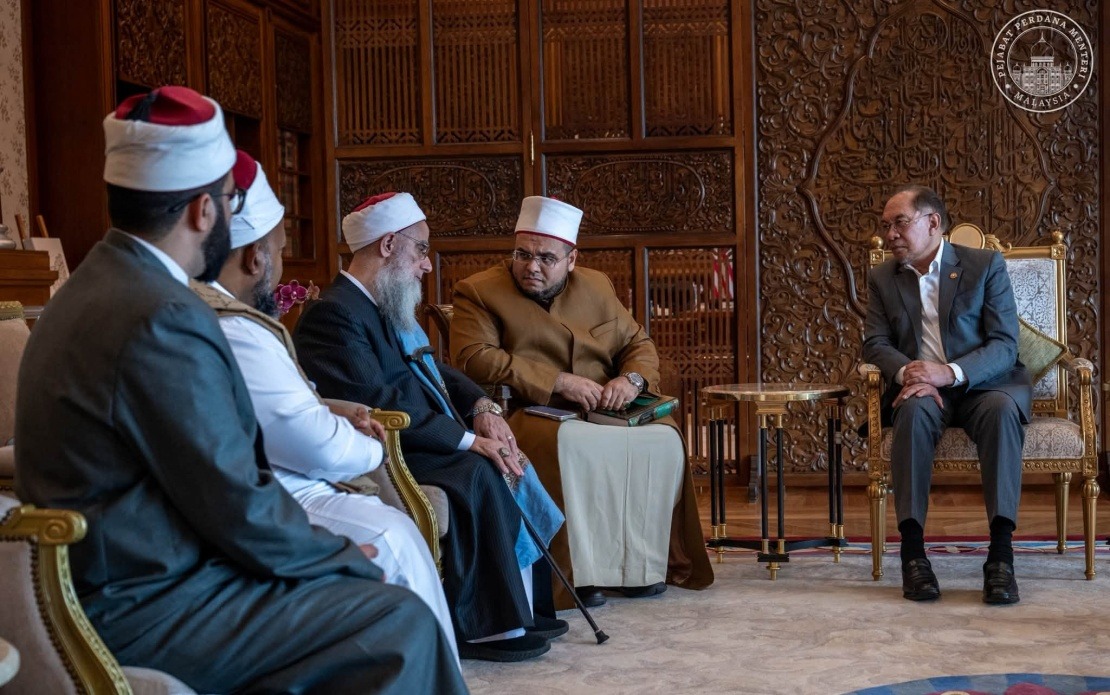
Prime Minister Datuk Seri Anwar Ibrahim received a courtesy visit from celebrated Egyptian Islamic scholar Sheikh Dr Mustafa An-Nadwi Al-Hasani at his Putrajaya office on July 20, in what officials described as an engagement reinforcing Malaysia's standing as a hub for Islamic learning and interfaith dialogue. The meeting underscored the government's commitment to fostering intellectual exchange with leading figures in Islamic scholarship across the Muslim world, particularly those representing orthodox Islamic traditions emphasizing scholastic rigour and moral philosophy.
Sheikh Dr Mustafa, based in Mansurah, Egypt, commands significant influence within contemporary Islamic academic circles as a specialist in hadith sciences and Islamic jurisprudence. His scholarly credentials carry particular weight given his direct lineage to Sheikh Abul Hasan Ali al-Nadwi, the twentieth-century Islamic luminary whose works profoundly shaped modern Islamic thought across the Arab world and South Asia. This generational connection positions Sheikh Dr Mustafa within an intellectual tradition that balances traditional Islamic learning with engagement on contemporary issues affecting Muslim societies.
During their discussion at the Putrajaya office, Anwar characterized the visiting scholar as representing a counterpoint to contemporary trends in public discourse. The Prime Minister's public remarks, shared through social media, emphasized Sheikh Dr Mustafa's dedication to preserving rigorous intellectual standards and ethical foundations within Islamic scholarship. Anwar highlighted the scholar's commitment to hadith studies specifically, a disciplinary field requiring meticulous textual analysis, chain-of-transmission verification, and contextual interpretation—methodologies that demand patience and sustained intellectual engagement rather than sensationalism.
Anwar's framing of this visit carried implicit commentary on the information environment in Malaysia and globally. By contrasting the "quiet, gentle" arrival of genuine knowledge with the oversized influence of sensationalism in contemporary media landscapes, the Prime Minister articulated a concern resonating across Southeast Asian societies grappling with information saturation and the polarizing effects of social media amplification. The metaphor of knowledge arriving "like morning dew"—nourishing yet unobtrusive—reflected a philosophical orientation valuing substance over spectacle, precision over populism.
The bilateral exchange encompassed substantive conversations regarding current regional and global affairs, suggesting engagement beyond ceremonial pleasantries. Malaysia's multicultural political context and its navigation of Islam's role in a plural society represent topics of ongoing interest to international Islamic scholars seeking to understand how Muslim-majority democracies balance religious identity with inclusive governance. Sheikh Dr Mustafa's expertise in reconciling traditional Islamic learning with contemporary social dynamics positioned such discussions as mutually beneficial, with the visitor potentially gaining insights into Southeast Asian Islamic intellectual development while sharing perspectives from the broader Islamic scholarly establishment.
Anwar's public acknowledgment of Sheikh Dr Mustafa's knowledge dissemination activities during his Malaysia visit indicated a broader programming component to the Egyptian scholar's presence. Beyond the formal governmental meeting, the visiting scholar apparently conducted educational sessions, lectures, or seminars targeting Malaysian Islamic intellectuals, students, and community leaders. Such engagement contributes to Malaysia's positioning as a destination for advanced Islamic learning and cross-pollination of ideas within global Islamic academic networks, competing with traditional centres of learning in the Middle East, Pakistan, and Indonesia for influence among Southeast Asian Muslims seeking theological and intellectual development.
The timing of this visit reflects Anwar's strategic emphasis on Islamic scholarship and moral philosophy as anchors for Malaysia's development trajectory. Since assuming the premiership, Anwar has consistently highlighted the compatibility between Islamic principles and democratic governance, economic development, and social cohesion. Welcoming prominent Islamic scholars reinforces this narrative while signalling to the Malaysian Muslim constituency that intellectual and spiritual concerns occupy significant space within the government's strategic priorities. This positioning counters perceptions that modern governance necessarily marginalizes religious considerations, instead presenting Islam as enriching rather than constraining national development.
Sheikh Dr Mustafa's scholarly specialization in hadith sciences carries particular resonance within Southeast Asian Islamic communities historically influenced by Southeast Asian Islamic scholars trained in Middle Eastern centres. Hadith methodology represents foundational knowledge for Islamic legal reasoning, theological interpretation, and the authentication of religious practice. By hosting scholars advancing rigorous hadith scholarship, Malaysia maintains intellectual connections to these classical Islamic disciplines while positioning itself as a venue where such advanced learning remains vibrant and relevant to contemporary Muslim societies.
Anwar's expression of prayers for Sheikh Dr Mustafa's wellbeing and continued scholarly contributions, coupled with requests for the visitor's intercession on Malaysia's behalf, reflected customary diplomatic courtesy extended to visiting religious figures. Yet these gestures also communicated deeper connections between Malaysia's stability and prosperity to broader Islamic scholarly networks. The implicit message suggested that Malaysia's wellbeing transcends secular governance and economic metrics, becoming interwoven with moral and spiritual dimensions represented by figures of scholarly stature and spiritual authority.
The visit occurred within broader patterns of Malaysian engagement with international Islamic intellectual networks. As Malaysia navigates complex questions regarding Islamic identity, secular governance, religious diversity, and development priorities, connections with established Islamic scholars offer perspectives grounded in centuries of Islamic intellectual tradition. Sheikh Dr Mustafa's presence symbolized how Malaysian policymakers draw on transnational Islamic resources when formulating responses to challenges intersecting faith, politics, and contemporary social realities affecting Southeast Asian Muslim communities.

