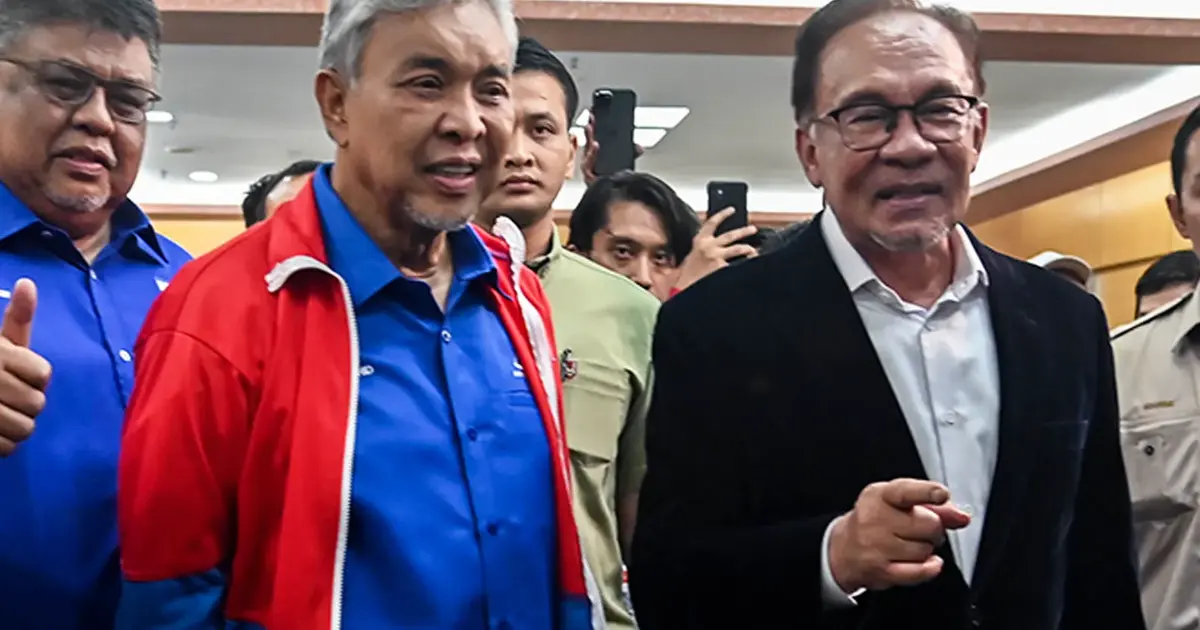
Relations between Prime Minister Anwar Ibrahim and UMNO President Ahmad Zahid Hamidi have reached unprecedented lows, according to observations by political commentator Khairy Jamaluddin, reflecting deepening fractures within Malaysia's governing coalition ahead of critical state elections. The deterioration stems directly from strategic disagreements over how Barisan Nasional and Perikatan Nasional should contest seats in Negeri Sembilan, with the botched alliance arrangement exposing fundamental misalignments between UMNO's leadership and the Pakatan Harapan-led federal government.
Khairy's assessment carries particular weight given his position as a former minister with access to inner political circles. His characterisation of the situation as a "massive rupture" between the two major components of Malaysia's ruling machinery suggests the damage extends far beyond routine inter-party bickering. The Negeri Sembilan state election has become a flashpoint for broader coalition tensions that have been simmering beneath the surface since the Unity Government's formation. What began as tactical disagreements over seat allocation has metastasised into a fundamental trust crisis that threatens the stability of the federal administration.
The BN-PN arrangement for Negeri Sembilan illustrates how coalition partners can rapidly undermine each other's positions when pursuing state-level advantages. Rather than presenting a unified front, both blocs attempted to maximise their respective seat wins, creating confusion among voters and party members alike. This fragmentation directly contradicts the stated objective of the Unity Government—to deliver stable, coherent governance after years of political turbulence. Instead, Malaysian citizens witnessed two major ruling coalitions essentially operating at cross-purposes in a single state election, undermining the very unity that justified their government partnership.
For Anwar Ibrahim, this trust deficit with Zahid presents a significant governance challenge. The Prime Minister depends on continued UMNO support to maintain his parliamentary majority and implement his administration's policy agenda. When the relationship between these two powerful figures deteriorates, it creates uncertainty throughout the government apparatus and weakens the administration's ability to execute decisions with conviction. Civil servants, investors, and regional partners all monitor such relationships as barometers of governmental stability and decision-making capacity.
Zahid's position adds another layer of complexity to this dynamic. As UMNO President and the party's de facto leader, he wields considerable influence over the party's parliamentary caucus. His relationship with Anwar effectively determines whether UMNO deputies will vote reliably on government measures, support key legislation, or potentially destabilise the administration. A deteriorating trust relationship increases the likelihood of backbench rebellions, legislative delays, and policy reversals that can cripple government effectiveness.
The underlying causes of this rupture reflect competing visions for Malaysia's political future. UMNO leadership may perceive Anwar as sidelining Barisan Nasional in favour of his own Pakatan Harapan base, while simultaneously attempting to position itself as the primary beneficiary of state elections. Conversely, Anwar's administration may view UMNO's willingness to align with Perikatan Nasional—a coalition that includes Parti Islam Se-Malaysia, which traditionally opposes Pakatan—as a betrayal of the Unity Government's foundational principles. These fundamental disagreements about coalition loyalty and political strategy cannot be easily resolved through conventional diplomatic channels.
The regional implications of this deterioration deserve consideration. Negeri Sembilan, while not the most economically dominant Malaysian state, holds symbolic significance in understanding broader coalition dynamics. The state election serves as a testing ground for how BN, PH, and PN can coexist in Malaysia's political ecosystem. A successful, harmonious state election might have reinforced confidence in the Unity Government model; instead, the discord signals potential instability that could influence investor sentiment and regional partner perceptions of Malaysian governance.
Historically, trust deficits between coalition partners often precede broader governmental crises. When personal relationships between top leaders deteriorate and joint decision-making becomes contentious, the effects cascade downward through party organisations and government machinery. Committee work becomes adversarial, policy development slows, and parliament becomes a battleground rather than a legislative chamber. Malaysia has experienced these dynamics during previous coalition governments, and the warning signs appear increasingly apparent in the current administration's trajectory.
The timing of this crisis also merits scrutiny. With Negeri Sembilan elections concluded and their outcomes still reverberating through political circles, attention now focuses on whether both sides can rebuild sufficient working relationships to sustain the government. The window for remediation may be closing; continued erosion of trust could trigger political realignments that reshape Malaysia's governing landscape. Anwar must determine whether UMNO remains a reliable coalition partner or whether alternative arrangements might prove necessary. Simultaneously, Zahid faces questions about whether continued involvement in the Unity Government serves UMNO's strategic interests.
Government stability depends ultimately on the willingness of coalition partners to subordinate short-term electoral interests to medium-term governance objectives. The Negeri Sembilan episode demonstrates this principle in reverse—immediate state-level advantages were pursued at the cost of federal stability and mutual confidence. Whether both leaders can recalibrate their approach and recommit to coherent coalition governance remains the critical question facing Malaysian politics in coming months.

