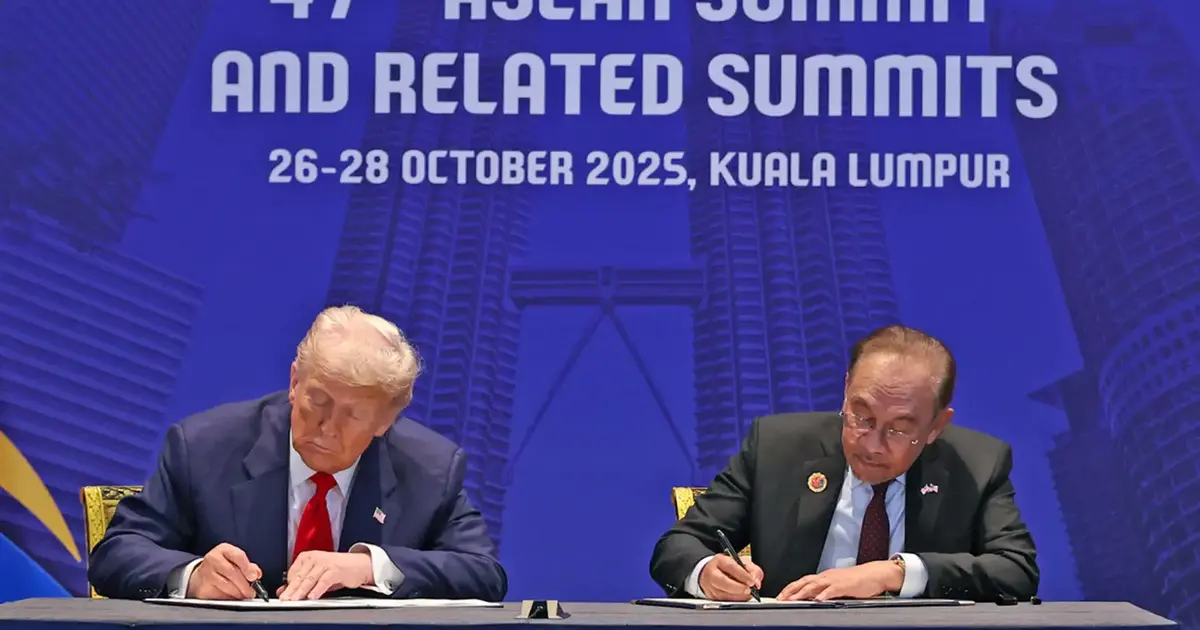
The administration of Prime Minister Anwar Ibrahim has launched a formal application to eliminate a lawsuit brought by members of the opposition contesting the constitutional validity of a reciprocal trade arrangement between Malaysia and the United States. This procedural move represents a significant escalation in the political and legal tensions surrounding the trade pact, which has proven controversial across the country's partisan divide.
The application to strike out the suit comes as the opposition parliamentarians simultaneously pursued a parallel legal strategy, filing their own motion requesting that constitutional questions arising from the trade agreement be elevated directly to the Federal Court for determination. This two-pronged legal approach by the MPs reflects the profound constitutional questions at stake regarding how international commercial agreements should be ratified and implemented within Malaysia's governmental structure.
The Malaysia-US reciprocal trade agreement has emerged as a contentious issue in recent months, generating substantial debate within parliament and civil society. Trade agreements of this magnitude typically involve complex negotiations spanning multiple sectors of the economy, from agriculture and manufacturing to services and intellectual property. The opposition's legal challenge signals that there are substantive disagreements about whether the government followed proper constitutional procedures in entering into such commitments without what they argue constitutes adequate parliamentary oversight or approval.
Constitutional scholars and legal observers have noted that Malaysia's framework governing international treaties contains inherent ambiguities about the precise roles of the executive branch, parliament, and the courts. The question of whether a reciprocal trade agreement requires explicit parliamentary ratification or merely governmental authorization remains contested territory in Malaysian constitutional jurisprudence. These unresolved questions have become increasingly salient as Malaysia deepens its involvement in regional and global trade frameworks, from the Comprehensive and Progressive Agreement for Trans-Pacific Partnership to bilateral arrangements with major trading partners.
The government's decision to seek dismissal of the suit through procedural mechanisms rather than engaging substantively with the constitutional arguments suggests confidence in the legal foundations of its position. However, this strategy also carries political risk, as it may be perceived by opposition supporters and trade critics as an attempt to avoid transparent judicial examination of the government's actions. The court's response to the strike-out application will provide important signals about how Malaysia's judiciary approaches cases involving the separation of powers and executive prerogative in international relations.
For Malaysia's business community and trading partners, the outcome of this legal dispute carries material consequences. Trade agreements establish the rules governing tariffs, investment protections, and market access for companies operating across borders. Uncertainty about the legal validity of such arrangements, if it persists for extended periods, can create hesitation among investors and complicate the implementation of agreed trade provisions. The United States, which has pursued reciprocal trade agreements as a cornerstone of its commercial strategy, will be monitoring how Malaysian courts treat this challenge.
The timing of these legal maneuvers reflects broader tensions within Malaysia's political landscape. Since assuming office, the Anwar administration has pursued a relatively expansive international trade agenda as part of its economic development strategy. This approach has drawn scrutiny from opposition figures who argue that such agreements warrant more rigorous parliamentary scrutiny and that their terms sometimes impose constraints on Malaysia's domestic policy flexibility. The trade pact with the United States, a major economic power, has particularly attracted attention given the breadth of sectors potentially affected.
The constitutional questions that the opposition MPs seek to elevate to the Federal Court touch upon fundamental principles of governance. They include interrogating whether international agreements fundamentally altering Malaysia's domestic economic landscape require something beyond cabinet approval, whether parliament should have explicit authority to consent or reject such arrangements, and how Malaysia's constitutional structure allocates decision-making power in this domain. These questions extend beyond the specific trade agreement at hand and bear implications for how the country structures its engagement with future international commercial initiatives.
The Federal Court's potential involvement in these constitutional questions would represent a significant moment in Malaysian constitutional law. If the court agrees to hear the referral, it would have an opportunity to establish clearer precedent regarding executive authority in international commerce, a domain that has historically received less judicial scrutiny than other areas of constitutional law. Such clarification could reshape how future governments approach trade negotiations and how parliament exercises its oversight functions.
For Malaysia's citizens and civil society organizations concerned with trade policy, this legal dispute offers a potential pathway for broader public participation in decisions affecting the national economy. If the court determines that parliamentary involvement is constitutionally required, it could establish a framework for more transparent deliberation about trade agreements before they become binding obligations. Conversely, if the court upholds government authority to enter such agreements without specific parliamentary approval, it would affirm the executive's considerable discretion in international commerce.
The opposition's simultaneous pursuit of strike-out dismissal by the government and constitutional referral creates a complex procedural landscape. The trial court must first determine whether to allow the suit to proceed or grant the strike-out application. Only if the suit survives this threshold will the question of constitutional referral likely be resolved. This sequencing means that Malaysian courts will deliberate these questions over coming months, with the specific trade provisions potentially remaining in legal limbo during this process.
Beyond the immediate dispute, this litigation reflects evolving sophistication in how Malaysia's political actors engage with constitutional law and judicial processes. Rather than purely legislative or executive confrontation, opposition parties are increasingly channeling their objections through the courts, seeking to establish legal precedents that constrain executive power. This trend suggests that Malaysia's courts will face growing demands to articulate clearer constitutional principles governing economic governance and international relations—domains that previously received limited judicial attention.
The case underscores broader questions about democratic legitimacy in trade policymaking. As international commerce becomes ever more complex and consequential for national economies, questions about whether conventional executive decision-making structures remain appropriate gain urgency. Whether Malaysia's courts will address these deeper governance questions or confine themselves to narrower procedural rulings remains to be seen, but the decision will significantly influence how the country conducts international commerce in coming years.