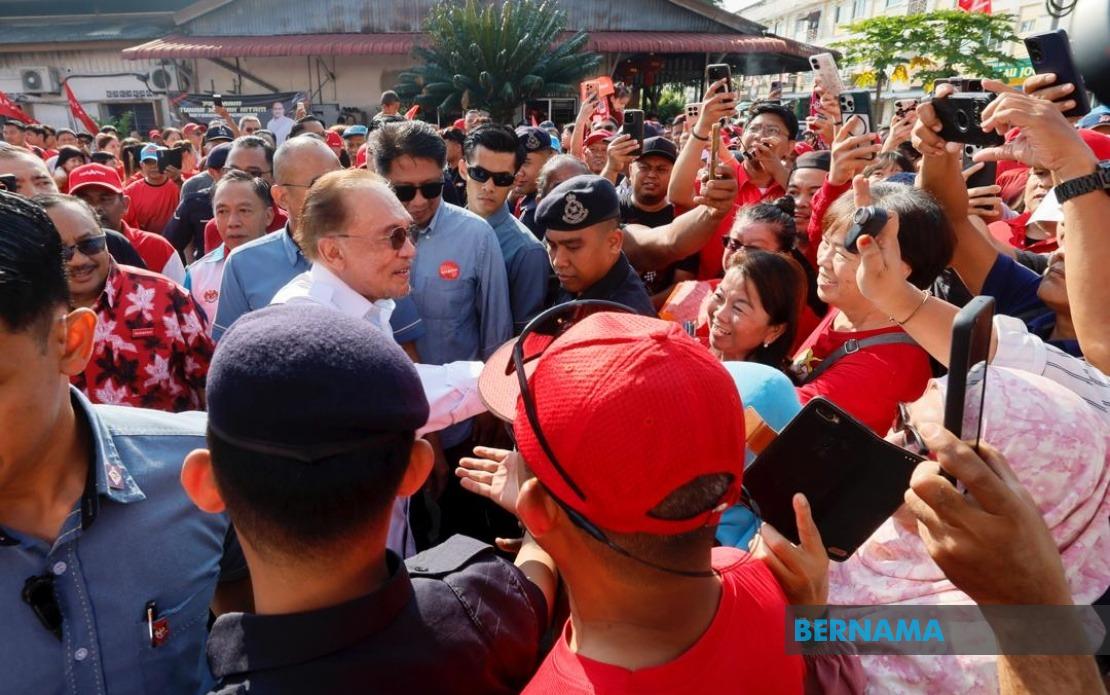
Prime Minister Datuk Seri Anwar Ibrahim's arrival in Johor on the ninth day of the state election campaign has galvanised the Pakatan Harapan machine in two key constituencies, signalling the coalition's determination to make substantial gains in what has become one of Malaysia's most contested elections. The timing of the visit to Machap and Layang-Layang constituencies, just days before the July 11 polling date, underscores the strategic importance of the Simpang Renggam parliamentary area and its surrounding state seats to PH's overall electoral prospects in the southern state.
Nur Hafiz Roslan, who is contesting the Machap state seat, described the Prime Minister's presence as transformative for campaign morale and organisational energy. He emphasised that Anwar's personal engagement conveyed a philosophical direction for the campaign grounded in public service rather than political antagonism. The message from the PH chairman stressed that campaign workers and candidates should approach their duties as a form of righteous service, prioritising community welfare above partisan considerations. This framing appears designed to present Pakatan Harapan's candidates as motivated by principle rather than personal ambition, a distinction that carries weight in Malaysian electoral politics where cynicism about politicians remains widespread.
The practical implications of this messaging strategy are evident in how Nur Hafiz articulated the campaign's immediate goals. He committed to delivering services without discrimination, suggesting that PH's appeal extends beyond its traditional voter base to encompass all demographic groups within the Simpang Renggam area. This inclusive positioning is particularly significant in constituencies with mixed populations, where winning requires building coalitions across ethnic and religious lines. By framing service delivery as non-partisan and universal, PH candidates attempt to neutralise concerns that they may favour certain communities over others.
Guna Balakrishnan, the PH candidate for Layang-Layang, expressed parallel sentiments, noting that the Prime Minister's visit had strengthened his capacity to engage with residents and reinforced the expectation that electoral success carries responsibility for tangible development. This point merits attention in the Malaysian context, where voters increasingly judge political leaders on infrastructure projects, economic opportunities, and visible improvements to their constituencies. Anwar's reportedly direct instruction to ensure area development if given the mandate transforms the campaign from abstract political positioning into a performance contract understood by both candidate and electorate.
The public event itself, styled as an informal breakfast gathering called 'PMX Santai Sarapan Bersama Masyarakat', attracted more than one thousand residents to Simpang Renggam. The casual, approachable format appears deliberately designed to contrast with formal, hierarchical political spectacles and to present the Prime Minister as accessible and relatable. The choice of a breakfast programme rather than a formal rally suggests a deliberate strategy to humanise the campaign and create informal spaces where constituents might feel comfortable approaching candidates and discussing local concerns. This approach acknowledges evolving voter preferences for less stage-managed political engagement.
The feedback from attendees reveals the psychological impact of direct Prime Ministerial engagement on voter confidence. Chuan Chee Mei, a 48-year-old resident, reported that witnessing Anwar's visible commitment to candidates and willingness to participate in grassroots community activities reinforced her decision to support PH. This observation highlights an important dynamic in Malaysian politics: voters often interpret a national leader's campaign involvement as an indicator of a candidate's viability and the coalition's seriousness about winning specific seats. When a Prime Minister personally campaigns in a constituency, it signals internal party confidence and organisational capacity, factors that influence undecided voters.
Noor Takiyudin Salleh's comment about the Prime Minister's approachable demeanour and the substantial crowd size suggests that voter turnout at campaign events itself carries value as a signal of momentum and public interest. In the Malaysian electoral context, the ability to draw large crowds and sustain visible enthusiasm functions as a proxy for grassroots support and organisational strength. The attendance figure of more than one thousand people becomes a data point that campaigns circulate to demonstrate popular backing, particularly in the final days before voting when undecided voters may be swayed by perceptions of which coalition is gaining momentum.
The broader context of the Johor state election involves 172 candidates competing for 56 state seats, a competitive environment where marginal gains matter significantly. Pakatan Harapan's strategy of deploying the Prime Minister in person to contested constituencies reflects the razor-thin margins that may determine overall outcomes. In elections where victories and defeats are measured in hundreds of votes, the morale-boosting effect of Prime Ministerial engagement and the resulting media coverage provide tangible campaign benefits. Early voting scheduled for July 7, preceding the main polling date by four days, means that campaigns must maintain momentum throughout the final week.
The significance of the Machap and Layang-Layang constituencies extends beyond their individual electoral value. These seats fall within the Simpang Renggam parliamentary area, suggesting that PH views this region as crucial to its parliamentary representation in Johor. Winning multiple state seats within the same parliamentary constituency creates reinforcing effects, as state representatives can work collaboratively to address constituent concerns and deliver visible development benefits. Conversely, a mixed result where one coalition wins certain state seats while losing others complicates governance and may dilute service delivery effectiveness.
From a broader Southeast Asian perspective, the Johor election reflects intensifying electoral competition across Malaysia that mirrors regional patterns. Coalition-based electoral politics, demographic shifts, and voter demands for performance-oriented leadership are reshaping how Malaysian parties campaign and govern. The emphasis on service delivery, area development, and community engagement evident in this campaign resonates with voter priorities across Southeast Asia, where rapid urbanisation and economic pressures have heightened expectations for tangible governmental performance.
The Prime Minister's personal involvement in constituency-level campaigning also reveals organisational calculations about resource allocation. Rather than dispersing senior leadership across numerous constituencies, PH appears to be concentrating Anwar's presence in constituencies deemed winnable but competitive, a strategy that maximises the return on his limited campaign time. This targeted approach requires accurate voter research and internal polling to identify which seats represent the coalition's best opportunities for gains, and which seats are already secure or hopelessly lost.
Looking forward to July 11, the campaign momentum generated by Anwar's visit and the accompanying media coverage will likely persist through early voting and into polling day itself. The narrative of a Prime Minister engaged in grassroots campaigning, accessible to ordinary residents, and committed to service-oriented leadership provides PH with a compelling counter-narrative to opposition messaging. Whether this campaign energy translates into actual electoral gains will depend on the efficacy of ground organisation, the effectiveness of opposition strategies, and the turnout decisions of voters across Johor's diverse constituencies.

