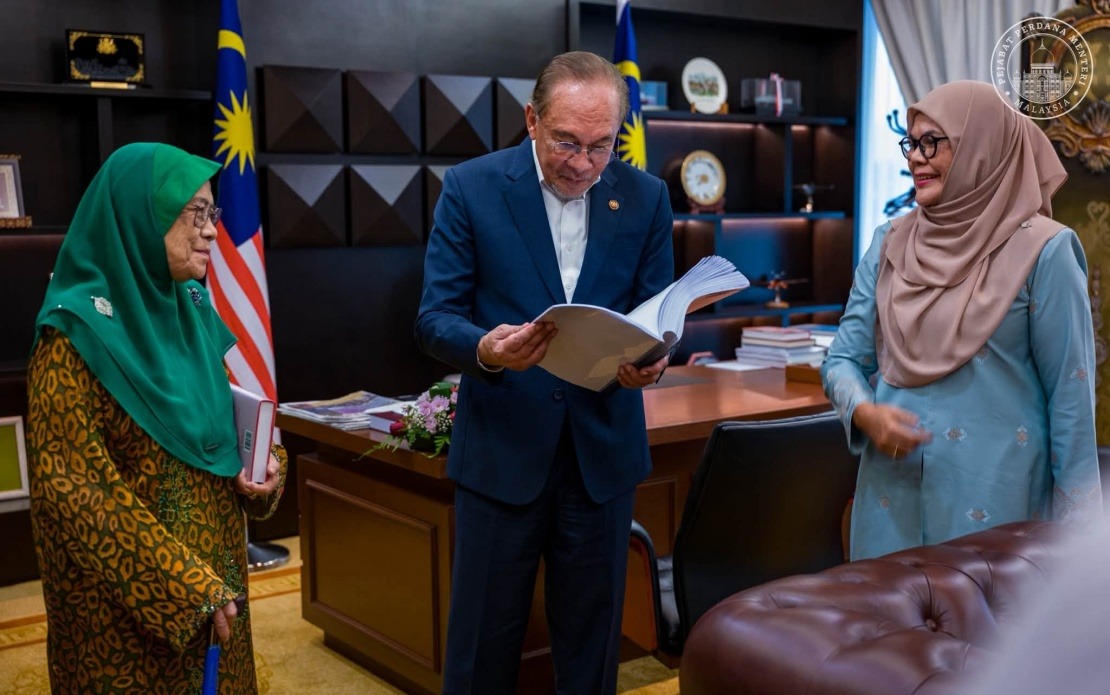
Prime Minister Datuk Seri Anwar Ibrahim has expressed optimism that a newly-published book encapsulating his political philosophy and ideological framework will become an enduring resource for Malaysian policymakers and thought leaders in decades to come. In comments shared on social media, Anwar underscored the significance of preserving his intellectual contributions to contemporary discussions around governance, national development, and the cultivation of personal and civic values among Malaysians.
The volume, authored by Professor Dr Salinah Ja'afar from the Academy of Malay Studies at Universiti Malaya, represents a scholarly attempt to systematically capture and articulate the Prime Minister's evolving worldview. Ja'afar, who holds academic credentials as both a linguist and lecturer, undertook the ambitious project of translating Anwar's varied pronouncements, writings, and public discourse into a cohesive analytical framework suitable for academic and public consumption.
Anwar's involvement in the manuscript's development extended beyond passive endorsement. He actively reviewed the draft material and supplied substantive feedback to ensure accuracy and completeness. Recognising the need for rigorous scholarly oversight, the authors enlisted Professor Emeritus Datuk Dr Nik Safiah Abdul Karim, an internationally respected specialist in Malaysian language and linguistics, to serve as academic adviser throughout the book's preparation. This collaborative structure reflects an effort to ground the project in credible scholarly methodology rather than presenting it as mere political promotion.
The Prime Minister also participated in exclusive interviews conducted by both Ja'afar and Nik Safiah specifically for the book, allowing him to elaborate on themes and concepts that might otherwise remain inaccessible to readers. These discussions were designed to provide comprehensive coverage of the intended subject matter, ensuring that the final publication captures the depth and nuance of Anwar's thinking across multiple domains.
In his statement, Anwar acknowledged the author's considerable labour in attempting to document and communicate his accumulated ideas, perspectives, and intellectual approach—elements he attributed to his personal experiences, extensive reading habits, and reflective engagement with Malaysia's political and social landscape. The acknowledgment hints at a broader ambition: transforming what might otherwise remain scattered across speeches, articles, and policy decisions into an organised, accessible archive of contemporary Malaysian political thought.
For Malaysian observers, the emergence of such a book carries several implications. First, it signals an attempt by the current Prime Minister to secure intellectual legacy at a moment when his government faces substantive policy challenges and political pressures. Second, it reflects a conscious effort to position his tenure as philosophically coherent rather than merely reactive to circumstances. Third, it suggests confidence that his approach to governance and nation-building possesses enduring value worth preserving in written form for scholarly reference.
The focus on nation-building and personal values as central themes aligns with Anwar's long career trajectory in Malaysian politics, encompassing his earlier roles in student activism, Islamic movements, and reform-oriented governance. By framing the book as intended for future generations, he implicitly suggests that his ideas transcend immediate political utility and possess applicability to perennial questions facing Malaysian society.
The involvement of distinguished academics like Nik Safiah, whose scholarly reputation extends well beyond Malaysia's borders, lends the project academic credibility. Her role as adviser signals an effort to meet standards of intellectual rigor expected in serious scholarship, rather than producing a straightforward political memoir or campaign document. This distinction matters for whether the publication will gain traction within university settings and among intellectuals inclined toward critical engagement with political ideas.
For Southeast Asian readers more broadly, the book represents a window into how contemporary Malaysian leadership conceptualises governance challenges and nation-building priorities. It offers insight into how a major regional political figure reconciles Islamic principles, democratic governance, economic development, and social cohesion—questions relevant across the region's diverse political landscape.
The publication also reflects broader trends in Malaysian politics toward greater documentation and intellectualisation of political narratives. As Malaysia grapples with questions of democratic consolidation, institutional reform, and social unity following political turbulence in recent years, frameworks for understanding leadership philosophy gain heightened relevance. Whether Anwar's documented ideas ultimately influence future policy directions or simply serve as historical testimony remains an open question, but the attempt to codify them signals recognition that intellectual coherence matters to political legitimacy in contemporary Malaysia.

