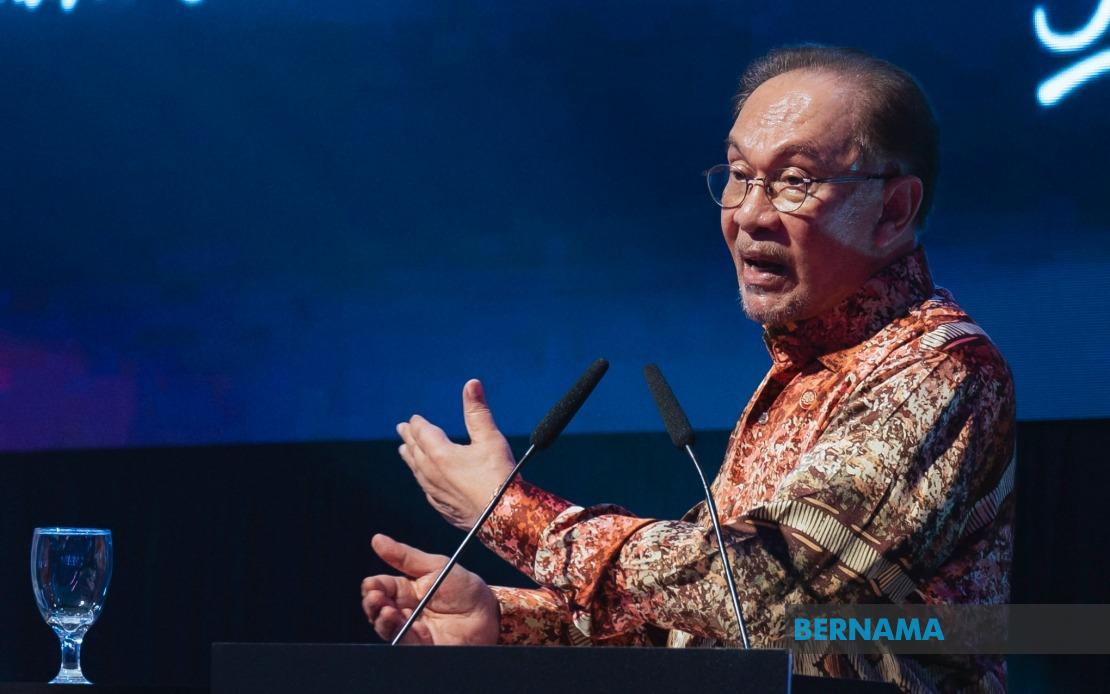
Prime Minister Datuk Seri Anwar Ibrahim's recent comments on Taiwan have drawn scrutiny for appearing to acknowledge China's stated willingness to use force if peaceful reunification fails. Yet a closer examination reveals the remarks were neither an endorsement of military action nor a departure from Malaysia's longstanding diplomatic framework. Instead, they articulate a principle central to international relations theory: that deterrence requires the credible possibility of defensive capability, even when nations genuinely prefer negotiated outcomes.
Anwar's core argument rested on an analogy grounded in Malaysian experience. He contended that no government would passively accept the fragmentation of its territory without mounting resistance. This observation, while straightforward, carries implications that extend beyond Taiwan. It reflects a fundamental premise underlying state behaviour: territorial integrity remains a non-negotiable interest for any nation, regardless of how that nation came into being or the current political divisions within it. Malaysia itself, as a federation comprising distinct states and populations, would undoubtedly defend its territorial cohesion if faced with secessionist movements or external pressure to dissolve. To suggest otherwise would be to deny the elementary self-interest that motivates state action.
The distinction between possessing deterrent capacity and actively seeking conflict is crucial to understanding the Prime Minister's position. Deterrence theory, a cornerstone of strategic thinking since the Cold War, posits that the availability of defensive or retaliatory options—coupled with the credible will to employ them—can prevent aggression more effectively than appealing to goodwill alone. This does not mean force becomes the preferred instrument. Rather, it means that renouncing force entirely removes a barrier to potential challengers and can paradoxically increase the likelihood of conflict by eliminating the costs associated with aggression. In the Malaysian context, such thinking has long guided defence policy, which emphasises maintaining sufficient military capability to deter threats whilst pursuing diplomatic and legal remedies whenever possible.
Within Malaysia's stated One China policy, Anwar's remarks assume particular significance. Malaysia recognises the People's Republic of China as the legitimate government of China and does not accord Taiwan formal diplomatic recognition as a separate sovereign entity. Simultaneously, Malaysia maintains robust economic relationships and cultural exchanges with Taiwan, a pragmatic approach that acknowledges geopolitical realities without formal contradiction. Given this framework, Anwar's position suggests that if Malaysia accepts the One China principle, it must also acknowledge the legitimacy of Beijing's concern regarding what it views as an internal matter of national reunification. This does not equate to endorsement of any particular method; rather, it reflects acceptance that territorial integrity ranks among China's primary national interests, much as it would for Malaysia.
The Taiwan perspective diverges sharply from this framing. Taipei regards itself as a sovereign, democratically governed state entitled to self-determination, and interprets any reference to force—even in abstract deterrence terms—as lending credibility to coercion and threatening Taiwan's security. From this standpoint, dialogue about Beijing's military options risks normalising the threat of force and undermines efforts to resolve differences through peaceful means. This objection carries weight, particularly given the asymmetry of military power across the Taiwan Strait and the genuine anxiety such rhetoric generates among Taiwan's population. Yet understanding Anwar's argument on its own terms requires distinguishing between observing what China has stated and endorsing that position.
Malaysia's geopolitical situation places it in an exceptionally delicate position regarding Taiwan Strait tensions. As a major trading nation heavily dependent on regional stability and freedom of navigation through critical shipping lanes, Malaysia faces direct material consequences from any military conflict in the vicinity. Such a confrontation would disrupt supply chains serving Malaysian manufacturers, threaten regional security architecture that has underpinned decades of relative peace, and potentially force Malaysia to choose sides in ways inconsistent with its principle of non-alignment. These considerations make it imperative for Malaysian leadership to emphasise restraint, dialogue, and peaceful settlement mechanisms whenever addressing cross-strait issues.
Yet Malaysia must simultaneously avoid misrepresenting the substance of statements by its leadership. Anwar's comments, when examined carefully, reflect a realist appreciation that states do not pre-commit to accepting territorial dissolution, not an embrace of military solutions. The logic is defensive rather than aggressive: acknowledging that a state would resist dismemberment is not equivalent to advocating that dismemberment occur, any more than a homeowner installing a security system advocates for burglary. This defensive posture becomes dangerous only when coupled with aggressive intent, which remains absent from Malaysia's articulated position.
The balance Malaysia has attempted to strike involves multiple elements. First, maintaining formal adherence to One China policy, which aligns with regional consensus and Malaysia's own diplomatic interests. Second, avoiding any statements or actions that could be construed as endorsing military coercion against Taiwan or any party. Third, consistently advocating for peaceful dispute resolution through dialogue, negotiation, and international legal frameworks. Fourth, preserving economic and people-to-people relationships with Taiwan within the constraints imposed by the One China framework. This multifaceted approach, whilst occasionally creating apparent tensions, reflects the genuine complexity of Malaysia's position as a Muslim-majority Southeast Asian nation with interests spanning the entire region.
Understanding deterrence also requires recognising its paradoxical nature: the most effective deterrence is never tested, because the threat of consequences prevents the prohibited action from occurring. A credible deterrent that successfully prevents conflict appears useless to observers, who see no application of force and consequently dismiss the deterrent's importance. This invisibility of success means that discussions about deterrent capacity often seem provocative to external observers, even when the objective remains preventing rather than enabling conflict. Malaysia, in navigating discussions of this type, must communicate clearly to all audiences that its interest lies in preventing confrontation rather than facilitating it.
Regional stability considerations underscore why Malaysian policymakers must tread carefully when addressing Taiwan issues. ASEAN's established principle of non-interference in internal affairs, combined with the grouping's commitment to peaceful resolution of disputes, creates a framework within which Malaysia must operate. China, as a major power with interests across Southeast Asia, has demonstrated willingness to use economic leverage and security pressure to advance its preferences, whilst Taiwan maintains extensive unofficial relationships throughout the region. For ASEAN nations like Malaysia, maintaining equidistance—or at least the appearance of equidistance—whilst protecting legitimate interests requires sophisticated diplomatic messaging.
The international response to Anwar's remarks also reflects broader anxieties about Taiwan's future and China's intentions. Western observers, particularly those from nations firmly committed to defending Taiwan or at least preventing its conquest through force, interpreted the Prime Minister's acknowledgment of China's stated deterrent logic as inappropriate concession to Beijing's narrative. This reflects the reality that Taiwan has become a focal point of great power competition, with multiple audiences scrutinising statements from leaders of strategically important nations. Malaysia, positioned between these competing pressures, finds its own statements about Taiwan subjected to interpretation by parties with strong interests in the outcome.
Looking forward, Malaysia's approach should continue emphasising several principles. The nation should reiterate that its One China policy coexists with support for peaceful resolution of cross-strait issues, emphasising that force cannot be the instrument through which such resolution occurs. It should stress that Malaysia's acknowledgment of other states' interests does not extend to endorsing particular methods for pursuing those interests, especially methods involving military action. Additionally, Malaysia should position itself as an advocate for ASEAN's collective interest in regional stability, highlighting how any Taiwan Strait conflict would impose costs on all Southeast Asian nations regardless of their formal positions on the dispute. By framing Malaysia's stance as rooted in enlightened self-interest rather than deference to any particular power, the government can maintain diplomatic credibility whilst supporting its stated commitment to peaceful resolution.
Anwar's remarks, properly understood, represent not a dangerous flirtation with conflict but rather an acknowledgment that states behave according to predictable logic regarding their territorial integrity. Whether one agrees that China's deterrent posture makes strategic sense, it remains undeniable that most nations—Malaysia included—would resist dissolution without attempting to defend themselves. This realist observation need not translate into endorsement of military solutions. Instead, it can inform more sophisticated approaches to conflict prevention that begin by understanding why parties behave as they do, then directing diplomatic and legal efforts toward creating alternatives to the outcomes each side seeks to prevent. For Malaysia, maintaining this nuanced position whilst avoiding both endorsement of coercion and naive optimism about peaceful solutions represents the genuine challenge ahead.

