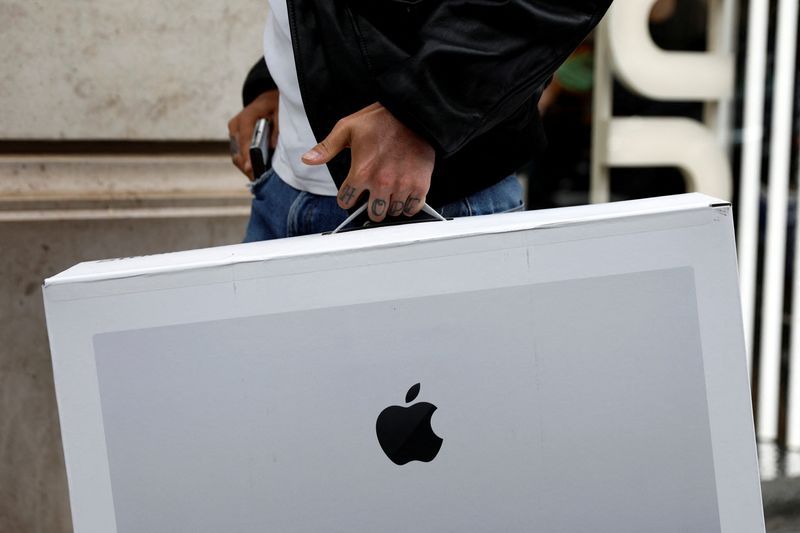
The technology sector witnessed a significant reshuffling in market hierarchy on Friday when Apple eclipsed Nvidia to claim the title of world's most valuable company, a development that underscores evolving investor sentiment towards the artificial intelligence landscape. Apple's valuation reached $4.88 trillion as its shares remained stable, while Nvidia's market worth dipped to approximately $4.86 trillion following a 3.5 percent decline. This reordering carries symbolic weight given that Nvidia had dominated the rankings for nearly a year, commanding the market's attention as the primary beneficiary of the global AI boom.
The shift reflects a fundamental recalibration in investor thinking about where true value creation lies within the artificial intelligence ecosystem. Rather than remaining fixated on semiconductor manufacturers and their capital-intensive expansion efforts, capital is now flowing towards companies capable of translating AI capabilities into profitable consumer applications. Apple's ascent comes despite the company having been largely dismissed as a laggard in the AI race for not channelling massive resources into developing proprietary language models like competitors including Microsoft and Google. Toni Meadows, head of investment at BRI Wealth Management, notes this perception has undergone a dramatic reversal, with market participants now appreciating Apple's more measured approach to artificial intelligence integration.
Apple's strategic advantages lie in fundamentals that extend well beyond raw computational power. The company operates an ecosystem where hardware, software, and services form an integrated value proposition that creates substantial switching costs for users. Moreover, Apple's services revenue stream—encompassing cloud storage, subscriptions, and digital transactions—provides multiple avenues to monetise artificial intelligence capabilities without the astronomical capital expenditures required to build large language models from scratch. The company's customer base generates voluminous personal data daily through iPhone usage patterns, app interactions, and digital behaviours that could significantly enhance artificial intelligence applications tailored to individual users. This strategic positioning rewards durability and proven cash generation over speculative technological breakthroughs, a sentiment that appears increasingly attractive to institutional investors reassessing risk.
The competitive positioning has particular relevance as Apple undergoes a leadership transition that will test the company's AI commitments. Chief Executive Officer Tim Cook is preparing to hand over operations to hardware specialist John Ternus in September, marking a generational shift in stewardship. Before this transition, Apple rolled out a substantially redesigned Siri assistant, representing the company's most significant effort to demonstrate credible artificial intelligence capabilities comparable to rival systems. This overhaul carries strategic importance as Siri has long been regarded as functionally inferior to competing voice assistants, a vulnerability that investors and critics have highlighted repeatedly.
However, Apple confronts a paradox that could ultimately constrain its artificial intelligence ambitions. The personal data that represents perhaps its greatest untapped resource for developing superior AI applications remains largely inaccessible due to the company's privacy-centric business philosophy and technical architecture. While competitors harvest user data more liberally to train machine learning systems, Apple has constructed operating system defences specifically designed to prevent such data collection and transfer. Unlocking this data trove would require fundamentally rethinking privacy commitments, potentially alienating customers and inviting regulatory scrutiny, yet leaving data untapped means surrendering an extraordinary competitive advantage in developing personalised artificial intelligence.
Nvidia's displacement from the top position should not be interpreted as a permanent or definitive verdict on the chipmaker's future trajectory. The company remains structurally positioned to benefit substantially from artificial intelligence infrastructure spending, as its graphics processing units continue powering the computational backbone underlying most generative AI systems. Nvidia could readily reclaim market leadership should investor sentiment shift again, particularly if capacity constraints or new applications drive accelerated spending on semiconductor infrastructure. The semiconductor industry's fundamentals remain robust, with demand for chips outpacing supply across multiple sectors including data centre operations, consumer devices, and emerging applications.
Apple's current valuation leadership also reflects execution risks that warrant caution. The company has pursued a premium pricing strategy to offset rising manufacturing costs, a tactic that could suppress demand if economic conditions deteriorate or consumer sentiment weakens. Price-sensitive markets particularly, including developing economies throughout Southeast Asia, may prove vulnerable to demand destruction if Apple attempts to maintain margins through higher prices rather than accepting compressed profitability. Benjamin Hall, vice president for alpha research at Segal Marco Advisors, emphasises that no meaningful structural distinction exists between the two companies' long-term prospects, with both likely remaining dominant participants in whatever artificial intelligence landscape emerges.
Investor enthusiasm surrounding semiconductor stocks has begun normalising after an extraordinarily rapid expansion. The Philadelphia SE Semiconductor Index, which tracks the broader sector, declined nearly 19 percent from its all-time highs during July as market participants questioned the sustainability of artificial intelligence-driven spending trajectories. Despite this recent turbulence, the index has outperformed Nvidia specifically, suggesting the weakness reflects profit-taking and valuation concerns rather than fundamental deterioration in sector prospects. This pattern indicates that artificial intelligence excitement has begun dispersing across a wider constellation of companies rather than concentrating exclusively on the most obvious beneficiaries.
Memory chip manufacturers have emerged as particular beneficiaries of this broadening investment thesis. Micron Technologies crossed the $1 trillion market valuation threshold in May as investors increasingly recognised that artificial intelligence infrastructure depends critically on data memory and storage capacity, not merely computational processing power. South Korea's SK Hynix further expanded the competitive arena by listing on the Nasdaq exchange earlier in the month, introducing another established player into markets dominated by American and Taiwanese manufacturers. This geographical and corporate diversification could substantially reshape competitive dynamics across the semiconductor supply chain, with implications extending throughout Southeast Asia's manufacturing and technology ecosystems.
The broader implications of Apple's ascendancy suggest that artificial intelligence investment cycles may be maturing beyond initial euphoria and beginning to reflect more nuanced understandings of value creation. Rather than rewarding companies that simply spend most aggressively on artificial intelligence development, markets increasingly differentiate between sustainable competitive advantages and speculative technology bets. For Malaysian investors and businesses, this recalibration carries important lessons regarding which technology companies merit capital allocation, with preference shifting towards enterprises demonstrating clear pathways to converting artificial intelligence capabilities into profitable services that customers willingly purchase.

