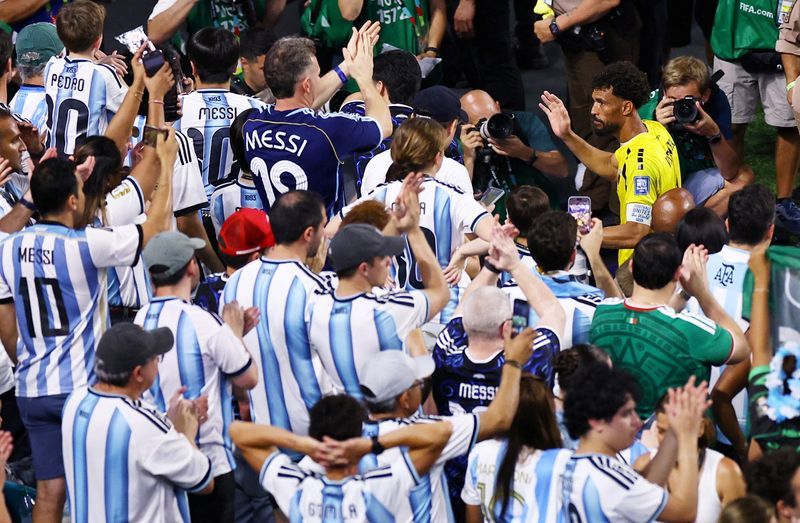
Argentina reached the World Cup round of 16 on Thursday with a hard-earned 3-2 extra-time victory over Cape Verde, yet the reigning champions' unconvincing performance in Kansas City suggests the tournament's most dominant side so far may be vulnerable in knockout football. The South American outfit, which had swept aside all opposition in the group stage, found themselves repeatedly undone by the tournament's newest participants, who twice clawed their way back into the contest before ultimately succumbing to a Cristian Romero header that deflected off Cape Verde defender Diney Borges in extra time. The result keeps Argentina on course for a deep tournament run, but it fundamentally altered the narrative surrounding Lionel Scaloni's squad heading into their round-of-16 showdown against Egypt in Atlanta on Tuesday.
What made this encounter particularly instructive was how thoroughly Cape Verde, competing in their maiden World Cup appearance, dismantled the tactical framework that had served Argentina so well through the group phase. Despite warnings from Scaloni that the Africans possessed genuine quality after drawing with established European powers Spain and Uruguay in their opening matches, the depth of their threat caught many observers off guard. The team that had previously dispatched Algeria 3-0, Austria 2-0, and Jordan 3-1 with clinical efficiency suddenly found itself chasing the game, scrambling to regain control, and ultimately dependent on the intervention of an own goal to secure passage. This reversal exposed fundamental issues with Argentina's defensive shape and their capacity to maintain possession in the face of determined pressing.
The vulnerability exposed in Kansas City stands in stark contrast to Argentina's immaculate preparation. During the buildup to the tournament, Iceland in June marked their first competitive engagement with European opposition since the 2022 World Cup final victory, raising concerns about whether the team had adequately tested their defensive resolve. The subsequent group-stage matches, though numerically convincing, offered scant opportunity to truly stress-test the backline under sustained, organised pressure. Observers had repeatedly questioned whether Argentina's passage through the group represented genuine dominance or merely the elimination of comparatively modest opponents. Cape Verde's stubborn resistance provided an answer that Scaloni and his coaching staff would have preferred to avoid.
Marcelo Gallardo, the respected former River Plate manager who represented Argentina in the 1998 and 2002 World Cups, provided perhaps the most measured assessment of proceedings. Rather than viewing the near-disaster as cause for panic, Gallardo suggested the experience might ultimately benefit the squad, arguing that Argentina would respond positively to the adversity. His comments carried weight given his World Cup pedigree and his understanding of tournament football's unforgiving demands. On ESPN Argentina, he characterised the match as a potential catalyst for improvement, observing that the team would undoubtedly receive a sharp reminder about the standards required to claim a second consecutive world title.
At the centre of Argentina's troubles was their inability to press effectively and maintain compact defensive shape. Lionel Messi, the 39-year-old captain whose record-extending 20th World Cup goal opened the scoring in the opening period, articulated the problem with characteristic clarity. The veteran attacker acknowledged the physical and tactical exhaustion that afflicted his side, explaining that Argentina could not sufficiently pressure Cape Verde's possession and that the gap between defensive lines became too expansive, allowing the opposition space in which to operate. His admission that the team struggled to regain possession in advanced areas highlighted how far their performance had fallen short of their group-stage standard. Messi's frank appraisal suggested that even the tournament's most luminous talent recognised the gravity of the shortcomings on display.
Scaloni, meanwhile, chose to emphasise the character demonstrated by his side's ability to recover from adversity rather than dwell on the quality of their football. The manager reiterated pre-match observations that World Cup football contains no truly straightforward matches and stressed the importance of his team's willingness to reassert themselves when circumstances became challenging. His response reflected the perspective of a coach prioritising results over performances, yet it simultaneously acknowledged that Argentina had been fortunate not to exit the tournament at the group stage. The victory, though three goals in his team's favour on the scoreline, felt uncomfortably narrow and exposed weaknesses that stronger opponents would ruthlessly exploit.
Two recovering defenders proved instrumental in securing Argentina's advancement, lending an almost poetic dimension to the outcome. Lisandro Martinez, who suffered a serious anterior cruciate ligament injury in early 2025, scored the team's second goal in a reminder of his recovery trajectory. Cristian Romero, recently returning from knee complications that had previously sidelined him during the tournament, ultimately provided the winning touch. Martinez's exuberant commentary after the match underscored the personal significance of his contribution, as he reflected on the demanding rehabilitation process and expressed gratitude to the club and national team medical staff for enabling his participation. These individual redemption narratives, while genuine, could not entirely mask the systemic defensive vulnerabilities that Cape Verde had successfully targeted throughout the encounter.
The implications for Argentina's knockout-stage prospects now assume critical importance with Egypt looming. The North African side, though ultimately eliminated from title contention through the group stage, will have observed Argentina's difficulties with considerable interest. Should Egypt replicate Cape Verde's tactical approach, pressing aggressively and exploiting the spaces between Argentina's defensive lines, the reigning champions could face elimination before the quarter-finals. The draw provides an opportunity for Scaloni to recalibrate his defensive organisation and address the fundamental issues of shape, spacing, and possession retention that undermined the team's dominant group-stage performance.
Argentina's immediate future involves training resumption in Miami on Saturday, allowing the coaching staff just three days to identify solutions to the problems exposed in Kansas City. The squad's credentials as tournament favourites remain intact, yet the psychological boost traditionally associated with perfect group-stage records has been thoroughly diminished. What the team does with the remainder of their tournament preparation will ultimately determine whether the Cape Verde scare becomes a cautionary learning experience or an early indication that their World Cup defence may yet unravel.

