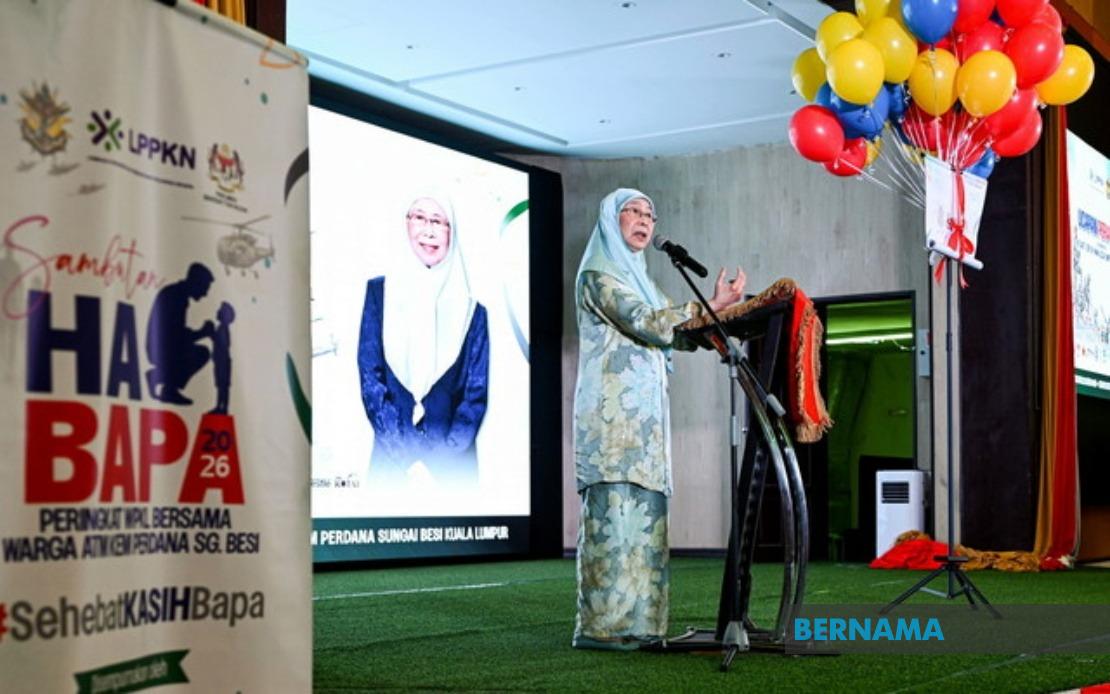
The Prime Minister's wife has called for renewed commitment to supporting fathers within the Malaysian Armed Forces, recognising the particular challenges they face in balancing their demanding service obligations with their responsibilities as parents and spouses. Speaking at the 2026 Federal Territory of Kuala Lumpur Father's Day Celebration, Datuk Seri Dr Wan Azizah Wan Ismail emphasised that military fathers deserve targeted empowerment initiatives given the unique nature of their sacrifices in defending national sovereignty.
Dr Wan Azizah, who represents Bandar Tun Razak in Parliament, underscored that supporting men in their paternal roles represents a critical investment in strengthening Malaysia's family institutions at the grassroots level. She argued that when fathers receive adequate institutional backing, they are better positioned to exercise leadership within their households and model values that ripple outward through communities. This perspective aligns with growing recognition that family stability and parental engagement directly influence broader social cohesion and national resilience.
A cornerstone of Dr Wan Azizah's argument centred on the National Family Compassion Policy (DKKN), which she identified as an essential mechanism for helping military fathers navigate the inherent tensions of their position. Armed Forces personnel frequently endure extended postings, operational deployments, and training commitments that take them away from their children for prolonged periods. Without supportive policy frameworks, such prolonged separations can strain family bonds and increase stress on both servicemen and their dependents. The DKKN framework aims to mitigate these pressures by providing practical assistance and acknowledging the distinctive burdens borne by military families.
The celebration itself, organised jointly by the National Population and Family Development Board (LPPKN) of the Federal Territory of Kuala Lumpur and the Malaysian Armed Forces, drew approximately 500 participants including military fathers, their spouses, and children, alongside representatives from various government agencies. The scale of participation suggests significant institutional interest in fatherhood support programming within defence and family welfare circles. The event's thematic focus, 'Sehebat KASIH Bapa'—a phrase emphasising the magnitude of paternal love and dedication—reflected a deliberate effort to celebrate rather than merely acknowledge the contributions of military fathers.
Beyond ceremonial recognition, the LPPKN has developed concrete operational initiatives designed to build capacity among men in their parental roles. The Fatherhood Module represents a structured educational intervention targeting the specific competencies required for effective parenting, with particular emphasis on skill development relevant to fathers managing family dynamics during periods of separation or operational stress. This programme-based approach reflects evidence-informed understanding that father engagement improves when men receive explicit guidance and skill-building opportunities rather than relying solely on intuition or inherited family patterns.
Complementing the Fatherhood Module is the Men Empowerment Network (MEN), a peer-support and advocacy initiative designed to create spaces where men can collectively reflect on their roles while building solidarity around shared experiences. For military fathers, such networks hold particular value given the often-isolating nature of defence service and the cultural expectations that military men should demonstrate emotional restraint. Creating structured forums where servicemen can discuss parenting challenges, exchange coping strategies, and access mentorship from senior personnel may help normalise conversations about fatherhood within traditionally male-dominated institutional environments.
The emphasis on father empowerment also reflects an evolving understanding of gender dynamics in Malaysian society. Rather than positioning support for fathers as competing with women's empowerment, Dr Wan Azizah framed paternal engagement as integral to family institution strengthening. This complementary approach acknowledges that sustainable family well-being depends upon both parents functioning effectively within their respective roles, and that supporting men in their domestic responsibilities ultimately benefits children, spouses, and by extension, the nation's social fabric. For military families particularly, where operational demands may skew household responsibilities toward remaining spouses, reinforcing the father's sense of purpose and capability becomes strategically important.
The particularity of military fatherhood deserves deeper examination in the Malaysian context. Defence force personnel operate within hierarchical, duty-bound institutional environments that can sometimes marginalise the non-professional dimensions of personnel's lives. Servicemen may internalise cultural messages that prioritising family time represents a distraction from military excellence, creating psychological tension between institutional demands and personal aspirations as fathers. Programmes explicitly validating the importance of fatherhood within military contexts help counteract such institutional messaging and signal that the Armed Forces recognises family well-being as compatible with, rather than antithetical to, operational effectiveness.
From a policy perspective, the initiatives discussed by Dr Wan Azizah point toward a broader Malaysian government commitment to repositioning fatherhood as a legitimate focus of public health and social policy. Historically, family support programming in Malaysia has concentrated disproportionately on maternal health and child welfare, sometimes rendering fathers marginal to institutional conversations despite their essential roles. The explicit inclusion of military fathers within national family development dialogues suggests willingness to broaden that aperture and recognise that comprehensive family support strategies require explicitly gendered attention to men's needs and capacities.
The sustainability of such initiatives depends upon adequate resourcing and consistent institutional prioritisation. One-off celebratory events, while valuable for morale and recognition, require complement from ongoing programming, training resources, and policy integration across defence establishment structures. This means ensuring that military unit commanders understand father-support initiatives as central to personnel welfare and retention, that family support services maintain adequate staffing, and that the National Family Compassion Policy receives sufficient budgetary allocation to deliver tangible assistance rather than symbolic recognition alone.
For military families throughout Malaysia and Southeast Asia more broadly, the elevation of fatherhood support within defence contexts carries practical implications. Singapore, Indonesia, and Thailand have similarly grappled with balancing military operational demands against family well-being, and regional peer-learning around effective fatherhood support programming could strengthen institutional capacity across the region. Malaysian initiatives like the Fatherhood Module and Men Empowerment Network represent potentially exportable models that other regional defence establishments might adapt to their own contexts and cultural frameworks.
Looking forward, Dr Wan Azizah's remarks suggest that father empowerment will remain a priority within Malaysian government discourse around family policy. The convergence of military institutional needs, family welfare objectives, and broader social development goals creates natural alignment for sustained programming. Whether such initiatives receive the financial and administrative support necessary to move beyond pilot projects and ceremonial events will largely determine their actual impact on the lived experiences of military fathers and their families across Malaysia.

