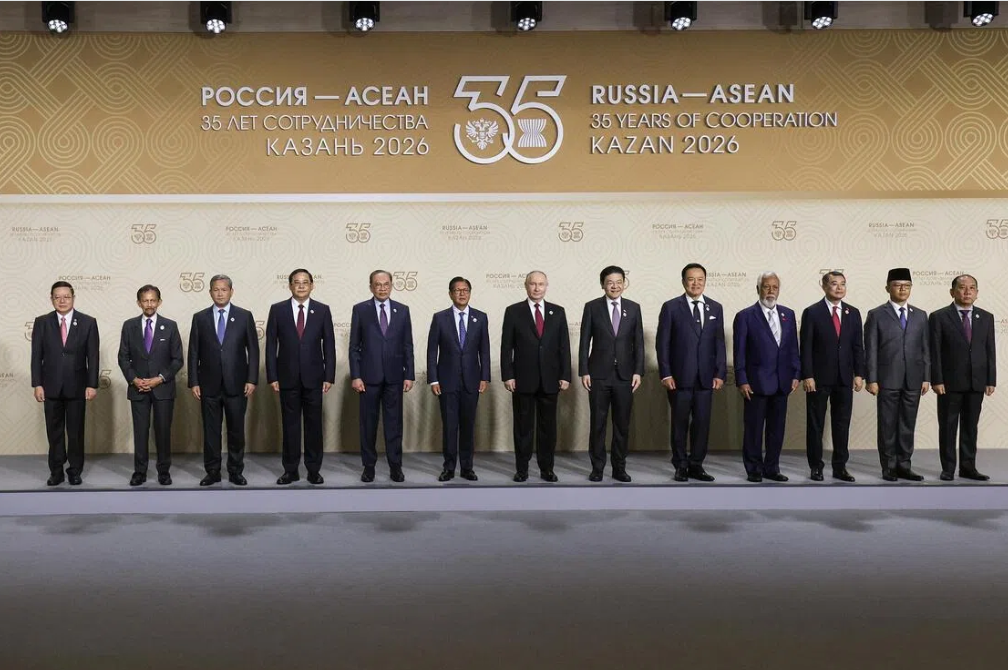
Asean and Russia have reaffirmed their commitment to expanding cooperation across multiple sectors at a summit held in Kazan, a major city in southwestern Russia. The Asean-Russia Commemorative Summit, convened on June 17 and 18, served as a significant milestone in the relationship between the regional bloc and Moscow, commemorating 35 years of bilateral ties and 30 years since the establishment of their dialogue partnership. The convergence of diplomatic delegations from across Southeast Asia reflected the importance both sides place on strengthening institutional frameworks for engagement, despite the complex geopolitical environment in which they operate.
Three major documents emerged from the summit to guide future cooperation. The Kazan Declaration functions as a comprehensive review of progress achieved over the past three and a half decades while establishing priorities for the years ahead. Specifically, the declaration identifies maritime affairs, commerce and investment, energy security, transportation links, security cooperation, academic partnerships, and cultural initiatives as key areas requiring enhanced attention and resources. Complementing this overarching framework, a Joint Statement on Cultural Cooperation aims to deepen interpersonal connections and expand cultural programming between Asean member states and Russia. Most significantly, the Asean-Russia Comprehensive Plan of Action spanning 2026 to 2030 provides detailed roadmaps for practical initiatives, offering concrete timelines and benchmarks for measuring progress across agreed sectors.
Singapore's Prime Minister Lawrence Wong, speaking during the final day of proceedings, articulated a measured approach to the relationship that acknowledges both opportunities and constraints. Wong emphasised the importance of identifying areas where Asean and Russian strategic interests converge and establishing mechanisms for collaborative problem-solving on initiatives that promote dialogue, reduce mutual suspicion, and contribute to peace and sustainable development throughout the region and internationally. He welcomed Russia's endorsement of Asean Centrality—a foundational principle affirming Southeast Asia's role as the driving force in regional architecture and diplomacy—and acknowledged Moscow's consistent participation in key Asean-led forums including the Asean Regional Forum and East Asia Summit. Wong noted that Russia would participate in these platforms during the Philippines' hosting later in 2024, and confirmed Singapore's intention to continue facilitating Russian engagement when it assumes the rotating Asean chairmanship in 2027.
Beyond conventional diplomacy, Wong identified practical areas where bilateral cooperation could yield tangible benefits for both populations. Disaster management and drug trafficking prevention emerged as priority concerns where Asean and Russia could pool resources and expertise to address shared challenges. Educational and cultural exchanges, Wong argued, remain vital mechanisms for building mutual understanding and strengthening societal-level connections. He highlighted the regular participation of Russian officials in civil service training programs across Asean member states, including in Singapore, as evidence of ongoing people-to-people engagement that transcends government-to-government relations.
Wong framed Asean's strategic positioning within a broader context of global unpredictability and increased geopolitical tension. He characterised the bloc's twin strategic objectives—deepening internal integration while simultaneously forging partnerships with external powers—as particularly crucial in an era marked by shifting power dynamics and competing interests among major powers. Against this backdrop, Wong underscored Singapore and Asean's consistent advocacy for strict adherence to international law and the rules-based global order as the foundation for maintaining stability and preventing conflicts from escalating beyond peaceful resolution.
The Singapore prime minister's remarks on conflict resolution revealed careful diplomatic language designed to balance principled positions with pragmatic engagement. Regarding Ukraine, Wong reiterated that Singapore's stance derives not from alignment with any particular power bloc but from unwavering commitment to the principles of national sovereignty and territorial integrity enshrined in the United Nations Charter. Singapore continues to support diplomatic initiatives aimed at achieving ceasefire agreements, with the ultimate goal of establishing peace arrangements consistent with international law. This framing allows Singapore and Southeast Asia more broadly to maintain relationships with multiple powers while preserving moral credibility on fundamental principles.
Wong welcomed recent developments in the Middle East, specifically highlighting the peace agreement between the United States and Iran as a potentially transformative step toward resolving longstanding regional conflicts. He expressed optimism that such accords could facilitate the reopening of the Strait of Hormuz, a critical waterway through which substantial portions of global energy supplies transit daily. For an energy-importing region like Southeast Asia, the security and stability of international maritime passages and shipping lanes represent vital economic interests that transcend narrower geopolitical rivalries. Wong's emphasis on unimpeded transit rights, grounded in the United Nations Convention on the Law of the Sea, reflects Asean's broader concern about preserving the sanctity of international waterways against territorial encroachment or arbitrary restrictions.
Singapore's historical position on Russia's invasion of Ukraine has been unambiguous. The Singapore government has explicitly characterised the invasion as a violation of international law and has maintained sanctions and restrictions against Russia since 2022, measures that remain in effect. This principled stance creates an apparent tension with Singapore's participation in engagement and dialogue with Moscow at the Kazan summit. However, Wong's framing suggests that even amid substantive disagreements on specific issues, both sides recognise value in maintaining diplomatic channels and identifying collaboration opportunities. This approach mirrors Singapore's broader foreign policy philosophy of maintaining relationships across competing power centers while refusing to align exclusively with any single bloc.
On the sidelines of the summit, Wong met directly with Russian President Vladimir Putin at Putin's initiative, constituting a significant diplomatic moment. During their bilateral discussion, the two leaders reviewed the state of Singapore-Russia relations and exchanged perspectives on major regional and international developments. Wong subsequently conveyed optimism about future cooperation, noting in public statements that dialogue and engagement remain valuable even when nations hold divergent views on important matters. He reiterated Singapore's appreciation for long-standing historical ties with Russia and its people, expressing determination to identify and pursue opportunities for partnership in domains where mutual interests align. Wong also met with Rustam Minnikhanov, the elected head of the Russian Republic of Tatarstan, a region that has maintained distinct bilateral relations with Singapore dating back to then-Minister Mentor Lee Kuan Yew's 2007 visit.
The Kazan summit underscores an important reality about contemporary Southeast Asian diplomacy: the region's desire to maintain working relationships with all major powers rather than align definitively with competing blocs. For Malaysia, Vietnam, Indonesia, and other Asean members, the ability to engage constructively with Russia while maintaining Western partnerships represents a delicate but essential balancing act. The five-year action plan adopted in Kazan provides structure for this engagement without requiring Asean members to compromise their principles regarding international law, sovereignty, and rules-based governance. As geopolitical tensions persist globally and regional security challenges mount, such frameworks for dialogue and cooperation become increasingly important for maintaining stability and preventing Southeast Asia from becoming a proxy battleground for great power competition.