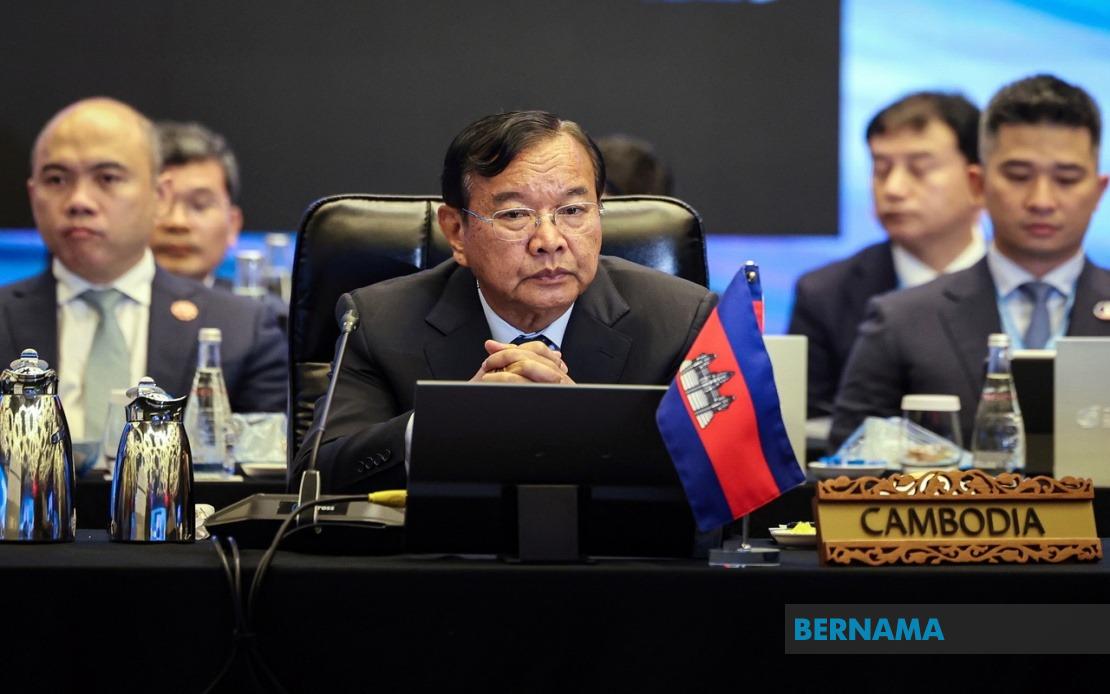
Cambodia's Foreign Minister and Deputy Prime Minister Prak Sokhonn has underscored ASEAN's indispensable role as the cornerstone of regional peace and stability in Southeast Asia, particularly as the bloc navigates an increasingly turbulent global environment. Speaking during commemorations of ASEAN's 59th anniversary, Sokhonn emphasised that the organisation's foundational principles—enshrined in the ASEAN Charter and the Treaty of Amity and Cooperation—remain as relevant today as they were at the bloc's founding nearly six decades ago.
The Cambodian minister painted a striking contrast between ASEAN's past and present circumstances. Over the decades since its establishment on August 8, 1967, ASEAN has fundamentally transformed Southeast Asia's trajectory, steering the region away from a period marked by deep divisions, geopolitical rivalries, and pervasive uncertainty towards one increasingly characterised by dialogue, institutional cooperation, and measurable gains in shared economic prosperity. This evolution represents one of Asia's most significant diplomatic achievements, underpinning decades of relative peace and collaborative development across the ten founding and newer member states.
However, Sokhonn's remarks acknowledge a sobering reality confronting contemporary Southeast Asia. The region now operates within a far more volatile international landscape, marked by the resurgence of armed conflicts in neighbouring areas, rapidly intensifying geopolitical tensions between major powers competing for influence, and mounting challenges to the post-World War II international legal order and multilateral institutions. These pressures directly affect ASEAN members, whether through economic disruption, security dilemmas, or diplomatic complications arising from great-power competition in their strategic waters and territories.
Crucially, the Cambodian foreign minister has rejected a passive posture for ASEAN in this environment. Rather than merely reacting to external changes and pressures—a stance that would render the bloc essentially subordinate to global forces beyond its control—Sokhonn insists that ASEAN must proactively shape the region's future and influence broader international outcomes. This distinction is significant: it reflects a recognition that ASEAN's collective agency matters, and that member states possess sufficient combined weight and diplomatic skill to chart their own course rather than simply accommodate external demands.
The emphasis on ASEAN's unity and centrality addresses persistent concerns about the bloc's internal cohesion. Despite its reputation for consensus-building through the ASEAN Way, the organisation has occasionally struggled with divisions when member states' national interests diverge sharply—most notably regarding Myanmar's governance, maritime disputes, and responses to great-power activities in the South China Sea. Sokhonn's reiteration that unity remains critical to weathering geopolitical headwinds carries particular weight given these historical tensions.
Cambodia itself has assumed symbolic importance in these discussions. The country joined ASEAN in 1999, following its emergence from political crisis and international isolation. Sokhonn's expression of pride in Cambodia's contributions since accession reflects the broader narrative of ASEAN as an institution that accommodates and integrates recovering or developing states into a rules-based regional framework. Cambodia's subsequent role in ASEAN affairs, including its assumption of the ASEAN chair, underscores how the bloc provides platforms for smaller and newer members to exercise diplomatic influence.
Sokhonn's commitment to strengthening ASEAN's unity, resilience, and global relevance speaks to three distinct but interconnected challenges. Unity requires managing internal differences while maintaining consensus; resilience demands capacity to withstand external shocks and pressures; and global relevance necessitates ASEAN's voice being heard authoritatively in international forums addressing issues from climate change to trade and security.
The formal invocation of the ASEAN Charter and the Treaty of Amity and Cooperation is particularly noteworthy. These documents embody principles of non-interference in internal affairs, peaceful dispute resolution, and sovereign equality—principles that some analysts argue are increasingly strained by contemporary security challenges and humanitarian concerns. By emphasising strict adherence to these instruments, Sokhonn signals that ASEAN's institutional integrity depends on members maintaining their commitment to foundational rules, even when doing so proves diplomatically inconvenient.
For Malaysia and other Southeast Asian nations, Cambodia's message carries practical implications. It reaffirms ASEAN's continued commitment to being the region's primary forum for managing disputes and coordinating responses to external pressures. This matters for disputes in the South China Sea, for economic integration agendas, and for collective positioning vis-à-vis major powers. The underlying argument is that ASEAN's value lies not merely in its historical achievements but in its potential to continue serving as a stabilising force and negotiating platform as regional and global conditions evolve.
The current ASEAN composition—comprising Brunei, Cambodia, Indonesia, Laos, Malaysia, Myanmar, the Philippines, Singapore, Thailand, Vietnam, and Timor-Leste—represents a significant regional bloc with combined economic weight and strategic importance. The inclusion of Vietnam and Timor-Leste expanded ASEAN's reach into mainland Southeast Asia and the Pacific respectively, enhancing its claim to represent the region's core interests and diverse perspectives.
Sokhonn's remarks ultimately reflect a broader anxiety within Southeast Asian leadership about the region's vulnerability to external forces. By reaffirming ASEAN's indispensability and calling for proactive rather than reactive engagement with global challenges, Cambodia's foreign minister articulates a vision of ASEAN as an institution worth preserving and strengthening. Whether member states can maintain sufficient unity to actualise this vision remains an open question, particularly given competing national priorities and external pressures that sometimes pull individual members in conflicting directions.

