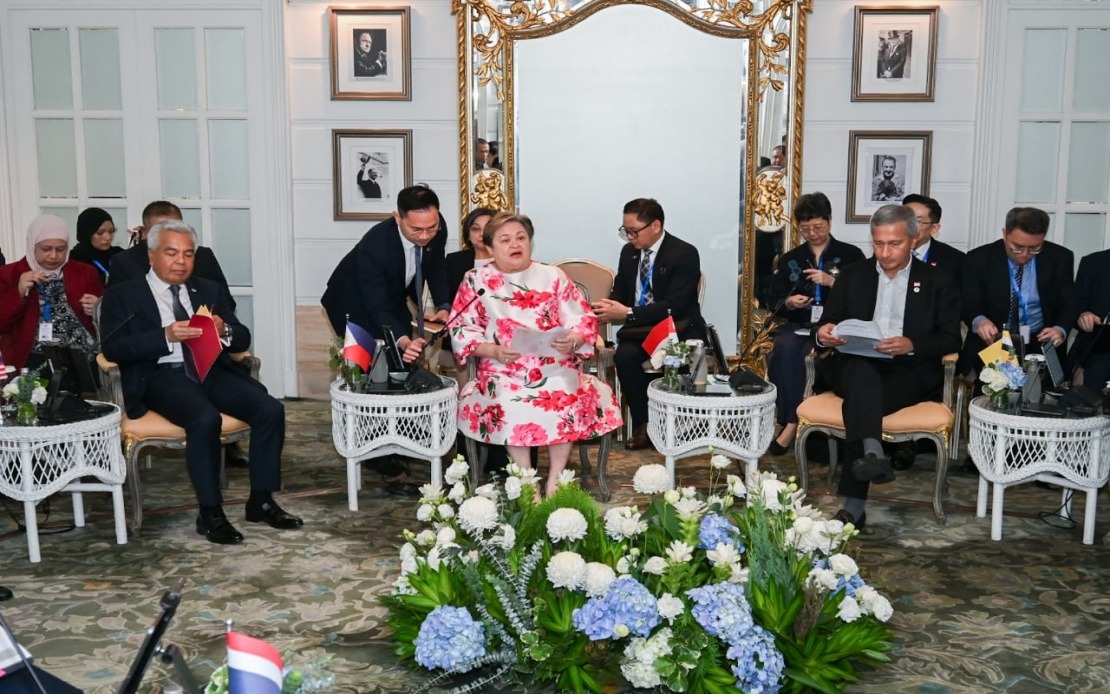
The Association of Southeast Asian Nations has doubled down on its commitment to the Five-Point Consensus as the cornerstone of its approach to Myanmar's ongoing political turmoil, signalling that the regional bloc remains steadfast in its engagement strategy despite mounting frustration from the military junta. At a significant gathering of foreign ministers in Bangkok, ASEAN leadership reaffirmed that the framework adopted in April 2021 continues to guide the organisation's diplomatic efforts, even as Myanmar's parliament last week formally rejected the proposal that has formed the basis of negotiations for the past three years.
Maria Theresa Lazaro, the Philippine Foreign Secretary and Special Envoy on Myanmar for ASEAN's current Chair, emphasised that the Five-Point Consensus remains non-negotiable for the regional bloc's engagement with all parties, including Myanmar's military-led government. Her statements underscored ASEAN's determination to maintain a consistent diplomatic position amid efforts by Naypyidaw to sideline or marginalise the plan. The insistence on this framework reflects ASEAN's attempt to preserve its institutional credibility at a time when its influence over the Myanmar situation has been questioned both internally and by international observers who question whether the organisation's consensus-driven approach can effectively pressure the junta toward meaningful reform.
The most recent ministerial meeting marked a watershed moment in ASEAN's Myanmar diplomacy: it was the first in-person gathering between ASEAN foreign ministers and Myanmar's foreign minister since the political crisis erupted in February 2021. The fact that such a meeting could be convened at all represented a diplomatic achievement for the Philippines' rotating leadership, particularly given the tensions that have characterised ASEAN's engagement with Naypyidaw over the past three years. This development suggests that despite mutual frustrations, channels of communication remain open and both sides recognise value in maintaining dialogue within the ASEAN framework rather than allowing relations to deteriorate completely.
Concretely, ASEAN outlined three interconnected expectations for Myanmar during the talks, each addressing critical dimensions of the humanitarian and political crisis unfolding within the country. The first expectation centres on expanding humanitarian assistance to Myanmar's civilian population, which has been severely affected by ongoing violence and economic deterioration. ASEAN indicated that the Philippine Chair is planning a humanitarian mission designed to identify additional avenues for delivering aid and assessing the scale of unmet needs within Myanmar, reflecting recognition that humanitarian concerns have become inseparable from the broader political settlement.
The second expectation demands tangible reduction in violence, with particular emphasis on protecting civilians from military operations and conflict-related casualties. This component of ASEAN's approach addresses what human rights organisations and international observers have documented as widespread atrocities and indiscriminate violence. By elevating violence reduction as a discrete diplomatic objective, ASEAN is attempting to create measurable benchmarks against which progress—or the lack thereof—can be assessed during future reviews of Myanmar's compliance with regional expectations.
Third, ASEAN has insisted on more inclusive political dialogue that moves toward national reconciliation, encompassing both the creation of a conducive political environment and the release of political prisoners detained by Myanmar's authorities since the 2021 coup. This element acknowledges that purely humanitarian measures cannot substitute for a genuine political settlement that addresses the underlying drivers of conflict. The emphasis on inclusivity signals ASEAN's recognition that sustainable peace requires engagement across Myanmar's fractured political landscape, including ethnic minority groups, civil society representatives, and diverse elements of the opposition movement.
Thailand's Foreign Minister Sihasak Phuangketkeow, whose government hosted the ministerial gathering, characterised ASEAN's approach as one of "calibrated engagement," a diplomatic terminology that acknowledges the tension between maintaining dialogue with Myanmar and avoiding the appearance of acquiescing to the junta's actions. His framing of this engagement as a "two-way street" reflects ASEAN's frustration that diplomatic overtures have not been reciprocated with substantive concessions from Naypyidaw. This language also implicitly criticises Myanmar's recent parliamentary rejection of the peace plan, positioning the junta as the obstinate party unwilling to meet ASEAN halfway in pursuit of regional stability.
For Malaysian observers, the participation of Tan Sri Amran Mohamed Zin, the Foreign Ministry Secretary-General, underscored Malaysia's stake in the Myanmar situation and its continuing presence within ASEAN's coordinated diplomatic efforts. Malaysia, which shares a border with Myanmar and hosts significant numbers of Myanmar refugees and migrants, has particular interests in the resolution of the crisis. The Malaysian representation at this level, despite the absence of Cambodia's delegation, reflected ASEAN's continuing attempt to project unity on Myanmar despite the organisation's broader factional divisions between pro-engagement and more critical members.
The rejection of the Five-Point Consensus by Myanmar's parliament presents a significant challenge to ASEAN's diplomatic strategy, yet the organisation has chosen to interpret this setback as requiring renewed commitment rather than a fundamental reassessment of its approach. This determination partly reflects the absence of viable alternative frameworks that command consensus among ASEAN members, and partly reflects the calculation that abandoning the Five-Point Consensus would signal weakness and potentially invite further pressure from Myanmar's junta to accept its terms regarding political transition.
Sihasak indicated that ASEAN would evaluate Myanmar's progress in addressing the organisation's three key expectations at the ASEAN Summit scheduled for later in 2024, creating a future checkpoint at which the feasibility of the engagement strategy can be reassessed. This timeline suggests that ASEAN is attempting to balance its commitment to dialogue with the setting of realistic deadlines that might encourage Myanmar to shift its position. However, the absence of explicit consequences or ultimatums in ASEAN's messaging reflects the organisation's structural constraint as a consensus-based body: member states retain different views on how far pressure on Myanmar should extend, limiting the leverage that can be collectively wielded.
The broader significance of ASEAN's reaffirmation of the Five-Point Consensus lies in what it reveals about the organisation's role in Southeast Asian geopolitics. While ASEAN has consistently invoked the principle of non-interference in member states' internal affairs, the Myanmar crisis has forced the organisation to engage more directly with questions of governance, human rights, and legitimate political authority than its institutional traditions typically permit. The sustained emphasis on the Five-Point Consensus represents an attempt to maintain ASEAN's diplomatic identity as a mediating institution while simultaneously asserting that the organisation does possess some standards for acceptable state behaviour, even if enforcement mechanisms remain limited.
For the region's broader stability, ASEAN's approach reflects a calculated gamble that sustained dialogue offers better prospects for eventual political settlement than the alternative of isolated condemnation that might entrench Myanmar's junta further. However, the junta's apparent unwillingness to seriously negotiate within the ASEAN framework raises questions about whether this strategy can produce meaningful results or whether it merely provides Myanmar's military leadership with a diplomatic forum in which to legitimise its continued grip on power while addressing international criticism through tactical engagement.

