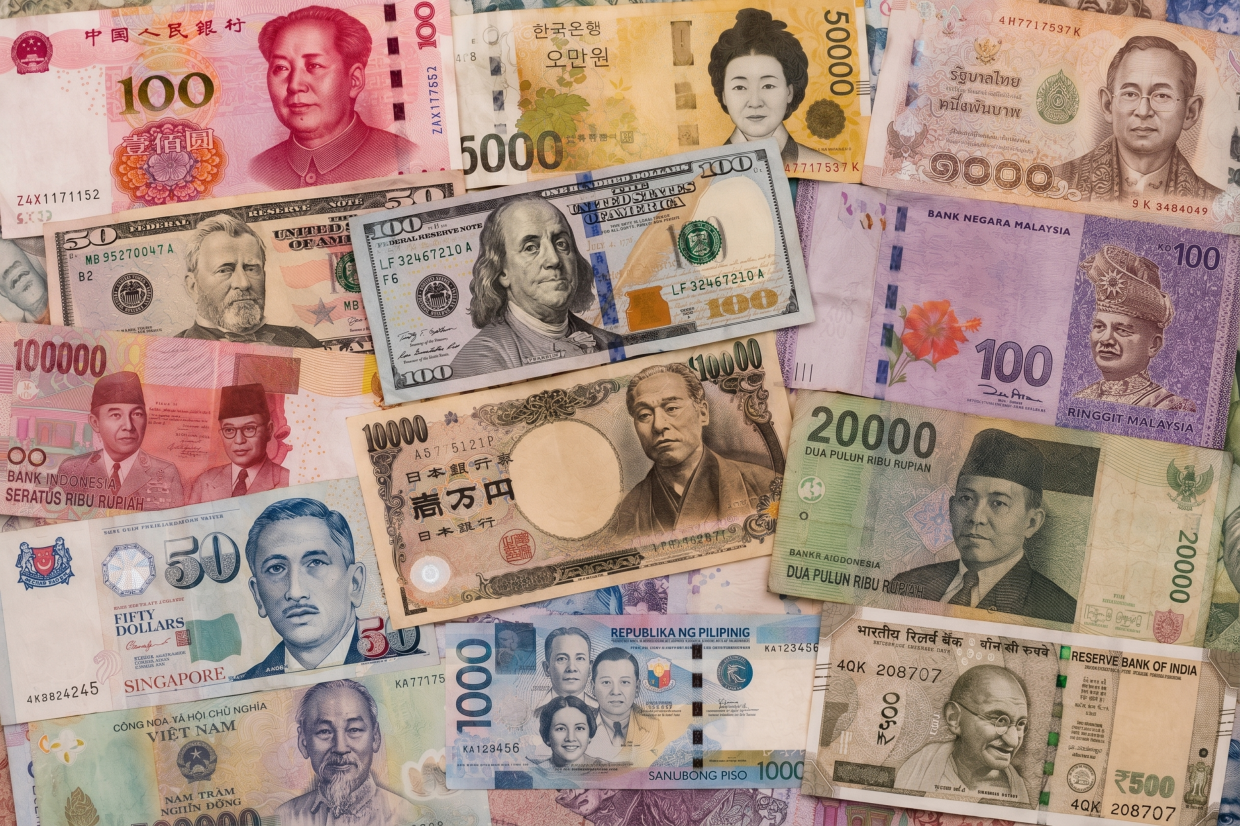
Geopolitical tensions in the Middle East sent shockwaves through Asian financial markets on Monday, triggering a broad-based retreat in regional currencies and equity declines across major bourses. The resurgence of conflict in the Gulf region pushed crude oil prices up by 4%, reigniting inflation concerns that have haunted policymakers throughout the year. This fresh shock drove the U.S. dollar index higher against a basket of major currencies, with investors retreating to the safety of dollar-denominated assets as they reassessed the risk landscape across emerging economies.
The weakness was particularly pronounced in Southeast Asia's currency markets, where traders dumped local units in favour of the greenback. Indonesia's rupiah slipped to 18,140 per dollar, marking its worst level in more than a month and signalling mounting concerns about imported inflation in Southeast Asia's largest economy. Elsewhere in the region, South Korea's won deteriorated to 1,507.9 per dollar as investors repositioned their exposure to Asian assets amid heightened volatility.
Malaysia's ringgit fell to 4.0780 against the dollar, reflecting both the broader regional currency weakness and mounting domestic political uncertainty. However, the country's equity market showed unusual resilience, with local stocks rebounding to a three-week high despite the currency pressure. This divergence underscores the complex dynamics at play in Malaysian markets, where investors are weighing macro fundamentals against political risk. The catalyst for this political concern stemmed from Saturday's local elections in Johor, where Prime Minister Anwar Ibrahim's coalition suffered a significant defeat at the hands of a crucial coalition partner, prompting speculation about the stability of the federal government and the possibility of early elections.
The political developments in Malaysia have taken on heightened significance given their potential impact on economic policy continuity. Goldman Sachs analysts flagged this concern directly, noting that any renewed doubts about the cohesion of the ruling federal coalition could erode the premium investors have previously assigned to Malaysia's policy stability narrative. The investment bank's assessment suggests that while Malaysia's underlying macroeconomic fundamentals remain solid, the political risk dimension cannot be ignored. Nevertheless, Goldman Sachs also noted that recent measures undertaken by Bank Negara Malaysia to encourage foreign exchange inflows should help contain any excessive depreciation of the ringgit, even if political uncertainty persists in the background.
South Korea bore the brunt of Monday's market turmoil, with the benchmark KOSPI index plummeting 7.96% to touch a ten-week low. The selling was particularly severe in semiconductor stocks, reflecting a significant shift in sentiment towards the sector that had dominated regional market gains. SK Hynix, the world's premier manufacturer of high-bandwidth memory chips crucial to artificial intelligence systems, suffered a devastating 13% slide after profit-taking followed its strong debut on the U.S. market on Friday. The collapse in SK Hynix shares exemplified broader concerns taking hold among investors about the sustainability of the exceptional earnings that semiconductor manufacturers have enjoyed riding the AI wave.
The repricing of semiconductor valuations reflects growing caution about whether the current cycle of corporate AI spending can sustain the record profit growth that chip makers have delivered. Market participants have become increasingly worried about the durability of demand for high-bandwidth memory chips, particularly given reports of more disciplined capital allocation by major technology companies and AI hyperscalers. Compounding these concerns is the structural impact of highly leveraged single-stock exchange-traded funds, which have amplified volatility in individual names and exacerbated selling pressure when sentiment turns negative. This combination of fundamental concerns and technical selling has created a treacherous environment for the region's chipmaking sector.
Despite the sharp decline, South Korea's equity market has demonstrated remarkable underlying strength this year, having advanced 63% from the start of 2024 and still ranking among the world's top-performing stock markets. The current drawdown represents a pullback of roughly 25% from the index's record closing level reached on June 22, putting the market into correction territory but hardly erasing the substantial gains accumulated over the past six months. This perspective suggests that while the recent selling has been severe, it largely reflects normalisation after an exceptional run rather than a fundamental breakdown in market structure.
Performance across the broader emerging Asian region was mixed, reflecting the divergent pressures facing different economies. Philippine equities managed to edge higher, suggesting investor appetite for certain segments remained intact despite the overall cautious tone. Indonesian stocks climbed 0.5%, indicating measured resilience in Southeast Asia's resource-rich economy. Taiwan's benchmark declined modestly, while Singapore's index contracted as much as 0.7%, snapping an impressive streak of seven consecutive sessions at record highs. This pattern suggests that while Middle East tensions and SK Hynix weakness drove regional selling, the impact was distributed unevenly across markets.
The week ahead will prove consequential for regional assets, as several key economic and monetary policy announcements are scheduled to provide fresh direction for markets. Singapore will release its advance second-quarter economic growth figure, offering insights into the health of the region's financial hub. The United States will publish inflation data that will likely influence global rate expectations, a critical variable for emerging market valuations. South Korea's central bank will announce its interest rate decision, with particular focus on whether the Bank of Korea will tighten policy further in response to inflation risks. Malaysia will report inflation figures and advance gross domestic product data, providing crucial indicators of the country's economic trajectory and the efficacy of government policies amid political uncertainty.
The convergence of geopolitical risk, sector-specific repricing, and political uncertainty creates a complex backdrop for regional investors. While the Middle East tensions appear to be a near-term shock that could moderate if conflict de-escalates, the questions about semiconductor demand sustainability reflect deeper structural concerns about the AI investment cycle. For Malaysia, the political dimension adds an idiosyncratic risk that requires careful monitoring. Collectively, these factors suggest that Asian markets may face continued volatility in the near term, with currency weakness likely to persist unless risk sentiment improves decisively.

